Detroit — Bishop Byrnes doesn’t hesitate a second when asked what it was about the life of his childhood hero, Missionary of Africa Fr. Remy McCoy, that fueled his own young priestly vocation.
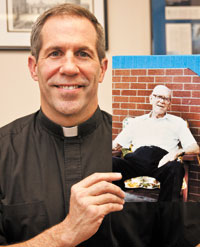
“The adventure,” Bishop Byrnes says. “And as I would look back, the fact that he was very clear about what his life was about. There wasn’t any question. Fr. McCoy was just so clear, and it was so simple — ‘I know who I am, I know what God called me to do, and I just do it.’”
Fr. Remy McCoy was part of Bishop Byrnes’s family growing up. He would “appear” Bishop Byrnes said, from time to time, coming to the Detroit area to raise money for the mission, and staying with his family all the while. Technically, Fr. McCoy was Bishop Byrnes’s first cousin, twice removed (the first cousin of a grandparent, in this case his mother’s father) — but he got to be known as Bishop Byrnes’s great uncle, for simplicity’s sake.
One thing was amply clear — Fr. McCoy was the first prominent figure in Bishop Byrnes’s life who compelled him to discern his own potential as a priest.
Throughout Bishop Byrnes’s childhood, college and seminary days, there would be a number of others, too. And Bishop Byrnes gives no small amount of credit to a number of mentors for shaping him in his priestly life.
‘The Rain Maker’
It starts, though, with Fr. McCoy.
In his role as vice rector of Sacred Heart Major Seminary, then-Fr. Michael Byrnes was recently helping lead a number of seminarians on a pilgrimage to the Holy Land, when they ran across a place in Jerusalem that was run by the Missionaries of Africa.
“I was talking with a priest there, and I mentioned to him that I was related to Fr. McCoy,” Bishop Byrnes said. The priest told to him the story of Fr. McCoy being known as “the rain maker” Bishop Byrnes relayed the story:
It was the late 1920s. Fr. McCoy was a pioneering missionary in Ghana, which is in western Africa. The people there — to whom he was relaying Christ’s news for the very first time — were subsistence farmers. And they were having a hard time in the midst of a serious drought.
One of the farmers, in dire straights, asked the tribe’s elders what he could do to hasten the rain.
At a loss, the elders suggested he talk to the priest — “he talks to God,” they said.
So they asked Fr. McCoy, “Can you make it rain?”
He said, “No — but my God can.”
They asked him if he could ask God to make it rain.
Fr. McCoy said, “Why don’t you ask him yourself?” At that, he taught them to pray.
When they walked back home, it rained. Immediately. And it rained only on their own village.
Word spread like wildfire, and over the next two months, people from different villages in the area would pray, and they would all get rain, inevitably, on that day or the very next day.
At the time of harvest, Fr. McCoy had 10,000 people camped outside of his compound, and they asked him to tell them about the God who could make it rain.
The account made a lasting impression on Bishop Byrnes.
“That was a powerful story,” he says. “And he was such a man of simple faith, doing whatever he needed to do to spread the Gospel.”
Bishop Byrnes says he visited Fr. McCoy in Ghana some 50 years after that, in 1985. By that time there were 150,000 Catholics in the area. Several bishops had been ordained from the diocese that had been started there.
“It was really from his planting the seed,” Bishop Byrnes says.
Beyond Fr. McCoy being “legendary,” Bishop Byrnes says his simplicity of purpose provided him with a rock-solid vision of the priesthood. During the time of his discernment, the Church was in the wake of the Second Vatican Council. Some of the confusion it caused in the local Church was right in front of the young Michael Byrnes.
“In one year, three priests (the family knew) left the priesthood,” he says.
But as for Fr. McCoy’s purpose and mission as a priest, “there wasn’t any question,” he says.
Always in mind
While his parents gave his faith roots (see story here), Bishop Byrnes says his sense of priestly vocation was always present on some level.
It was people along the way who helped nurture that vocation.
Saints included.
“St. Ignatius was very important, spiritually, to me,” says Bishop Byrnes. “And St. Paul has always been a patron saint for me.”
Another saintly role model Bishop Byrnes says he looks to is St. John De Brebeuf, the French-born Jesuit missionary who was martyred in Canada in 1649, known also as one of the North American Martyrs.
“He was a pioneering missionary. He was always a big inspiration for me,” says Bishop Byrnes. “I read his biography, and it’s just a phenomenal biography.”
When Bishop Byrnes got to high school at Detroit Catholic Central, he had a number of Basilian Fathers who made an impression on him, too. So much so that, afterward, he became an associate to the Basilian Fathers, attending monthly meetings to discern whether the order was the direction he wanted to go.
Though he opted not to pursue life as a Basilian, he did receive some sage advice from a future Catholic Central principal, Fr. Phil Acquaro, CSB, who at the time was a biology teacher at the school.
“He said one time when we were driving somewhere, ‘You know, Mike, you’re a gifted man,’” Fr. Byrnes recalled. “And the Gospel says, ‘To whom much is given, from him much will be expected.’ It’s one of those things that always struck in my head whenever I would make decisions about what direction my life was going to go.
“It helped me make some decisions that I might not have made otherwise.”
Charismatic college years
By the time Bishop Byrnes got to college at the University of Michigan in Ann Arbor, he had a notion of becoming a doctor. He started out majoring in biology, and it soon became a microbiology major.
“My parents were teachers,” he says. “So I was interested in biology and interested in chemistry.”
The priesthood didn’t disappear from his mind, though. He even thought that if he became a doctor, it could help him as a missionary.
It was while in college that he discovered an attraction to the charismatic renewal, a movement Pope John Paul II supported that was known for its vibrant form of worship and pursuit of the tangible gifts of the Holy Spirit as depicted in the Acts of the Apostles — praying in tongues, healing and prophecy included.
The college-aged Michael Byrnes was drawn to a group of men that were trying to found a religious order, called Servants of the Word.
“Their main apostolate was campus ministry,” he explains. “There was clarity, a sense of purpose that these men offered that I didn’t find in as compelling a way at the time as I was hearing about in the priesthood in general.
He stayed with the Servants of the Word through graduation, becoming a member of the brotherhood. And it was within that ministry that he found he was being called to be a diocesan priest.
“Really it came through the experiences of the work I had done,” Bishop Byrnes says. “It involved leading prayer meetings and preaching from time to time. We used to lead individual men’s groups.”
One experience he recalled was that of leading a Bible school in the Washtenaw County Jail. While most inmates wouldn’t own up to the acts that led them to incarceration, it was the occasional man truly seeking forgiveness that moved him.
“Every once in a while, you’d run across a guy who would say, ‘You know, I am so sorry I did that,’” Bishop Byrnes recalls. “And they’re just carrying that burden and not having anywhere to go… If you’re Catholic, you could go to confession, and it would be lifted.”
The prospect of helping in that manner dovetailed with a growing love Bishop Byrnes was developing for the Eucharist.
“I’d say I was growing in appreciation of what the Eucharist meant,” he says. “That participation in Christ’s sacrifice was drawing me as well — the possibility of extending that to others.”
Seminary and beyond
The next six years — what Bishop Byrnes remembers as “a very happy seminary life” at Sacred Heart Major Seminary — his formation was more direct.
He appreciated the guidance given to him by then-Msgr. John Nienstedt — seminary rector at the time and currently the archbishop of Minneapolis-St. Paul.
“He was very straightforward with me,” Bishop Byrnes says, noting that Msgr. Nienstedt always would give him clear instructions on what he needed to do. “That was very helpful to me.”
Another future diocesan bishop, Bishop Earl Boyea, currently of Lansing, had been Bishop Byrnes spiritual director while he was at the seminary, which Bishop Byrnes says “was very instrumental for me to make the transition to the priesthood.”
He also appreciated the classroom learning.
“The thing for me was I had read a lot of the Scripture, a lot of the spiritual books — but the rigor of the academic curriculum, that was the thing that I most benefited from.”
Post-ordination, while he has many priest friends and mentors to admire, Bishop Byrnes recalls a particular instance when it was a parishioner who helped him understand his role in life more clearly.
He was an associate pastor at St. Joan of Arc Parish in St. Clair Shores when he visited Regina High School in Warren to say Mass. It was there he ran into one of his young parishioners — or, rather, she ran up to him.
“An exuberant young lady grabs me, saying ‘Fr. Mike!’ and said to her friends, ‘This is my priest!’” he recalls. “And it struck me — I belonged to that kid. I really did belong to her in some way. She had a claim on me. And that was my experience in the parish. They had a claim on me. When mom was sick. Or when somebody had died and they wanted someone to come over … I belonged to them.”
Until the current college year at Sacred Heart Major Seminary, he says he felt that same sense of belonging to the seminarians in his role as vice rector. And to the people of Presentation/Our Lady of Victory Parish in Detroit. Although Deacon Hubert Sanders is administrator of the parish and oversees the daily life, Bishop Byrnes has been the pastor and, as such, an essential part of the parish’s life.
“My interaction with Presentation/Our Lady of Victory has been primarily on Sunday, but it’s been a really valuable time to me to be related to the parish,” he says. “I’ve often said that that parish has really helped me to shape by ability to preach Christ in a much bolder and clearer manner. That’s one of the things I’ll be grateful for in my time there … I list them as a real model of faith and perseverance in the Lord.”
In terms of the future, Bishop Byrnes says his eye-witnessed model of what an auxiliary bishop is resides in former Detroit Auxiliary Bishop John Quinn, now the bishop of Winona, Minn. Bishop Quinn oversaw the Central Region of the archdiocese when Bishop Byrnes was serving there.
“I got to see him in action and interact with him personally on a number of occasions, and that spoke to me a lot,” Bishop Byrnes says.
The future
Unexpectedly, Bishop Byrnes was able to hear yet another wise voice that instantly changed his life. Archbishop Pietro Sambi, the papal nuncio to the United States — an ambassador, essentially — was the one who broke the news to him that he would be a bishop.
“He said, ‘Remember, when Jesus called his disciples, they simply followed, and I’m hoping you will do the same,’” Bishop Byrnes says. “That image helped me right at that moment. Yes, it is a call to step in line with the apostles, and the apostles are the ones who got to walk a little closer to Jesus.”
He’s glad, too, that the archbishop he will be assisting is someone he’s known. Then-Fr. Allen Vigneron was one of his first teachers at Sacred Heart Major Seminary, and was rector when he graduated.
“He was a big influence,” Bishop Byrnes said.
As an auxiliary bishop, however, it’s Bishop Byrnes who may be among those who influence other future Church leaders. Archbishop Vigneron has indicated to him that that will be part of his responsibilities as a bishop.
“Archbishop Vigneron told me my work would be to help parishes and help priests,” he said. “I love being a priest, and helping priests with whatever they do — that’s attractive to me … It’s not like I’m this expert pastor-type, but I feel like, offering encouragement and support to priests, that’s a good thing.”