Following annual Rose Mass, Catholic psychiatrist offers ways Church can better minister to those facing mental illness
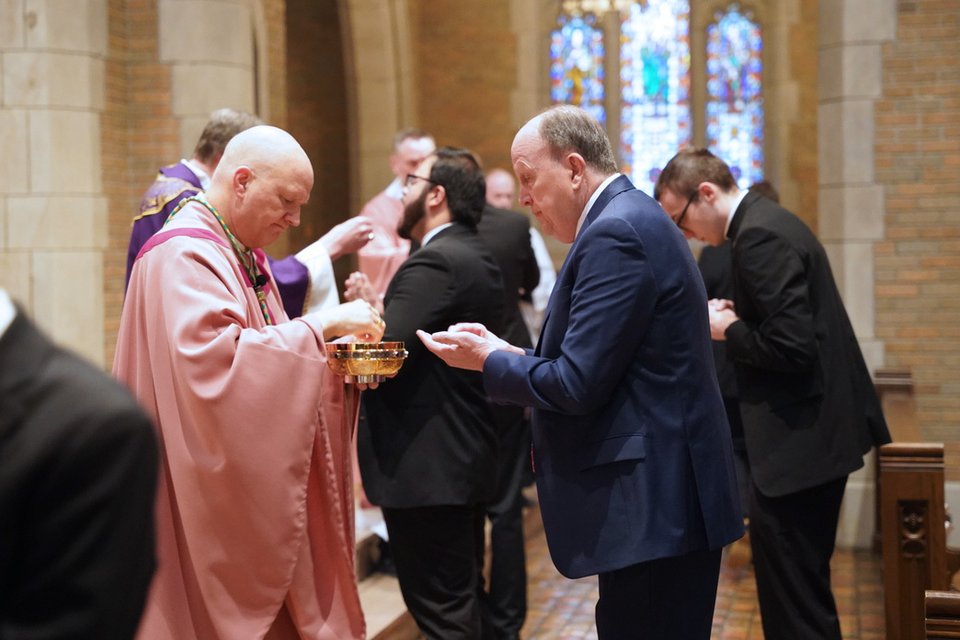
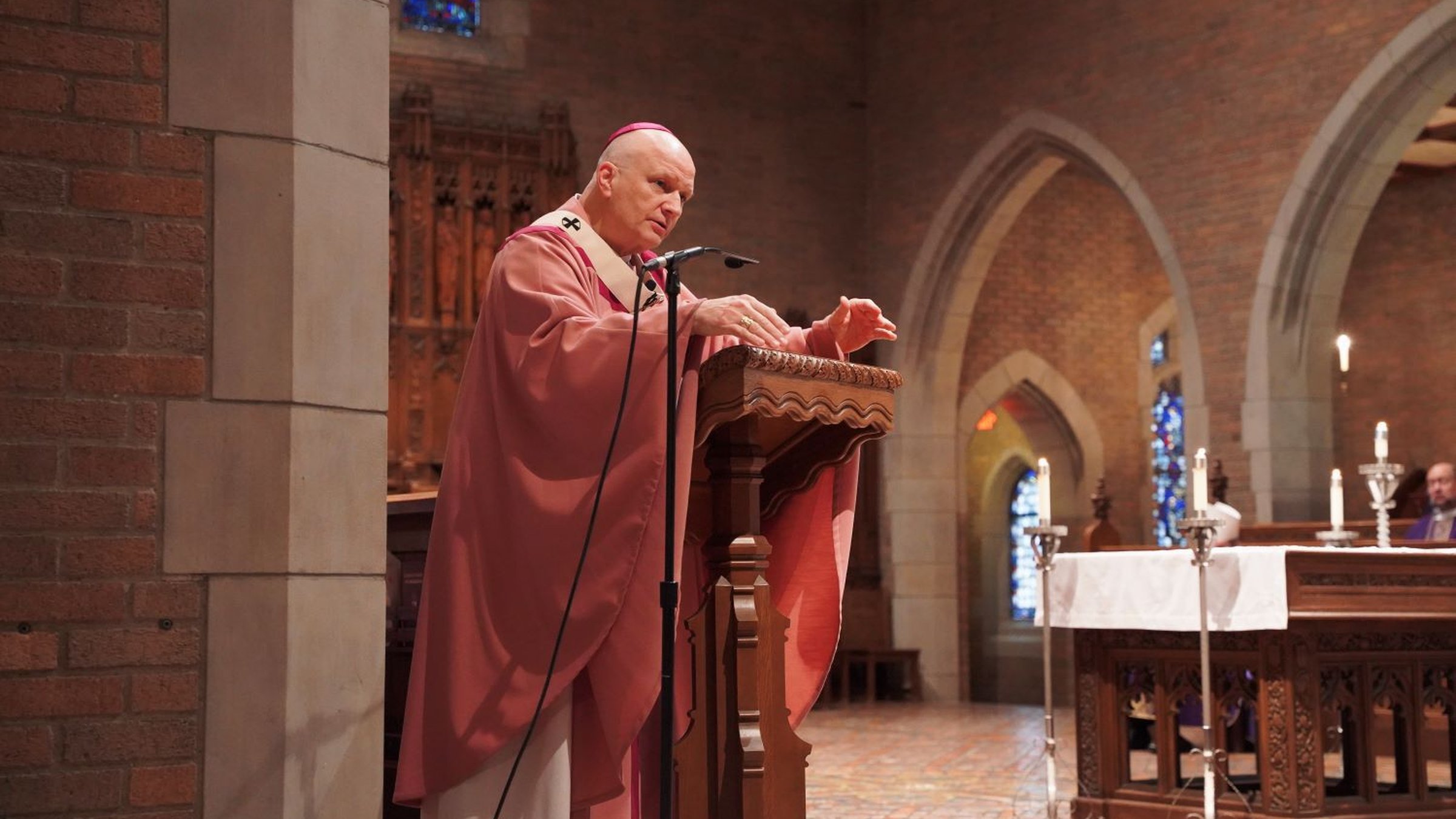
DETROIT — Archbishop Edward J. Weisenburger thanked Catholic health care workers for “being God’s instruments for healing” during the annual Rose Mass on March 15 at Sacred Heart Major Seminary in Detroit.
The annual liturgy, which takes place on Laetare Sunday — the fourth Sunday of Lent, when clergy don rose-colored vestments — acknowledges and celebrates the ministry of Catholic health care workers, who recognize Christ’s presence in the sick.
“It’s an honor to celebrate the Rose Mass for those in the health care profession,” Archbishop Weisenburger said in his homily, recalling the work of his eldest sister, Mary Anne, who worked for 28 years as a nurse practitioner in neonatology in Oklahoma City.
Archbishop Weisenburger recalled the calm assurance his sister brought to patients and the compassion all health care providers offer to the people in their care.

“There is an inherent dignity in all professions as together we build up the kingdom of God. Still, there are blessed professions where your endeavors draw so very close to the Gospel,” Archbishop Weisenburger said. “Not only figuratively, but sometimes literally, you able to touch the bones of humanity and become God’s instruments for healing them.”
Archbishop Weisenburger acknowledged doctors, nurses, and clinicians may feel overwhelmed at times, especially as medical technology, regulations and demands become more complex.
“Yet on your worst days, be touched by the best of your days,” Archbishop Weisenburger said. “Think of the multitude of ways God has given you the opportunity not just to preach the Gospel, but to live it in a unique and wonderful way. Blessed are you in the health care profession.”
Dr. Michael Redinger says Catholic Church has an answer to the mental health crisis
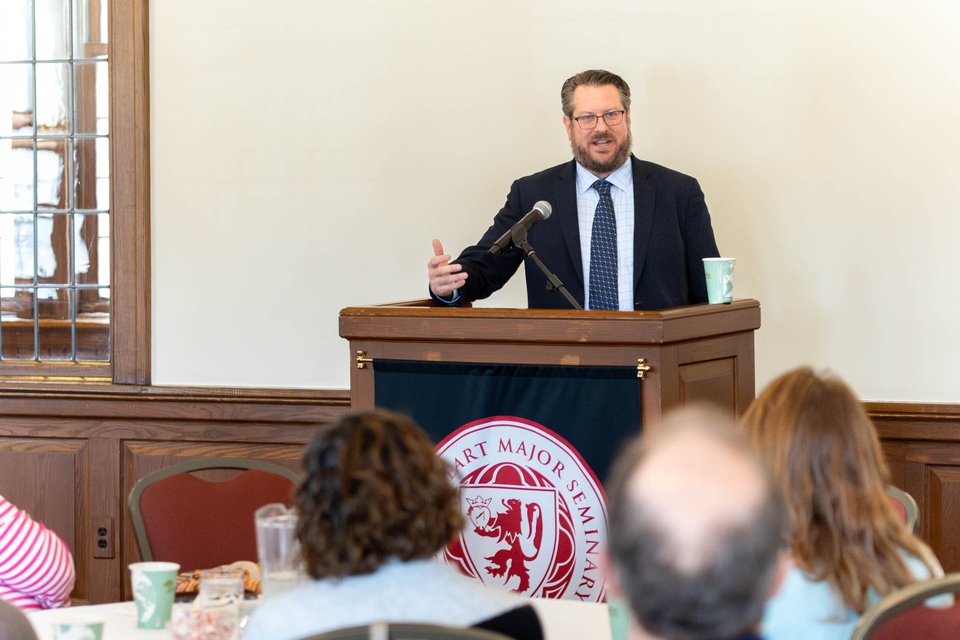
Following the Rose Mass, health care professionals had the opportunity to hear a presentation from Dr. Michael Redinger, associate professor at Western Michigan University's Homer Stryker M.D. School of Medicine, about the Catholic response to the mental health crisis.
The Catholic Church has the pastoral model and insight into the human spirit to guide people out of the epidemic of loneliness and anxiety, said Dr. Redinger, a Catholic psychiatrist.
“We live in an age marked by inauthenticity and loneliness that is, in part, the root cause of the increased rates of depression and anxiety,” Dr. Redinger said, adding the COVID-19 pandemic accelerated an existing problem. “The Church has the tools to help us respond to this moment, grounded in a recognition of the inherent human dignity of those who experience mental illness.”
One in three high school students report persistent feelings of sadness or helplessness, Dr. Redinger said, with suicide rates for young people rising 57% in the last decade. Most disturbing of all, he said, at least 10% of students attempted suicide within the past year.
“Americans are lonelier now, certainly, compared to before the pandemic,” Dr. Redinger said. “And the data is very clear that post-pandemic, the effects of the pandemic are still very much with us.”
Cases of loneliness and isolation were already present before the pandemic, but the pandemic exacerbated the issue, particularly for young people, he said.

“COVID in many ways pushed society into our virtual spaces, from which we’ve never really come out," Dr. Redinger said. "But when we moved into those spaces, they offered few protections and were more dangerous than the social interactions young people had experienced prior to the pandemic.”
Dr. Redinger examined the Church’s history in ministering to those experiencing mental anguish, which he argued oftentimes gets an unfair analysis, being overly associated at times with spiritual warfare rather than mental health.
“The response of the Church, culturally, has been more nuanced historically than that,” Dr. Redinger said. “We have records from Benedictine monasteries, and not just the Benedictines, who took as their primary charge the care of those experiencing what we now would call mental illness.”
As psychology developed in the late 19th and early 20th centuries, many — but not all — psychologists began to think of their field as a replacement for religion, Dr. Redinger said, a view today is soundly rejected by Catholic psychologists.
“I think psychiatry and religion are compatible; I wouldn’t be practicing it otherwise,” Dr. Redinger said. “Much of that, I think, relates to an understandable religious skepticism of psychiatry and the psychological fields, but also in the reciprocal direction. This is something, I think, that fortunately has changed over the last 20 years or so.”

The Church, for its part, has been more receptive to embracing psychiatry in its ministry to people, especially in the past 20 to 30 years, Dr. Redinger said.
“One of my favorite documents came from the California Catholic bishops' conference, which issued a pastoral letter that drew from a series of conversations and focus groups with people from the clinical and pastoral care settings,” Dr. Redinger said. “The introduction says that, 'As pastors and bishops, we understand that mental health is a critical component of wellbeing. Therefore, ministering to those who suffer from mental illness is an essential part of the pastoral care of the Church.' This is something we are called to do as a Church.”
Dr. Redinger pointed to other examples of prominent Catholics and bishops finding therapy and psychiatric treatment as necessary companions to spiritual accompaniment.
Dr. Redinger, who serves on the board of directors for Catholic Charities in the Diocese of Kalamazoo, also highlighted the various free or reduced cost mental health resources available for schools and parishes.

“Our diocese has a trauma and recovery program, which is really unique," he said. “It’s a holistic, Catholic approach that utilizes the tools of a trauma-focused therapist. Also, in Kalamazoo, our Ascension hospital offers the only inpatient psychiatric unit in the area.”
The Church's evolving understanding of the mental health crisis also allows it to provide pastoral care to those who have experienced the effects of suicide in their lives, Dr. Redinger said.
In November 2025, Pope Leo asked the Church to pray for the prevention of suicide and the victims of suicide, with the Diocese of Phoenix producing an accompanying video as part of the Pope’s Worldwide Prayer Network, he said.
“The pope’s words, I think, really speak clearly to what I was trying to articulate from the very beginning,” Dr. Redinger said. “If the response of the Church to those with mental illness is prioritizing the inherent dignity that every person has by virtue of being sons and daughters of Christ, then the Church’s response is going to be one of compassion and closeness. Ultimately, what it comes down to is making our Church an authentic healing community. And I think that’s a big part of where we can go.”