Detroit — Msgr. Todd Lajiness, who becomes rector of Sacred Heart Major Seminary on May 5, said he takes his new position “with a deep sense of gratitude” to those who have held it before him.
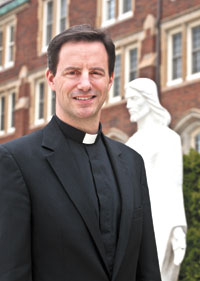
He hailed outgoing rector Msgr. Jeffrey Monforton and his predecessors as “really outstanding examples of pastoral leadership.”
Msgr. Lajiness, 43, said he hopes to build upon their efforts, and said he would focus on strengthening “the priestly identity of leadership.”
“As the time between a priest’s ordination and first pastorate keeps getting shorter and shorter, it becomes increasingly important for the seminary to teach what it means to be a pastoral leader — something priests used to learn from serving as an associate under several pastors before becoming one themselves,” he said.
In recent years, the seminary has studied the problem of some priests leaving ministry within just a few years of ordination. In response, Msgr. Lajiness said the seminary has surveyed recently ordained priests and the pastors who work with them and is reviewing the findings to form recommendations to the archdiocese on what might prevent such losses to an already strained presbyterate.
“The bottom line is to do our very best to prepare priests who are healthy and have a really deep relationship with Christ, and who really relate effectively to people,” he said.
But overall, Msgr. Lajiness said, seminary enrollment is robust, with the number of seminarians studying for the Detroit archdiocese — as well as the other dioceses and religious orders that send their priestly formation candidates there — on the rise.
|
However, a decline in financial aid for students studying for lay ministry certifications has reduced that segment of enrollment, he said.
The current academic year began with 119 seminarians — 53 at the college level and 66 in the graduate-level theologate.
Besides the Archdiocese of Detroit, the Michigan dioceses of Kalamazoo, Lansing, Marquette and Saginaw, as well as Gary, Ind.; Winona, Minn.; Fargo and Bismarck, S.D.; and Madison, Wis., as well as the Chaldean Eparchy of St. Thomas, Milles Christi and the Society of Our Lady of the Most Holy Trinity send their seminarians to Sacred Heart.
Msgr. Lajiness said the seminary’s program in the New Evangelization is doing well, with 20 students registered for the fall term. But he said he expects that to increase significantly once Sacred Heart receives approval for what he called “an alternate delivery program.”
The program offers both master’s degrees and a licentiate — a papal degree conferred by the apostolic University of St. Thomas Aquinas (the Angelicum) in Rome.
“The New Evangelization is an effort to bring the message of Christ anew and afresh to a society and a culture that needs to hear it again,” Msgr. Lajiness said of the concept that was developed by Blessed John Paul II.
“It is an effort to bring it again to a society and a culture that for decades has drifted away from a core belief and understanding of the Gospel message,” he added.
While there are other institutions offering degrees in the New Evangelization, Sacred Heart is the only one that can offer a papally approved licentiate.
The obstacle to the program’s growth, Msgr. Lajiness explained, is that although many bishops would like to send priests to study for the licentiate, the priest shortage has made it impossible to release them to come here for study.
“The alternate delivery for which we are seeking approval would involve an intensive 15-week summer program here at the seminary over four years, plus one online course per semester during the rest of the year,” he said.
Msgr. Lajiness has been serving as the seminary’s dean of students. He was named a chaplain of honor to His Holiness, one of the classes of prelate that carries the title “monsignor,” on Feb. 13, the same day his appointment to become the seminary’s rector was announced.
A formal inauguration will be held at a later date, probably in the fall, he said.
Msgr. Monforton is leaving the seminary to take up his new assignment as pastor of the largest parish in the archdiocese, St. Andrew, Rochester.