
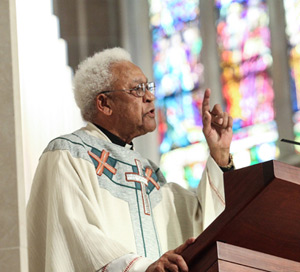
 Detroit — Msgr. James P. Robinson, SSE, who marched with Dr. Martin Luther King Jr. across the Edmund Pettus Bridge in Selma, Ala., played a pivotal role in advancing civil rights in the Deep South, and helped develop racial and civic relations in Detroit years later as rector of the Cathedral of the Most Blessed Sacrament, died Jan. 9 at the age of 83.
Fr. Clarence Williams, C.pp.S., a close friend of 38 years who referred to Msgr. Robinson as his “mentor,” said the monsignor would often tell stories of the civil rights struggles in his Alabama boyhood home, to which he would later return as an Edmundite priest to work toward racial reconciliation in the heavily segregated city.
When it came to the famed march and Dr. King, Msgr. Robinson was literally on the front lines, Fr. Williams recalled.
“They needed a number of ministers to pull the people together and to stand in front of the march — the Jewish ministers, the Protestant ministers, and the Catholic ministers. Msgr. Robinson, being so tall, was prominent in the photos,” he said. “He arranged for Martin Luther King to come to Selma to march across the bridge, and after that he was able to quell a riot in Selma that everyone attributed to him talking to people.”
Later, when federal funding was withheld from the city because of civil rights violations, then-Fr. Robinson was “influential” in working with Selma’s mayor to help bring together sparring groups to reform city government, which resulted in the city council evolving from an all-white body to include five black members and helped pave the way for a new city hall, library and convention center, as well as housing and urban development for the city’s poor.
“He’s a local hero” in Selma, Fr. Williams said, “and now that we’re coming on the 50th anniversary of the march across the Pettus bridge, his order wanted to have him buried there, because it could become a monument because he was such a central figure in that development.”
Growing up in the heavily Protestant South, Msgr. Robinson was drawn to Catholicism through the influence of missionaries from the Vermont-based Society of St. Edmund, who had come to Alabama to serve and convert the largely poor, black population.
While the missionaries did have something few religious communities in the neighborhood could offer — a desegregated gym where young black boys could play basketball — it was their service to the poor that attracted the young James, who began serving Mass at 8 years old and studying the faith under the Edmundite priests.
To avoid controversy with local Protestants, the missionaries refused to baptize him until age 16, “so it wasn’t a child’s conversion,” Fr. Williams said. “He never received Communion for eight years, until he reached 16. That was the kind of faith he had.”
He later sponsored his childhood friend and future Detroit Auxiliary Bishop Moses B. Anderson into the Church, and both entered the novitiate with the Society of St. Edmund in Putney, Vt. After professing first vows in 1951, he studied at St. Michael’s College in Colchester, Vt., and graduated magna cum laude in 1953. Four years later, he was ordained an Edmundite priest and began serving in the Mission Apostolate of the the Diocese of Raleigh, N.C.
From 1958-64, Fr. Robinson taught math and science at Cardinal Mindszenty High School in Dunkirk, N.Y., while earning a master’s in theology from St. Michael’s College. He served as a pastor in Elizabeth City, N.C., from 1964-69, and in 1967 became a founding member of the national Black Clergy Caucus.
Fr. Robinson then served as superior of the Edmundite Seminary in Burlington, Vt., before returning to Selma in 1971 as assistant director of the Edmundite Mission that had converted him as a boy.
In 1976, Fr. Robinson was called to the Archdiocese of Detroit, where he had often visited to care for his grandmother and celebrate weddings of friends who had moved north to work in the auto industry.
One of those friends was former Detroit Mayor Coleman Young, Fr. Williams recalled.
“As children in the South, they both had the same babysitter. So when he came to Detroit, he reunited with his childhood friend Coleman Young, and that helped a lot with the church-city relationship,” Fr. Williams said.
While Msgr. Robinson served multiple parishes in the city, his friendship with the mayor eventually led Cardinal Edmund C. Szoka to appoint him as rector of the Cathedral of the Most Blessed Sacrament in 1983, a position in which he was able to foster relationships between the archdiocese, city and the largely black neighborhoods surrounding the cathedral.
As rector, Msgr. Robinson also oversaw a remodeling of the cathedral and its pastoral center ahead of the city’s first-ever papal visit from St. John Paul II in 1987.
For as much as Msgr. Robinson was involved in civic affairs, though, he was even more committed to using his priestly service as a catalyst for change.
“He saw the Catholic Church as advancing racial (relations),” Fr. Williams said. “White men and women giving their lives for black families, that excited him and committed him, and he just tried to be the best priest he could be within his reality.”
Msgr. Robinson, a lifelong learner who received his doctorate in education from Madonna University in 1998, was incredibly smart, too.
“He would read papers in three different languages to know what was going on,” Fr. Williams said. “People forget that his master’s was in chemistry, and his dissertation was something about the atom, which was ground-breaking. He was just multi-faceted: the athlete, the scholar, a good religious, faithful grandson. Everything he did, he did well.”
But what he did best, undoubtedly, was serve others in holiness, Fr. Williams said.
“He taught a great lesson I’ll never forget, and it was simply the lesson of the missionaries that served him in Selma: ‘To work and not seek reward. To serve and not to think of pain. To love, and never count the cost.’ He really exemplified that model of the Edmundites beautifully.”
In Detroit, Msgr. Robinson served the parishes of St. Catherine/St. Edward (1976-83); St. Bernard of Clairvaux (1981); and St. John Berchmans/St. Juliana (1995); in addition to his rectorship of the cathedral from 1983 to 2003, where he continued to serve in retirement. He also served multiple terms on the archdiocesan Presbyteral Council and College of Consultors, was vicar of the former East Side and Northwest Detroit vicariates, and served on the board of trustees at Marygrove College and Madonna University.
In 1990, Pope John Paul II named him a Prelate of Honor to His Holiness, the second of three ranks of monsignor and a rarity for a member of a religious order.
Msgr. Robinson is survived by two sisters, Bennie Ragland and Gloria Middleton, and many nieces and nephews. A funeral Mass was celebrated Jan. 17 at the cathedral. Interment is planned for a later date in Selma, Ala.