
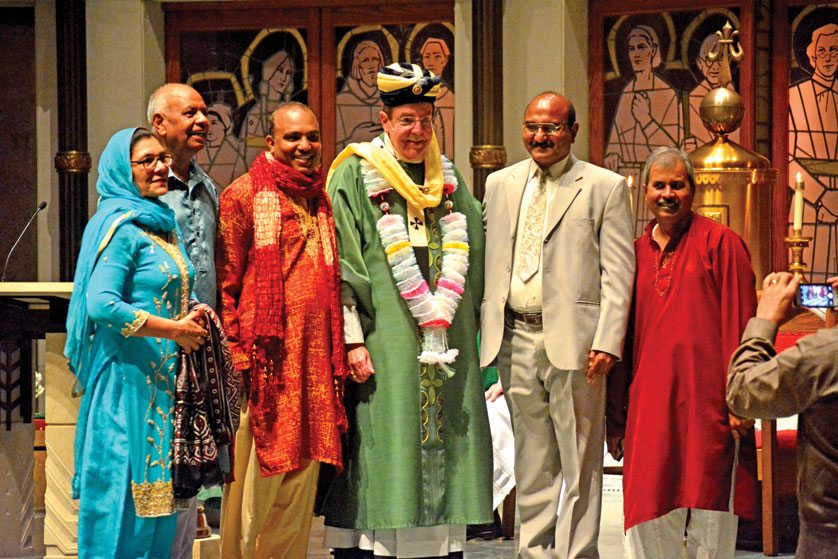
 Archbishop Allen H. Vigneron poses for pictures with members of the Pakistani community at St. Jude Parish in Detroit, who presented him with a traditional garland and turban during the parish’s 75th anniversary Oct. 29. (Mike Stechschulte | The Michigan Catholic)
DETROIT — In 1941, the city of Detroit was a thriving boom town, built on a budding auto industry and preparing to do its part to assist the Allied Forces in manufacturing supplies for World War II. The city’s population was 1.6 million, and many of them were Catholic.
Enter St. Jude Parish on the city’s northeast side.
Seventy-five years later, the parish — like the city in which it resides — doesn’t have the thousands of members it did in its heyday, but that doesn’t diminish the important role it continues to play in the community.
“Demographic changes and population shifts have impacted our numbers, but they have not changed our mission,” Fr. Shafique Masih, pastor of St. Jude, said during the parish’s 75th anniversary celebration Oct. 29. “In addition to fulfilling the spiritual needs of our parishioners and neighbors, we are able to provide many outreach programs, including our food pantry and neighborhood cleanup efforts.”
Through those efforts, St. Jude today serves as a lifeline to the poorest of the poor in the community, said Auxiliary Bishop Donald F. Hanchon, regional moderator for the Archdiocese of Detroit’s Central Region.
“If you live in this part of the city, you know about St. Jude’s food closet,” said Bishop Hanchon, who along with Archbishop Allen H. Vigneron and several priests helped celebrate the milestone Mass. “If you were simply to watch the amount of food that comes in and goes out to be distributed, it would stir your heart.”
Bishop Hanchon, who sang a rendition of “This Little Light of Mine” on ukulele for the congregation following Mass, told current and former parishioners they can still have an impact on Detroit’s faith.
“Many have written the city off and say that there’s no hope here, but your prayers and your service to Jesus in the most needy makes all the difference,” Bishop Hanchon said.
Parishioner Pauline D’Aoust, 92, said she remembers when St. Jude first started in the gym of nearby Denby High School before the current church, a magnificent neo-classical edifice with raised stone arches and vaulted ceilings, was constructed.
“At one time we had up to six Masses going every Sunday,” including on both the church’s main and lower levels, said D’Aoust, whose four children attended St. Jude’s school and were baptized there.
Archbishop Vigneron, in his homily, acknowledged there are many ways to chronicle St. Jude’s history, but none would be complete without reference to the many “individuals histories” of the parish — the baptisms, weddings, confirmations and funerals that made it a house of God for 75 years.
“Think about, for a moment, all of the sins that were forgiven in these confessionals, things we won’t ever know about until the end of time when the Book of Life is read out in front of Jesus and the whole host of heaven,” Archbishop Vigneron said. “Grace was at work.”
While St. Jude today has just 250 families — down from the 3,000 of its heyday — D’Aoust credited Fr. Masih, a Pakistani immigrant who has led St. Jude since 2012, with keeping the community strong.
“Father is keeping us alive,” D’Aoust said.
After Mass, Fr. Masih presented garlands to all of the clergy in attendance, as well as traditional Pakistani turbans to Archbishop Vigneron and Bishop Hanchon, which he called “a custom back in our home.”
“The garland shows that we welcome our guests, and the turban that we give to the archbishop today shows that he is the head of our family, and he is our shepherd,” Fr. Masih said.
Archbishop Vigneron said he was touched by the gesture, thanking Fr. Masih for coming to Detroit to be “a missionary here” and urging the congregation to pray for Christians who are still being persecuted in Pakistan.
“That Father honors me, Bishop Hanchon and the other priests with these elements of his culture is to me not simply a matter of folklore, but is a sign of my solidarity,” Archbishop Vigneron said. “I promise my prayers that there be peace for the Church in Pakistan, and that the martyrs there be included in the prayers of our people.”