
Detroit's Irish parish celebrates the 82nd anniversary of its inaugural 'Sharin' O' the Green' fundraiser to power parish missions
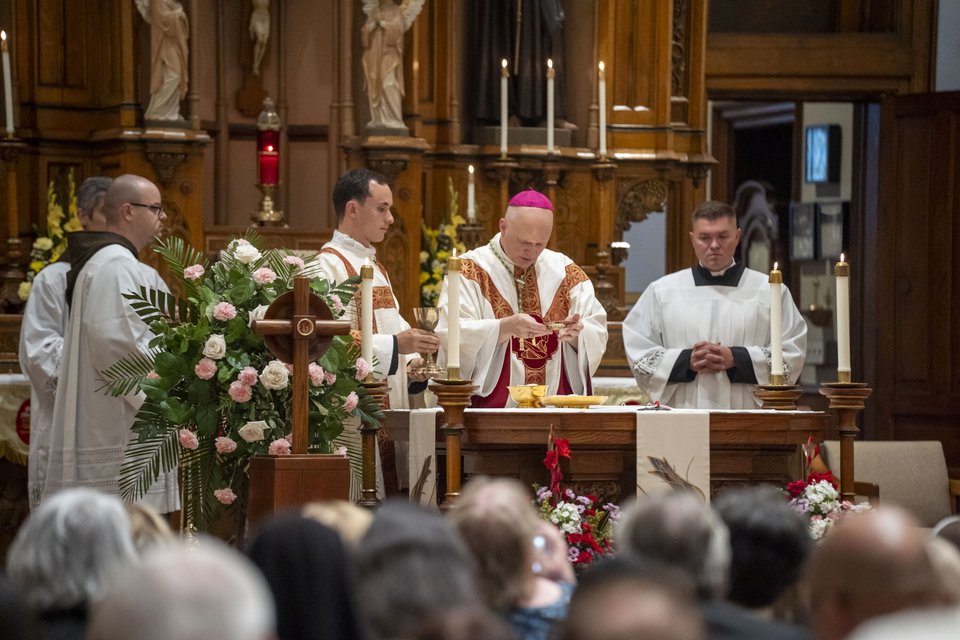
DETROIT — Detroit’s Irish community gathered at Most Holy Trinity Church in Corktown for the 191st time to celebrate the patron saint of Ireland and the faith he passed on to their ancestors.
The March 17 celebration marked the first time Detroit Archbishop Edward J. Weisenburger celebrated Mass at the center of the region’s Irish-Catholic community.
And while the archbishop has a distinctively German last name, Msgr. Charles Kosanke, pastor of Most Holy Trinity, found a creative way to welcome him into the community.
“On Friday, when I went with the delegation from Ireland to meet with the mayor, I said to Mayor (Mary) Sheffield, 'With the authority I have as the pastor of Corktown, I want to make you an honorary Irishman,'” Msgr. Kosanke said. “She asked, ‘Well, how does that work?’ I said, 'I’m just going to add an ‘O,’ at the beginning of your name.' And so today, with that same pseudo-authority, I’ll make the bishop an honorary Irishman: it’s ‘Archbishop O’Weisenburger.’”
Fr. John Herman, moderator of the Quo Vadis Domine Family of Parishes (St. Frances Cabrini, Allen Park; St. Mary Magdalen, Melvindale; St. Alfred and St. Constance, Taylor) who recently served as an associate pastor at Most Holy Trinity, delivered the homily, in which he admitted that as a German, it took him a while to embrace St. Patrick’s Day.

“I had a tough time celebrating St. Patrick’s Day with the Irish, who were so full of joy and so proud of being Irish,” Fr. Herman said. “But thanks be to God, I had a change of heart. I’ve recovered. And so it’s a great blessing to be here today with all of you for this wonderful, wonderful celebration of the feast of St. Patrick.”
Fr. Herman asked the assembly to think of St. Patrick as more than just a one-dimensional figure holding up a shamrock to explain the Trinity, reflecting on the missionary zeal he had for people who kidnapped and enslaved him in his youth.
“For him to return to the place of his slavery to convert the Druids, the people of Ireland — yes, he was as tough as nails, but he truly trusted in God in the face of so many challenges,” Fr. Herman said. “And he embodied the message of St. Peter in our first reading today: Whoever preaches, let it be with the words of God. Whoever serves, let it be with the strength of God.”
Fr. Herman explained that what made St. Patrick so successful in evangelizing the Irish was his respect for Irish culture and his genuine love for the people to whom he preached the Gospel of Christ.
“He had an incredible zeal, and incredible love for God and a great love for the very people who had enslaved him,” Fr. Herman said. “All of this clearly made him the apostle of Ireland, the one we are celebrating here today, centuries later.”

The Gospel reading from St. Luke recounted Jesus asking Simon to cast his nets out in the deep water after Jesus had preached from his boat, which Fr. Herman compared to St. Patrick being asked to return to Ireland after escaping slavery.
“The last thing Peter probably wanted to do was to go out in the deeper water and cast his nets another time, when the odds were great against catching anything,” Fr. Herman said. “But Jesus blessed Peter’s obedience and blessed his efforts with a catch of a lifetime. This is a powerful example of God’s grace and human effort coming together to bring about amazing results.
“What was St. Patrick thinking as God was calling him to return to the place of his slavery, to the place of such great suffering, to the place where he escaped?” Fr. Herman asked. “Was he feeling uncertainty, apprehension, fear? Maybe, maybe not. I can only imagine. But the results were such a beautiful catch.”
The result was that all of Ireland converted to Christianity within St. Patrick’s lifetime, and from that island, millions of Irish came to America, bringing their faith with them.
Fr. Herman asked the faithful to reflect on the Most Holy Trinity’s 191-year history — the second-oldest continuous Catholic parish in Detroit, including operating the oldest school in the city (established in 1838) and the St. Frances Cabrini Clinic, the oldest free clinic in the United States, serving the uninsured and underinsured in the community.

Fr. Herman particularly mentioned former Most Holy Trinity pastor Msgr. Clement Kern — Detroit’s “labor priest” — who opened Most Holy Trinity’s doors to immigrants, the unemployed, the homeless and all those in need of assistance and the light of Christ.
“One of the great blessings for me of serving here at Most Holy Trinity was coming to understand the history and the significance that this parish has held in the archdiocese and the significance of Msgr. Kern, who began this celebration, the 'Sharin’ O’ the Green,'” Fr. Herman said, referencing the name of the traditional event.
“He was the one who for decades served the needs of the poor right here,” Fr. Herman added. “He was there for the homeless, was there for the immigrant — very appropriate at this time to think about what he did for the first immigrants from Mexico and other places in Latin America, and what he did to support workers as they sought their rights and a better way of life. It’s amazing the impact that Msgr. Kern had here at Most Holy Trinity.”
Fr. Herman ended his homily by asking the faithful to think of the examples of St. Peter, St. Patrick and Msgr. Kern, in answering the call to go where God sent them to deliver the Gospel with a missionary zeal.

“All of us have a role to play in the mission of Jesus Christ because of our baptism,” Fr. Herman said. “We are his beloved sons and daughters. We'll face adversity and challenges in our lives. But we are all called, like St. Patrick, to place our faith in Jesus, whatever the odds may be.”
Sharin’ O’ the Green powers Most Holy Trinity’s missionary spirit
“Sharin’ O’ the Green” is Most Holy Trinity’s biggest fundraiser, helping support the operation of the parish, Most Holy Trinity Academy and the Cabrini Clinic.
This year’s celebration at the Peter and Connie Cracchiolo Community Center at Most Holy Trinity Academy was called “Doyles in Corktown,” featuring Irish fare in reference to the Irish pub on the grounds of St. John’s Resort in Plymouth.
Kevin Doyle, chief operating officer of the Pulte Family Charitable Foundation and co-founder of The Catholic Initiative, an organization created to invest in and partner with vibrant but under-resourced Catholic parishes and schools, served as the honorary chairman of the year’s event.
“When my great-great-great-great-great-great-grandfather, Patrick Doyle, arrived in Baltimore in 1839, he was a poor Irish immigrant, and his Catholic parish gave him and his family a place of home, belonging, community and opportunity,” Doyle said, speaking at the end of Mass. “His parish set him and all the Doyles who followed him up for a better life. When my wife and I lived in Baltimore, probably 10 years ago or so, the parish was still serving the poor. That’s why we created The Catholic Initiative's mission, in part to invest in and partner with vibrant, faith-driven communities to ensure that immigrants like the Doyles would still have a place of belonging and a place of community and place for faith for many, many years."

Msgr. Kosanke thanked all who attended "Sharin’ O’ the Green" for assisting Most Holy Trinity in carrying out the corporal works of mercy each day.
“God asked St. Patrick to bring the Gospel of Jesus to a land that enslaved him, as we heard, and Patrick is a great example of being a disciple, which is humility and compassion, bringing forgiveness and peace,” Msgr. Kosanke said. “Let’s also remember our Irish ancestors who came to this land, the Irish immigrants who escaped famine, economic hardship and political unrest. Our Irish ancestors were met with discrimination and institutional barriers.
“This sometimes was accompanied with anti-Irish, and even anti-Catholic, riots. I do not think that this was unique to the Irish, but it is experienced by every immigrant group to this day,” Msgr. Kosanke added. “My grandparents, Tom and Helena Clancey, were immigrants, and I see their faces as I encourage us to treat immigrants of today as created in the image of God, and therefore, as having human dignity. The Church must not only be the moral voice in our society, but must also put into action the corporal works of mercy. Our parish continues this legacy of compassionate service to this day.”
Archbishop Weisenburger added that the entire faithful, regardless of heritage, can draw inspiration from St. Patrick, as the descendants of people he evangelized.
“When you scratch the surface of a statue of St. Patrick today, you find a breathing man, a disciple on fire for evangelization and love for God,” Archbishop Weisenburger said. “How blessed are all of us on St. Patrick’s Day, all of us to be a little Irish; for when you scratch the surface of the Irish today, you still find men and women on fire for Christ.”