
“I came not to call the righteous but sinners” (Mt. 9:13b). Jesus spoke these words to the Pharisees after calling Matthew the tax collector to follow Him and subsequently eating with his friends. The Lord came not for “those who were convinced of their own righteousness” (see Luke 18:9) but for those who are painfully aware of their own sinfulness and thus of their desperate need for a Savior. This is why He came to be born of the Virgin Mary: to save His people from their sins.
But how aware are we today of our own sinfulness, our own need for conversion? Often, I hear sin referred to, even sometimes in homilies, as a “mistake.” There can be an attitude of “we all make mistakes” when people talk about sin today. But sin is not a mistake, but a deliberate choice — and in fact, if an action were truly a mistake, it would not be a sin, because to sin is to choose freely to do what we know is wrong, what we know is evil. Referring to sin as a mistake downplays the evil that sin is. Sin is not just an accidental “mess-up,” but a deliberate choice to turn away from God.
Do we also recognize today that we cannot save ourselves from our sinfulness? We live in an age of self-help programs and New Year’s resolutions. We seem to think that if we just have the right advice and enough personal willpower, we can fix ourselves. But try as we might, year after year, we find ourselves disappointed. In reality, we cannot, on our own, fix ourselves. We are in desperate need of Someone else to set us free.
“You shall call His name Jesus, for He will save His people from their sins.” Jesus’ very name means, “God saves.” His very identity is Savior. He came to this earth to set us free: free from sin and death and hopelessness. Let us let Him be who He is; let us let Him be our Savior.
Is there something in your life that you want to be different? That bad habit that you just can’t break? A relationship with a family member that has grown sour? A situation at work that seems to have no solution? A compulsive need to be right or to be liked? A tendency toward negativity or, conversely, to letting people take advantage of you?
The true and lasting change we desire in our lives is beyond our own power to achieve; it can only come about through the grace of God. But Jesus came to give us life to the full, “grace in place of grace” (John 1:16). He transforms us by pouring into our hearts His very own life. “Today in the city of David is born for you a Savior, who is Christ the Lord” (Luke 2:11). This is indeed “good news of great joy” (Luke 2:10)! “He has come to His people and set [us] free” (Luke 1:68b)! Let us cease trying to save ourselves and finally allow Jesus alone to save us and set us free.
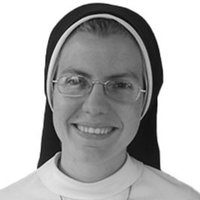
Sr. Mary Martha Becnel, OP, is a member of the Ann Arbor-based Dominican Sisters of Mary, Mother of the Eucharist.