Detroit — With attendance expected to top 100,000 by the end of its final day, Sunday, the Detroit Institute of Arts’ “Rembrandt and the Face of Jesus” exhibit has been among the museum’s most popular — so popular it is among a rare few to have an extended run.
|
Visits from parish groups and field trips from Catholic schools, as well as many individual Catholics, have factored into the exhibit’s success.
Among the throngs to visit the exhibit, a number of Catholic clergy and religious gave their opinions.
“I think this exhibit is one of the most significant ones the DIA has done,” said Basilian Fr. Gordon Judd.
“Rembrandt’s use of light and shadow draws out the aura of Jesus. In some of the images, he just shimmers,” he said.

Besides the artistic technique, Fr. Judd also marveled at the evolution of the 17th-century Dutch artist’s choice of subject matter: “I also found it interesting to see how Rembrandt moved from Jesus the wonder-worker to Jesus the one who draws us into our own inner journey,” he said.
The exhibit has stirred interest in the art world, but Fr. Judd said it might also prompt a spiritual awakening in some of the many who have seen it, “because the paintings speak so strongly of the inner life of faith.”
“Art leads people into exploring history; why not the spiritual?” he asked.
Sr. Marie Henderson, RSM, who teaches drawing at the University of Detroit Mercy and whose sculptural pieces adorn many local Catholic institutions, was surprised it took so long to display such an exhibit.
“I was impressed from an artistic viewpoint that the images hadn’t been together since they left Rembrandt’s studio,” she said.
The exhibit brings together Rembrandt’s portraits of Jesus and other works depicting biblical scenes involving Christ that have been held by museums or private collectors in various countries.

For artists, Sr. Henderson said, there is great value in seeing the works up close and learning how Rembrandt worked on his own paintings and with his students.
Rembrandt’s Jesus paintings feature his pioneering use of Jewish models from Amsterdam’s Jewish Quarter, but Sr. Henderson said even more important was the way the artist brought out Christ’s humanity.
“Jesus became approachable,” she said.
Msgr. John Zenz, pastor of Holy Name Parish, Birmingham, said he found the exhibit “spiritually invigorating and challenging, because it reminded me that I need to look for the face of the Lord in every face — no face is ordinary.”
He said he was “particularly touched by the number of times Rembrandt painted the scene of the two disciples with Jesus at table — the Emmaus story.”
“I also got new insight into the scene from John 8 of the woman caught in adultery. The way Rembrandt painted it, he had the woman and Jesus on a lower level just outside theTemple, while concurrently above the people are going to offer atonement sacrifices for sin.
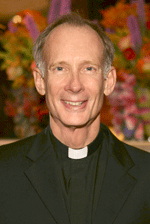
“In other words, forgiveness was happening in two ways — in a ritual way in the Temple and in an existential and direct way by Jesus,” Msgr. Zenz said.
Seventh-grader Kayla Byrom and eighth-grader Julia Roarty saw the exhibit with other classmates from St. Clare of Montefalco Elementary School in Grosse Pointe Park.
“My favorite was the one of people sitting down having dinner with Jesus, representing how they broke bread together,” Kayla said.
Julia said she was impressed by the way Rembrandt used light, shadow and color to illustrate different experiences. “It was like you could have been in the room with Jesus,” she said.
Julia said that among her favorites were the portraits that showed Jesus with “kind of like a smile — not with his teeth showing, but a happy face.”
That also impressed Msgr. Daniel B. Gallagher, a priest of the Diocese of Gaylord assigned to the Vatican’s Secretariat of State in Rome, who saw the exhibit while back in Michigan at Christmastime.
Msgr. Gallagher, who has taught philosophy at Sacred Heart Major Seminary, wrote a scholarly review of the exhibit for the January edition of The Berkshire Review, in which he speculated on the significance of “the strangely parted lips in his faces of Jesus.”
“By painting Christ with an open mouth, Rembrandt may reveal his radical acceptance of the Jews. For his model — his ‘Christ’ — may have said something worth listening to.”
Msgr. Gallagher’s full article may be found online at www.berkshirereview.net.