Robert Delaney and Mike Stechschulte | The Michigan Catholic
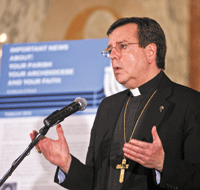
Detroit— Archbishop Allen Vigneron pointed to the many challenges facing the Catholic Church in southeast Michigan as he spoke to local media about the new pastoral plan for the Archdiocese o fDetroit.
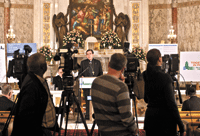
“These are challenges not what are being experienced in the industries. I often take great heart in thinking that what I’m trying to do is not unlike what General Motors, Ford or Chrysler are having to do, what the cities are having to do, and what the schools are having to do,” he said Feb. 20 at a press conference at the Transfiguration church campus of Blessed John Paul II Parish in Detroit.
The archbishop last week released his plan for reorganizing the archdiocese’s 267 parishes — commonly known as “Together In Faith” — a plan that includes dozens of parishes clustering, merging, or in a few cases, closing altogether. The plan includes varying timelines for action.
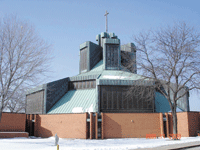
St. Donald Parish in Roseville will close this year, and Our Lady Queen of Peace in Harper Woods will put its church building up for sale in the summer.
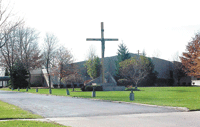
Eight other parishes will merge into four by the end of the year, and still others will merge, cluster or close in coming years, depending on various factors including debt repayment and priest availability.
While most news organizations focused on some of the plan’s details — which and how many parishes would be closing or merging — the archbishop spoke in terms of underlying dynamics and the need to reallocate resources to best serve the Church’s mission. One of those dynamics is a decrease in parishioners, he said.
“We are seeing a decrease in participation by Catholics in Sunday Mass. Only half of the people in my diocese who we claim to be Catholic are registered in parishes, and of those half, only 30 percent come toMass.So, that’s 15 percent of people who are members of the Catholic Church who are attending church,” he said.
Archbishop Vigneron said this participation problem is “not a Catholic problem — this is a religion-in-the-United-States problem.”
“Lots of other churches, synagogues and religious communities have problems very similar to us. We need to address these problems on a number of levels,” he said.
The archbishop said both a shortage of money and a shortage of priests are factors in the need to consolidate parishes, but he added that the more worrisome trend to him is the shortage of priests.
“We know by statistics that we are probably going to have 100 fewer priests in the next 10 years. It’s a long turnaround time to get a new priest. It’s a minimum of at least six years from when they enter into the seminary until ordination, and even at that, a man is not immediately ready to be a pastor simply once he becomes a priest,” he said.
Archbishop Vigneron said parishioners haven’t noticed a decrease in pastoral service, even as the ranks of clergy have declined. That, he said, was a testament to the priests’ hard work and sacrifice.
A strengthened focus on vocations figures prominently in the new pastoral plan, but the archbishop emphasized the need to maintain viable parish communities in the face of a shortage.
“Much more than what has to happen in our institutions is the challenge for us as a Catholic community to reappropriate our mission. This pastoral plan … is principally about our mission, about evangelization and catechesis, about vocations and the need to help young men who are called (to the priesthood) to be able to hear that call.”
He added that service outreach, lay leadership and youth education were also priorities.
“These are the goals that we need to work at. And we don’t want to be distracted by anything that is not focused on our mission. God has given us a mission, and we want to do the best job we possibly can to share Christ with the world,” the archbishop added.
Archbishop Vigneron said the reconfiguration of parishes is not primarily about reducing the number of churches inDetroit, as the decline in Mass attendance is being experienced by both urban and suburban parishes, although not so much in rural areas.
He also pointed to the strong presence of the Catholic Church in Christian service activity within the city.
“This is not just about the city of Detroit; that’s an important part, but this plan affects all six counties of the archdiocese,” he said.
But while the Catholic Church can point to a great deal of social service activity, Archbishop Vigneron said “the most important thing the Catholic Church offers the community is holiness.”
“We have to become much more energetic in saying ‘we have something wonderful here.’ We have the Eucharist, we have Jesus present in our midst, and we’d like to invite lots more people. We’d like to invite people who don’t come any more to come back; we’d like to invite people who’ve never thought about coming to come, and be part of our faith,” he continued.
The archbishop expressed confidence that, as the archdiocese squarely faces the challenges before it, the faithful will support it.
Recalling a trip he made to St. Joseph Parish, Lake Orion, the archbishop recounted a businessman’s encouragement in the face of tough times.
“(He said) I’ll contribute to the support of my parish and the support of my Church if you promise me that you won’t kick the can down the road, if you promise me that you’ll make the hard decisions that need to be made so that we aren’t wasting our resources, but using whatever we have as effectively as we can,’” Archbishop Vigneron said. “And that’s what we’re trying to do.”
Archbishop Vigneron also introduced a new pastoral letter that goes into greater detail about the philosophy and principles of Together in Faith — Phase II. The pastoral letter is being distributed to all parishioners; the full text can also be found at www.aodonline.org.
Details of the pastoral plan's decisions for each parish can also be found on the website.