


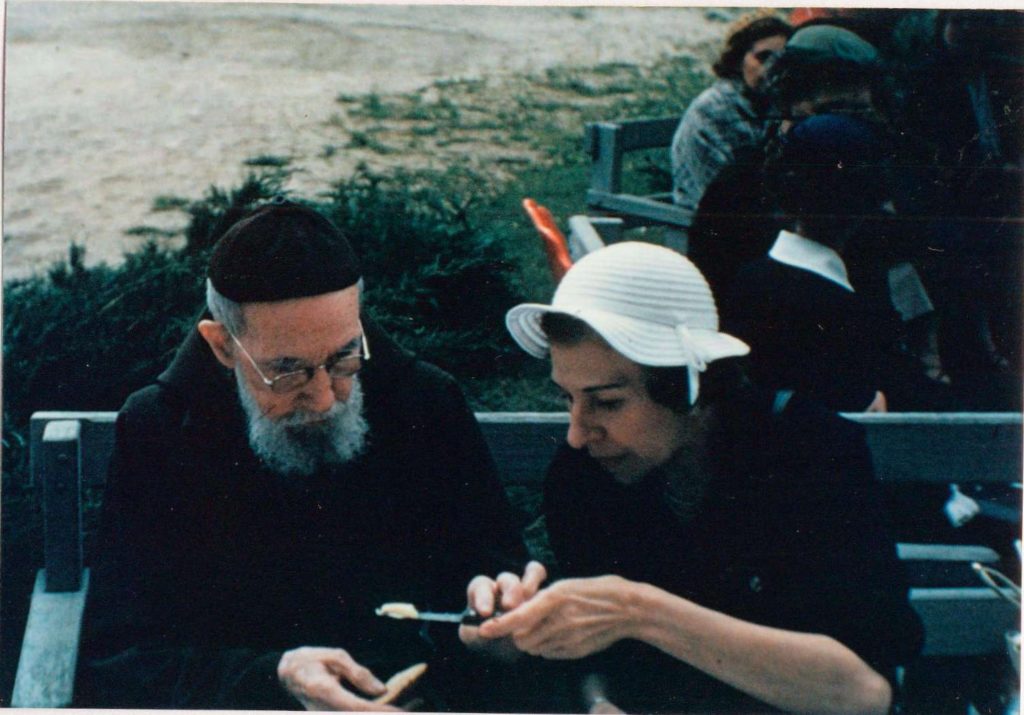
 Fr. Solanus shares a piece of cake with a well-wisher and visitors at a picnic in Huntington, Ind., in 1955. At a recent conference at Sacred Heart Major Seminary, speakers said the beatification of the humble friar should challenger Detroiters to step outside their own comfort zones to share the Gospel with others.
 Saints are meant to be imitated, not marveled at, symposium panelists stress
DETROIT — The veneration of saints and holy people can be a dangerous thing for the Church if it’s not accompanied by a clear call to conversion, Ralph Martin told a room full of people Oct. 28 at Sacred Heart Major Seminary.
“Holiness is not just for a few special people,” Martin said. “The danger with the veneration of any saint is that we look at them as somebody ‘up there’ whom God did a special thing with. But we’re not just supposed to admire them or marvel at them. We’re supposed to imitate them as they imitated Jesus.”
The professor of theology and director of graduate studies in the New Evangelization at the seminary was one of a panel of people who spoke during a symposium about the holiness and virtues of Fr. Solanus Casey, who will be beatified Nov. 18.
During Martin’s 15-minute talk, he emphasized that while Fr. Solanus had special gifts — such as the gift of prophecy and healing — he was not made to be special in terms of his eternal destiny.
“Do you realize that the only people who ever make it to heaven are saints?” Martin asked the priests, laity and church ministers in attendance. “You don’t need to be canonized to make it to heaven, but we have to be completely surrendered to the will of God — completely devoted to loving God with our whole heart and mind and soul and strength.”
Other panelists included Capuchins Bro. Richard Merling, co-vice postulator for Fr. Solanus’ sainthood cause, and Fr. Martin Pable, along with seminary professors Edward Peters and Fr. Peter Ryan.
Fr. Stephen Pullis said the fact that Fr. Solanus’ beatification will occur on the one-year anniversary of the Archdiocese of Detroit’s Synod 16 is “no coincidence.”
“That’s God’s providence to show us that Fr. Solanus is an image and a witness to how to ‘unleash the Gospel,’” said Fr. Pullis, director of evangelization, catechesis and schools for the archdiocese, referencing Archbishop Allen H. Vigneron’s pastoral letter.
Fr. Pullis said Fr. Solanus was a prototype for the archdiocese’s adopted paradigm of “Encounter, Grow, Witness,” showing that even a simple friar in humiliating circumstances didn’t shrink from his baptismal call to evangelize.
“When he came to Detroit, he wasn’t just the porter; he was the assistant porter — the second-string door-opener,” Fr. Pullis said. “He could have had lots of excuses. There were certainly plenty of smarter friars who had missions more closely connected to what we might call ‘evangelization,’ such as preaching and hearing confessions. But Solanus didn’t make any excuses. He used the opportunities he was given in life to share the Gospel with the people he encountered.”
Fr. Ryan, a Jesuit and professor of theology at Sacred Heart, said Fr. Solanus isn’t the only porter to have been beatified or canonized — which also is no coincidence.
Fr. Ryan pointed to St. Alphonsus Rodriguez and St. Andre Bessette as other examples of doormen-turned-saints.
“Given the examples from Scripture, especially the example of the Lord himself, it’s not surprising that God continues to favor the lowly,” Fr. Ryan said. “He’s meek. He’s humble of heart. And He works in remarkable ways through people who share those qualities.”
Fr. Solanus didn’t just endure his lowly state, Fr. Ryan added; he was profoundly grateful for it.
“The Lord’s stunning humility and generosity ought to inspire profound gratitude,” Fr. Ryan said. “It’s no wonder Fr. Solanus used to say, ‘Gratitude is the first sign of a thinking, rational creature.’”
While Fr. Solanus worked extraordinary miracles, he would first encourage others to make a sign of gratitude to God, such as going to Mass or confession more frequently, donating to the missions or praying the rosary, Fr. Pullis said.
Such simple acts of holiness make it easy to imitate a saint like Fr. Solanus, Fr. Pullis said.
“Fr. Solanus had his rule of life. What about ours?” Fr. Pullis said. “Living and working in Detroit, there are plenty of opportunities of people in need. We can find them. We can be like Solanus and look for those who need to hear and experience God’s love.”
Detroiters have long looked up to Fr. Solanus as a shining example of an ordinary, down-to-earth man who gave extraordinary glory to God, Martin said — a fact that should encourage others to do the same.
“What (soon-to-be) Blessed Solanus did with people, we’re being called to do for people in the Church,” Martin said. “Every Catholic layperson by the witness to their life needs to be willing to speak to people about Jesus, to help people grow in faith.”
Prayer, fasting and almsgiving were a regular part of Fr. Solanus’ life, Martin said, and must be regular part of ours, too.
“We need to make an offering, make a sacrifice and put some skin in the game,” Martin said. “Sometimes there’s a passivity among us that God will do whatever He’ll do in my life, but Scripture says ‘Strive for that holiness without which nobody can see God.’”



