Detroit—Many Catholics in the pews today are receiving the quality teaching and doctrine about their faith, but, as Auxiliary Bishop Michael Byrnes explained, “they may not have had that kind of life-changing encounter with Jesus.”
“One of the things we find is that we try to catechize people who haven’t been fundamentally evangelized,” said Bishop Byrnes, who is the episcopal vicar and regional moderator for the archdiocese’s Northeast Region. Bishop Byrnes also was appointed last year by Archbishop Allen H. Vigneron to oversee several archdiocesan efforts related to the New Evangelization.
“Without that consciousness of having encountered in a real deep way God’s personal love for oneself, a lot of the catechesis doesn’t make that much sense,” he said. “We do have many people in the pews who grew up being Catholic and living the best they can, but who may not be conscious of this personal encounter, this life-changing conscious experience of God’s personal love for them.”
Within the archdiocese, formation for catechists is the key to helping people better absorb the Catholic faith.
Sr. Kathleen Matz, CDP, says that presenting a catechetical methodology when training catechists is crucial to stay faithful to tradition, while it also promotes a more active participation of those being catechized.
“Our team begins with the premise that the catechist is one who echoes the Gospel and has a deep-lived faith in Jesus Christ,” said Sr. Matz, who is associate director in the archdiocesan Office of Evangelization and Catechesis.
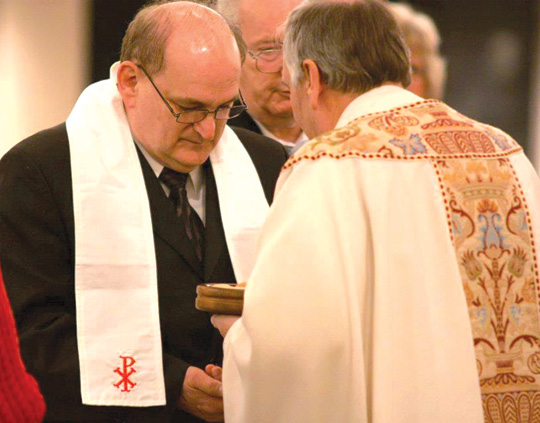
The archdiocese has many concrete ways to form catechists, Sr. Matz said, including the annual Catechetical Sunday, which this year is Sept. 15, and will offer numerous opportunities to further train leaders.
These opportunities throughout the year include commissioning catechists during the Sunday liturgy, sponsoring retreats for catechists, and having a reception and prayer service focusing on this year’s theme, “Open the Door of Faith.”
“The theme ‘Open the Door of Faith’ is one that is designated to reflect on the wonderful opportunity that a catechist has to witness his or her faith to another person,” Sr. Matz said, “whether that be a child, a teenager, a young adult or a seasoned adult.”
As Sr. Mary Louise Putrow, OP, says, one of the biggest improvements in catechesis today is in the approach to forming Christians.
“In the second century Tertullian said Christians are made, not born,” said Sr. Putrow, who has taught catechetical formation at Sacred Heart Major Seminary since 1988.
“I think another thing is that we can bring the best to our catechesis today in terms of faith development,” she said. “What we know about growth into the moral life, what we know about understanding, how children learn.”
This all ties into the Church’s mission of the New Evangelization, said Sr. Putrow, which she sees as a major concept that needs promoting today.
“It gives another quality to the way catechesis is formulated,” she said, citing the National Directory for Catechesis, which states, “Catechesis is an indispensable stage in the rich, complex, and dynamic reality of evangelization. It is a remarkable moment ‘in the whole process of evangelization.’”
She added that a specific change geared toward reaching today’s Catholics is in the context of the methods used.
“We have movement out of the ‘question and answer’ methodology [of past generations] and into a more holistic methodology,” she said, describing it as chancing from educational to a pastoral context.
Today, she said, catechesis has become the “development of a living, active, conscious faith which is based on instruction.”