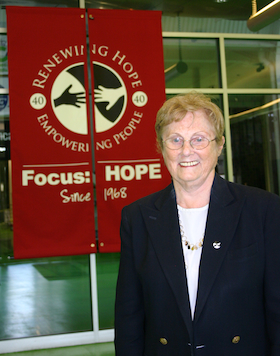
Detroit -- Eleanor Josaitis was a woman who thirsted for justice and worked tirelessly to pursue it, strengthened by her strong faith.
This was the sentiment expressed by three archbishops of Detroit -- Archbishop Allen Vigneron, and former archbishops Cardinal Adam Maida and Cardinal Edmund C. Szoka. Josaitis died on Tuesday morning at Angela Hospice in Livonia. Josaitis, the well-known social activist who co-founded Focus: Hope with Fr. William Cunningham, was 79.
Following the Detroit race riots of 1967, Archbishop Vigneron recalled her actions when many others wanted to flee Detroit.
"Eleanor Josaitis decided not only to stand fast, but to do all she could to bring the love of Christ to a people so badly wounded by violence and division," Archbishop Vigneron said. "The decision she and Fr. Bill Cunningham made to stay, to stand with the people of Detroit, has had consequences far beyond our ability to measure."
He added that Focus: HOPE over the years has done a lot to fulfill her and Fr. Cunningham's vision.
"So much of their work has come to fruition quietly in the hearts and lives of countless Detroiters, and will be fully comprehended only in the heavenly homeland into which we pray the Good Lord quickly welcomes her," he said.
Cardinal Edmund C. Szoka, who got to know Josaitis during the 1980s when he was Detroit's archbishop, offered thoughts about her passion to her mission.
"Eleanor Josaitis did an outstanding job through Focus: Hope in aiding people to acquire the necessary skills to earn a good living," said Cardinal Edmund C. Szoka. "She was a very dedicated person, devoted to the mission to overcome injustice and build racial harmony in Detroit's fractured community."
Cardinal Adam Maida said it was clear that Josaitis was fueled in life by her love of Christ through the poor. She embodied Christ's command to love Him by caring for "the least of my brothers," he said.
"Her faith gave her courage and wisdom," Cardinal Maida said. "She was driven by her faith in giving of herself so generously to the needs of the poor. She is a great woman, and a wonderful citizen of the city of Detroit.”
Josaitis was a housewife raising five children in Taylor when she joined forces with Fr. William Cunningham to start the civil and human rights organization that became known as Focus: HOPE.
After Detroit's 1967 riots. she and Fr. Cunningham wanted to something to help bring people back together, and she began by moving back into the city — against her family's wishes — and training priests to speak to people about breaking down racial barriers. Their goal was to have a program for the summer, but it eventually developed into having food programs, and, later, job training, education, children's, arts and scholarship programs.
The organization, Focus: HOPE, had been shepherded until recently by Josaitis. Fr. Cunningham died in 1997, and in 2006, Josaitis stepped down from the organization's CEO position to concentrate on raising funds and networking.
Over the years, Josaitis amassed a laundry list of recognition awards, including of the 100 Most Influential Women by Crain's Detroit Business and the Michigan Women's Hall of Fame.
Focus: HOPE offered the following memorial of Eleanor Josaitis...
The housewife turned civil rights activist dedicated the last 43 years of her life to “intelligent and practical action to overcome racism, poverty and injustice” as proclaimed in the Focus: HOPE mission statement. She became a national advocate for a food program designed to meet the nutrition needs for children and seniors; a proponent of job training programs that gave women and minorities access to the financial mainstream, and a passionate Detroiter who strove to revitalize the city and its neighborhoods.
“There’s no greater way to eliminate racism and poverty than to see that people have education, skills, jobs and opportunities in life,” she frequently said.
Josaitis is widely regarded as a leader who fought with courage and tenacity for causes close to her heart. She experienced the jubilation of winning Congressional approval of a national food program that has assisted hundreds of thousands of low income families; the loneliness of a lengthy, and eventually victorious, federal discrimination lawsuit against a local employer; and the satisfaction of providing job training and support services that have put more than 10,000 talented men and women into successful, good-paying careers.
Josaitis said the turning point in her life came as she watched a televised report on the violence inflicted on civil rights marchers in Selma, Alabama. The horrific scene of dogs and firehouses unleashed on American citizens ignited her passion for justice.
She became a civil rights activist—and a few years later co-founded Focus: HOPE when violence erupted in her own city. She often recalled walking the streets of Detroit the day after the riots ended telling Cunningham they had to do something to get at the root of the problems that caused the tragedy.
Among their first actions was conducting a study that showed the pricing and quality discrepancies between urban and suburban grocery and drug stores. Their findings gained national attention and put Focus: HOPE on the map as an organization that would make a difference in the inner city.
Josaitis and Cunningham were an unlikely pair. She was raising a family in suburban Taylor, while he was a Catholic priest who preached at her church and had become a regular guest for Sunday dinner at her home. Her five children grew up with “Uncle Bill” and Focus: HOPE integrated into their family.
While Cunningham was the outspoken visionary, Josaitis was the practical operations manager. When he passed away in 1997, many thought Focus: HOPE would fade from existence. Nothing could be further from the truth. Josaitis came into her own as a leader and public figure. With fierce determination, she took Focus: HOPE into the 21st century despite economic, political and social challenges.
Although she often asked others to help her “make Father Cunningham’s work live on,” in reality it was her work as well. She Where there was a problem, she found a solution. When she saw students having difficulty getting to school on time because of day care issues, she told Cunningham they had to open a child care center. When prospective students couldn’t pass a basic math and reading test, the co-founders started skill enrichment classes. When she saw children walking to school past abandoned houses, she worked her connections to get as many torn down as possible.
When she realized that a good education didn’t mitigate all the challenges faced by Focus: HOPE students, she started conducting etiquette classes. “I want them to know all the rules—what piece of silverware to use, how to shake hands, make eye contact, work a room, what to do at a cocktail party,” she said. “People put a label on you real quick. I want to remove that label.”
The firebombing of Focus: HOPE’s offices in the 1970s, the vile “love letters” she received, and the tornado that inflicted $18 million in damages to the campus just two months after Father Cunningham’s passing never discouraged her. And those tragedies only made the organization stronger.
“I refuse to be intimidated,” she said. “It just makes me want to work harder.”
Nothing warmed her heart more than graduates returning to give her hugs and tell her that they had a great job, a family, a house – and even took a vacation. She recalled one woman quietly walking up to thank her. “I’m about to get my Ph.D and I was once on your food program,” she whispered.
Josaitis often told the story of how she received a call from a woman looking for help with food. “I went on bragging about our great food program for women and children and she shouted into the phone ‘I’m 75 years old and you want me to get pregnant before you’ll give me food?!’
“She told me off like only your grandmother can,” Josaitis said. But the call ignited her passion for helping senior citizens gain access to the Commodity Supplemental Food Program. It took a few years and several trips to Washington before seniors were added—and they now make up the vast majority of participants in the 39 states that offer the program.
It was while advocating for the program, that Josaitis learned a lesson that shaped her leadership skills. When she and Father Cunningham were testifying before a congressional subcommittee, she sat across ‘from the meanest man I’ve ever seen.” During a break in the hearing, the late U.S. Senator Phil Hart took Eleanor aside and told her: “If you had decked him like you were going to, he’d have won and you’d have gone to the slammer. You have to learn to outclass them.”
The rest of her life was spent outclassing anyone who stood in her way.
She is survived by her husband, Don; children Mark, Janet (James) Denk, Michael, Thomas, and
Mary (Mark) Lendzion; grandchildren Elizabeth Josaitis, Kevin Josaitis, Nora Josaitis, David Denk, Chelsie Engel, Alec Josaitis and Alison Denk; sisters Margaret Krueger and Janet Lang, brother Louis Reed.
In addition to her family, she is survived by thousands whose lives are better off because of Eleanor Josaitis, Father William Cunningham, and Focus: HOPE.