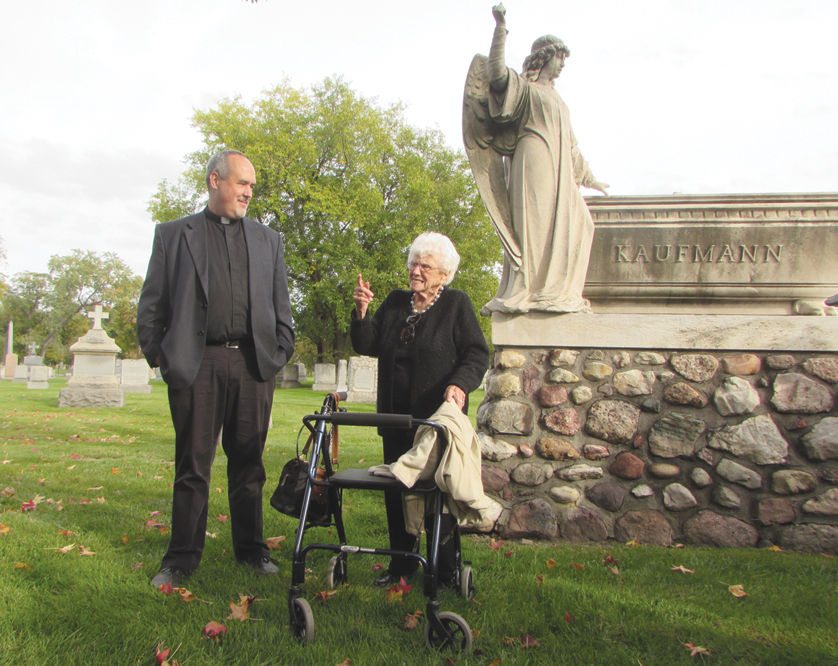
 Fr. Michael Depcik and Helen Booker, a member of the Detroit Catholic Deaf ministry, visit Detroit’s Mount Olivet Cemetery, where Fr. Henry Kaufman and Fr. Raymond N. Ellis — both influential in bringing Catholic Deaf ministry to Detroit — are buried.
Warren — One hundred years ago, Fr. Henry Kaufman, a priest of the Archdiocese of Detroit, saw the need to minister to Deaf Catholics in Metro Detroit.
He was commissioned by Bishop John Foley to start a Deaf ministry, and the first Mass for the Deaf in the archdiocese was held Oct. 11, 1914, at Fr. Kaufman’s own parish, St. Joseph Church on Jay Street.
Though Fr. Kaufman died many years ago, the ministry to Deaf Catholics in Detroit has continued and flourished to this day.
The Michigan Catholic recently interviewed several members of Detroit’s Catholic Deaf ministry, via an interpreter phone service, to learn their reflections on the 100th anniversary.
“There were 37 people at the first Mass,” said Fr. Michael Depcik, OSFS, director of St. John’s Deaf Center in Warren, who was born deaf.
Fr. Depcik, along with about 200 local Deaf Catholics, participated in an Oct. 10-11 anniversary celebration, complete with a tour of St. Joseph, a visit to the cemetery where two priests who led Detroit’s Deaf ministry are buried, and Mass with Archbishop Allen H. Vigneron at Sacred Heart Major Seminary.
He explained that the community did not have a permanent home until 1974, when the old school building next to the former Ascension Church in Warren became the new “home base” for Deaf Catholics.
Today, St. John’s Deaf Center not only offers signed Mass but also Bible study classes, sacrament classes and everything else offered by a typical parish.
In 1985, Deaf Catholics on Detroit’s west side gathered at Our Lady of Loretto Parish, Redford, to form Our Lady of Loretto West Detroit Catholic Deaf.
Fr. Depcik said 96 percent of Deaf Catholics do not attend church because of a lack of relevant resources and Masses in sign language.
“I often say that the Church is ‘deaf to the Deaf,’” he said.
However, “we have our own language, our own culture, and we tend to gather amongst ourselves because of the culture and the language.”
The cultural distinction used by the Deaf community in defining lowercase “deaf” versus “Deaf” hearkens back to a 1972 convention proposed by James Woodward, co-director of the Centre for Sign Linguistics and Deaf Studies at the Chinese University of Hong Kong.
The term “Deaf” refers to a sociolinguistic community, and the term “deaf” refers simply to the physical characteristic; The Michigan Catholic is using this distinction in this article.
Paul Kuplicki, financial coordinator of St. John’s Deaf Center, has been a member since the 1980s, right after he graduated college.
“I have been Catholic my whole life; my parents are deaf and also Catholic,” said Kuplicki, whose wife and two children are also deaf.
His daughter, who got married last year, is expecting a baby this January, and while they do not yet know if the baby will also be deaf, “we will continue to be members of St. John’s Deaf Center,” since the center welcomes both deaf and hearing individuals.
Sharon Meldrum, a professor of sign language studies at Madonna University in Livonia, said Our Lady of Loretto West Detroit Catholic Deaf has had “a huge impact on the Catholic Deaf community on the west side.”
Prior to the establishment of West Detroit’s location, Meldrum said there was an American Sign Language interpreter provided at a local Mass: “The hearing people were very welcoming to us at the time … hearing people were really feeling part of the Deaf Mass as well.”
However, she explained it was difficult to have the two communities celebrate Mass together, and the West Detroit foundation was a godsend.
Judy Vardon, also a member of St. John’s Deaf Center, was born hearing but became deaf as a child after being prescribed streptomycin for the Asian flu in the 1950s.
She and her husband, Larry, struggled in connecting with the Catholic faith for many years, until Vardon’s mother told her about St. John’s.
“We went every Sunday and found out more about the Catholic faith,” she said. “Now, I feel that I’m a very strong Catholic.”
Learn more
Join the public Facebook group, “St. John’s Deaf Center/Our Lady of Loretto Deaf Catholics,” to stay up-do-date with activities and events.