
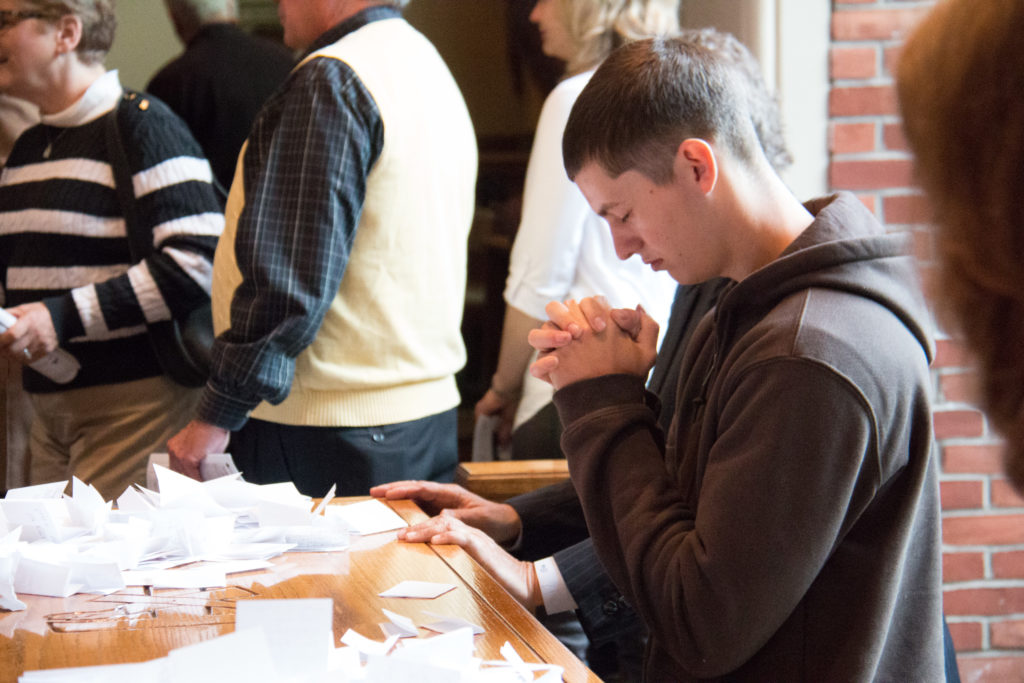
 A man prays at the tomb of Venerable Fr. Solanus Casey after the announcement of the Capuchin friar's beatification May 4. With the Nov. 18 beatification around the corner, Detroit Catholics are excited and energized to see one of their own become "blessed." “People feel a strong connection to Father. It’s like having someone in your family beatified,” Archbishop Allen H. Vigneron said. “Of course, in our region that’s very understandable. But really I think it’s across the whole country and other parts of the world, too." (Mike Stechschulte | The Michigan Catholic)
City 'thanking God ahead of time' for gift of Fr. Solanus Casey's beatification
DETROIT — For decades during the Great Depression and afterward, Capuchin Fr. Solanus Casey was the “go-to” guy for those who were sick, poor, afflicted or discouraged in their faith.
Standing at the doors of St. Bonaventure Monastery on Detroit’s east side, the holy Capuchin would welcome dozens — if not hundreds — of visitors per day: families with an ill child, destitute fathers desperate to make ends meet, loved ones distraught over a relative’s drifting from the faith.
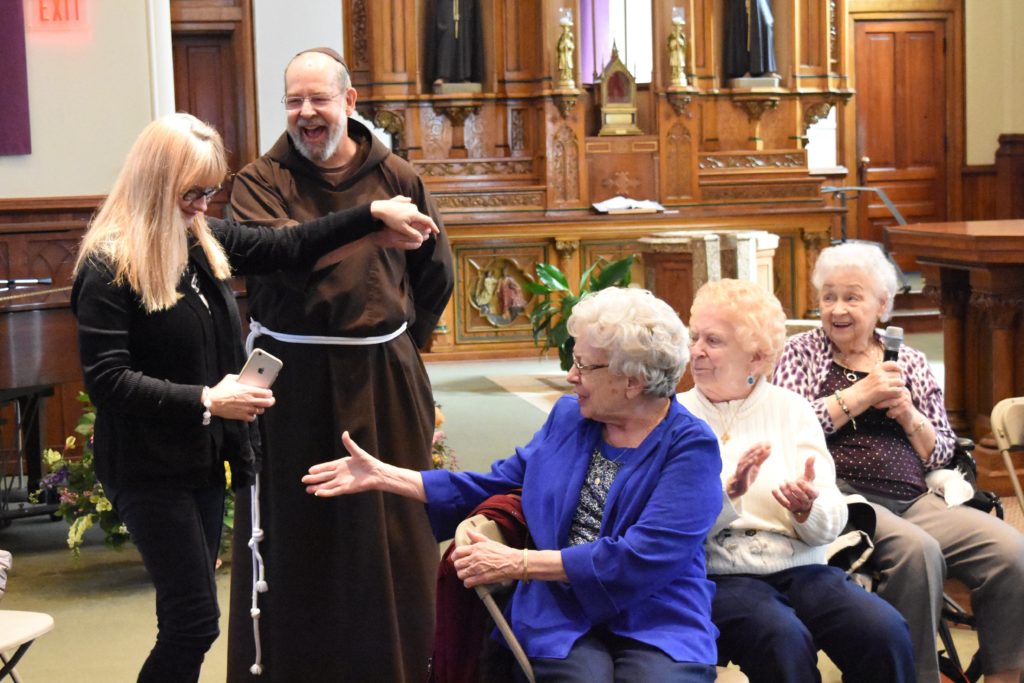 Fr. David Preuss, OFM Cap., director of the Solanus Casey Center, laughs with devotees of Fr. Solanus during an event earlier this year at St. Bonaventure Monastery. (Dan Meloy | The Michigan Catholic)
And no matter the situation — whether a healing was imminent or not — he would tell them the same thing: “Thank God ahead of time.”
Now that Fr. Solanus is set to be beatified Nov. 18 at Detroit’s Ford Field, home to the NFL’s Detroit Lions, the entire city is heeding his advice.
“I think excitement is at a fever pitch. Everybody is so enthused about it. I get people asking me about the occasion all the time,” said Detroit Archbishop Allen H. Vigneron in an interview with The Michigan Catholic. “The quick way the tickets were all assigned is a strong sense of the enthusiasm of the whole community.”
Indeed, it took just hours for the 66,000-seat Ford Field to “sell out” for the historic Mass — though the tickets were free — with eager Detroiters snapping up the chance to be in attendance to thank God for the gift of the friar’s extraordinary life and intercession.
“People feel a strong connection to Father. It’s like having someone in your family beatified,” Archbishop Vigneron said. “Of course, in our region that’s very understandable. But really I think it’s across the whole country and other parts of the world, too. I think Father’s humility and his accessibility help people feel that they belong to him and he belongs to them.”
 A stained-glass window shows the image of Fr. Solanus Casey and St. Teresa of Calcutta at St. Jude Parish in Detroit. (Mike Stechschulte | The Michigan Catholic)
Born and raised in Wisconsin, Fr. Solanus joined the Capuchin order in 1897. Rejected by the diocesan seminary due to low grades, he nevertheless continued his studies toward the priesthood, and in 1904 was ordained a “simplex” priest in Milwaukee — a designation that meant he couldn’t hear confessions or preach doctrinal sermons.
While some priests might have been discouraged by a lack of faculties, which left him to do menial tasks such as answering the monastery door and recording Mass intentions, Fr. Solanus happily accepted God’s will for him.
“Father was able to be such a powerful vehicle for God’s marvelous healing and works because he was so transparent. There was so little of Fr. Solanus personally to get in the way,” Archbishop Vigneron said. “That’s really the secret behind his humbly accepting never being able to preach, never being able to hear confessions. He simply accepted who he was and said ‘I’m happy to do whatever God wants of me.’”
As the monastery doorkeeper — first in churches and friaries around New York City and later in Detroit — Fr. Solanus quickly gained a reputation as a compassionate listener and intercessor during the Great Depression, and soon, dozens would arrive daily at the doors seeking “just a moment with Father.”
“Fr. Solanus responded very generously in some tough economic times, times that were very difficult for ordinary working people,” Archbishop Vigneron said. “He brought to them a sense of God’s presence besides the practical charity he extended.”
Soon, however, reports of miraculous favors attributed to the holy friar’s prayers began to spread throughout the region. A critically ill child would recover. A desperately needed rent check would arrive. A son serving in the war would miraculously escape danger.
To all who sought his help, Fr. Solanus’ trademark assurance was as simple as it was constant: He’d ask them first to pray, have faith and enroll their names in the Capuchins’ Mass intentions, and then, if he discerned God would favorably answer a prayer, would reply simply, “Don’t worry, everything will be fine.”
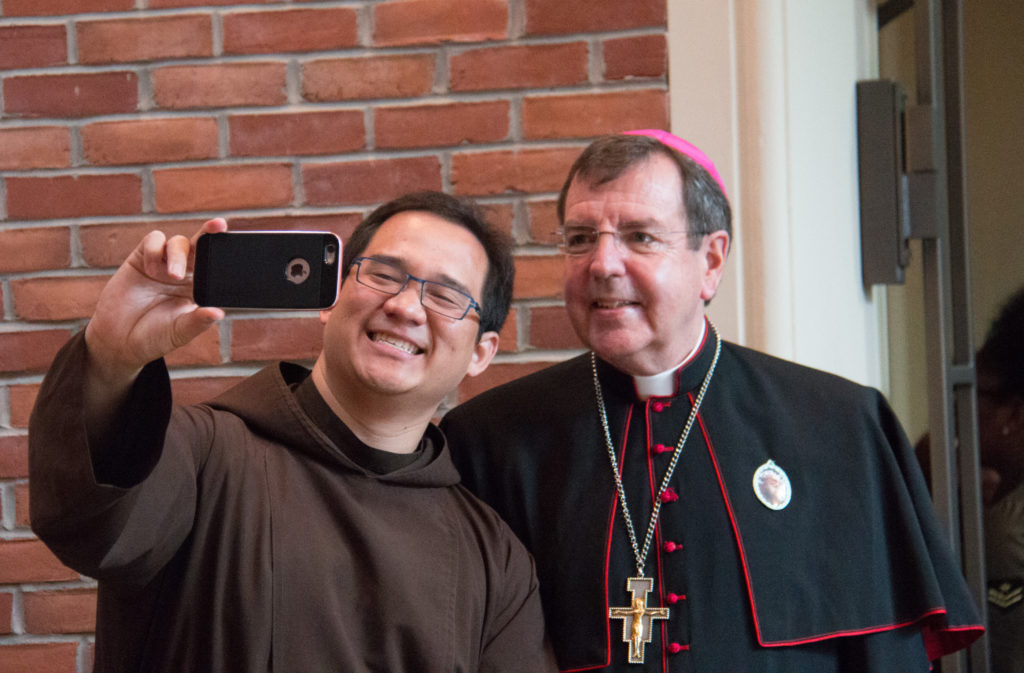 Capuchin Fr. Tom Nguyen poses for a "selfie" with Archbishop Allen H. Vigneron at the Solanus Casey Center.
 “The stories are always that Fr. Solanus would say, for example, ‘Go home, and at 4 o’clock the baby will be fine.’ Other times, he’d say, ‘Well, you know, God doesn’t always work a miracle, and you need to be prepared for what might occur,’” Archbishop Vigneron said.
Even if the friar discerned God wouldn’t grant a favor in the way a petitioner desired, Archbishop Vigneron said, Fr. Solanus’ disposition was always one of gratitude.
“Fr. Solanus would say what he always did, which was to ‘thank God ahead of time,’” the archbishop said. “In His wisdom, He knows when something extraordinary, something supernatural, will bring us closer to Him, and He knows the times when that’s not what’s going to be for our benefit.”
To understand why God gives miracles in some cases and not others, “you have to begin with the conviction that God loves us and would never do anything other than to dispose His providence for our wellbeing,” Archbishop Vigneron continued. “When people present a petition for Father’s intercession (today), I think he would assure them that God has heard their prayer and He’s already begun to answer it.”
The late Cardinal John Dearden opened the official cause for canonization for Fr. Solanus in 1976, a movement that’s been championed by each Detroit bishop since.
Archbishop Vigneron, who inherited the cause from his predecessor, Cardinal Adam J. Maida, said it doesn’t surprise him to see those efforts coming to fruition.
“I’ve always had confidence that Father would be beatified, and eventually that he’ll be canonized,” Archbishop Vigneron said. “I have no doubt about that.”
 Venerable Fr. Solanus Casey, OFM Cap., counsels a couple at St. Bonaventure Monastery in 1943.
However, the possibility “became very real” when the Capuchins told the archbishop about the miraculous healing of a Panamanian woman that took place in 2012. Suffering from a severe skin disease — an affliction from which Fr. Solanus himself died — she visited the friar’s tomb and prayed for healing. Almost instantaneously, her disease vanished.
“Once I heard about that, I thought, ‘There’s a very good chance that I’ll be the bishop to oversee this beatification,’” Archbishop Vigneron said.
Indeed, on May 4, Pope Francis announced the healing was an authentic miracle, paving the way for the recognition of something Detroiters have long known. Though the woman has wished to remain anonymous, she will be present for the beatification Mass on Nov. 18, along with others who have received favors.
Archbishop Vigneron said he takes the fact that Fr. Solanus was able to heal so many as a sign that “God loves Detroit” and hasn’t abandoned the city, despite its hard times.
“Not all holy people are wonder workers. That’s a special gift that God gives as He judges it appropriate,” Archbishop Vigneron said. “What I interpret this to mean, this fact that God gave Fr. Solanus this gift, is that he was humble enough to use it without it becoming a source of pride.
“Why does God do it? Whatever He does, whether He gives a miracle or not, it’s always about love.”