


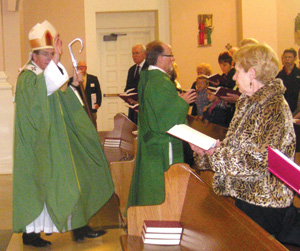
 Archbishop Allen H. Vigneron blesses the congregation as he leaves the sanctuary at the close of St. Mary’s 225th anniversary Mass.
St. Mary of the Immaculate Conception, Monroe
Monroe — When Monroe’s St. Mary of the Immaculate Conception Parish was founded in 1788 as St. Antoine on the River Raisin, George Washington wasn’t yet president, Wolfgang Amadeus Mozart was still composing music and Monroe was a wilderness fur-trading town inhabited by French Canadians and Native Americans.
Detroit Archbishop Allen H. Vigneron recognized that history and the entire history of the parish during the homily of the 225th anniversary Mass Oct. 27 at St. Mary.
“It’s very important for all of us in the archdiocese to remember St. Mary’s anniversary,” the archbishop said. “This parish for over two centuries has been a gateway or a stairway to God.
“I invite all of you to thank God that this parish for 225 years — from shortly after the Revolution, through the War of 1812, the Civil War, World Wars I and II and everything in between and since — has been a school of humility.”
Former St. Mary pastors Fr. Tim Babcock and Fr. Marc Gawronski joined the archbishop and current pastor Fr. David Burgard in celebrating the milestone anniversary.
“It’s been a foundation, a stronghold and a visible witness of the Catholic faith in Monroe,” said Fr. Burgard, a Monroe County native, of St. Mary’s impact on its community.
When asked how St. Mary has persevered for more than two centuries when other parishes have come and gone, Fr. Burgard replied, “It shows the strength of the faith in this particular area and how the Catholic identity has become part of the culture here and at the other parishes that continue to function to add to the work of the Church that started here. It’s just a joy to be part of that.”
Before the parish was established, the early settlers had to travel to Ste. Anne in Detroit, the only older parish in the archdiocese, if they wanted to attend Mass. Those attending Midnight Mass in Detroit traveled by horse-drawn sleighs on a frozen Lake Erie and Detroit River.
Fr. Pierre Frechette organized the parish on Oct. 15, 1788, and a planning document was signed by 46 prospective parishioners. A permanent clapboard cabin/chapel for visiting priests was built in 1795 on farmland two and a half miles from the parish’s current location. The parish moved to another nearby location before it landed at its current site.
A church was built in 1834, the year after Detroit became a diocese. That structure remains the nave of the current St. Mary Church. In 1903, a new sanctuary was added to the 1834 church. It was renovated after the Second Vatican Council and again in 1987 to its present-day configuration.
—Tim Keenan
St. Andrew, Rochester
Rochester — Archbishop Vigneron challenged the parishioners of St. Andrew Parish in Rochester, celebrating their 100th anniversary Oct. 26, to actively thank God for all of His graces imparted over a century of parish life.
“Your job tonight is not just to commemorate events,” Archbishop Vigneron said. “Each of you is here to fulfill a particular duty, to praise and thank God, carry in your hearts some awareness of the grace that God has poured out through this parish for the last 100 years.”
The liturgy, which included the participation of a Knights of Columbus 4th Degree Honor Guard and past parish pastors including Fr. Tim Babcock and Fr. Eugene Strain, was the high-water mark of a weekend of liturgies and receptions, history and homecomings.
Now one of the biggest parishes in the Archdiocese of Detroit with 4,744 families, St. Andrew started in a private home on Oct. 30, 1912, with a borrowed priest (Fr. Dennis Nedham of St. Mary in Royal Oak), 19 people who worked at the local Western Knitting Mill and no name. Two years later, another house was retrofitted as a permanent chapel under the patronage of St. Andrew the Apostle. Its first pastor, Fr. Charles Linskey, wasn’t appointed until 1917.
Other Masses were said in the area as early as 1909, but the parish generally recognizes 1912 as its inaugural year. The anniversary is being celebrated a year late due to the quick departure of former pastor Msgr. Jeffrey Monforton, who was appointed bishop of Steubenville, Ohio, last year.
Current pastor Msgr. Mike Hrydziuszko said he was blessed to be appointed when he was. “Coming in at the time of the centennial has let me listen to some wonderful stories about how the parish got to this point of its faith journey. It’s been a great opportunity to learn more about the wonderful people of St. Andrew Parish.”
St. Andrew’s first purpose-built church was started in 1923 and completed in 1928 at the downtown site of Walnut and Third streets. A school was opened in the early 1950s staffed by Adrian Dominican sisters. The present day rectory and offices were built in 1968 when construction on the current church began. It was completed in time for the Christmas Eve Midnight Mass of 1969. A daily Mass chapel was added to the church structure in 1988.
—Tim Keenan
St. Aidan, Livonia
Livonia — St. Aidan Parish in Livonia capped its 50th anniversary celebration with a special Mass Oct. 20.
When asked to describe St. Aidan’s relationship to its surrounding community over the past 50 years, Fr. Kevin Thomas, its pastor, said members of the parish seek to teach.
“We have an educational component that’s really big in our parish, and we offer a lot of different opportunities for people to learn about the church,” Fr. Thomas said, mentioning the parish’s New Evangelization study program, the latest of many programs the members of St. Aidan have started to connect people with the faith.
The parish’s connection with its community doesn’t end with education, however, as the church also helps to provide critical services to those in need.
“We do outreach to the community as far as helping the poor, and having a chaplain for the police department here,” Fr. Thomas added.
The church draws its name from St. Aidan of Ireland, known for his kindness to animals, and has more than 1,600 families, which Fr. Thomas jokes “keeps me busy.” As the parish moves past its half-century mark, Fr. Thomas reflected on the church’s identity, describing it as a “very healthy, thriving, and forward-looking parish.”
“When I first came here, I very quickly realized that the conditions that we had set up in the parish, to be a parish were very mature and exactly what was needed,” he said.
Archbishop Vigneron was principal celebrant for the anniversary Mass. The Mass marked the end of a yearlong celebration, including a dinner dance and another smaller reception for the parish.
—Nick Pizana
St. Augustine &
St. Monica, Detroit
Detroit —St. Augustine and St. Monica Parish on Detroit’s east side also celebrated a milestone anniversary with a special Mass Oct. 20, ending its 100th year since its predecessor parish was established in 1912.
St. Augustine and St. Monica was founded as a new parish in 1989 as a combination between St. Catherine/St. Edward and St. Bernard parishes, but its roots go back much further than that. Its history goes back all the way to 1912, when St. Catherine of Siena Parish was founded. Also once home to a high school whose last graduating class was in 1967, St. Catherine was combined with St. Edward Parish and School in 1973 before becoming the current parish 16 years later.
With about 300 current families, St. Augustine and St. Monica boasts a men’s club, Bible study, faith sharing meetings, a door-to-door evangelization team, travel club, various Christian service outreaches and help for pregnant women through the Image of God pregnancy center. The parish also offers opportunities for liturgical involvement such as a vibrant choir and altar society.
Msgr. Daniel Trapp has been pastor of St. Augustine and St. Monica since 1996.
—Mike Stechschulte



