
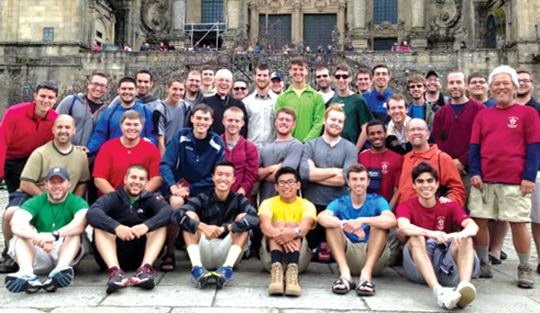
Detroit — Walking 72 miles across rural northern Spain, a foreign land across the ocean, with nothing but the sack on your back and your fellow travelers takes courage, and so does becoming a priest.
Thirty-three young men from the Archdiocese of Detroit did the former from June 10-19, and Fr. Tim Birney hopes at least a few of them will do the latter as well.
The nine-day walking pilgrimage along the Camino de Santiago, the famed “Way of St. James,” was the culmination of a year’s worth of effort and planning by Fr. Birney, director of priestly vocations for the archdiocese, a chance to get away and let the “quiet whisper of God’s voice” speak to the nearly three dozen young discerners.
“Everyone who attended had to be a single Catholic, not in a relationship, and discerning the priesthood at some level,” said Fr. Birney, speaking afterward to The Michigan Catholic. In addition to 28 discerners between the ages of 18 to 25, five current seminarians from Sacred Heart Major Seminary also attended.
And for some pilgrims, the discernment process came and went years ago, as joining Fr. Birney and the 33 young men along the trail were Fr. Steve Rooney, pastor of Our Lady of Mt. Carmel Parish, Temperance; Fr. Sal Palazzolo, associate pastor of St. Lawrence Parish, Utica; and Auxiliary Bishop Donald Hanchon.
‘Nothing better to do
than talk’
Jeff Oldani, 18, of St. Mary Queen of Creation Parish, New Baltimore, called the Camino “the best experience of my whole entire life.”
Oldani said a friend, Alex Gadeke, alerted him to the opportunity, and both decided to take the chance.
“It was kind of a ‘Well, if you go, I’ll go,’ kind of thing,” Oldani said. “I’ve never left the country or been in an airplane or anything. Being with 37 guys who were there for the same reason and thinking about discerning and having no distractions with TV or cellphones or anything and just going to Mass every day and celebrating the Eucharist, it was just a great experience and it brought us all closer to God I think.”
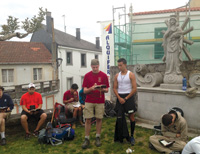
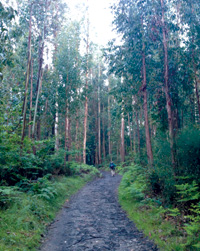
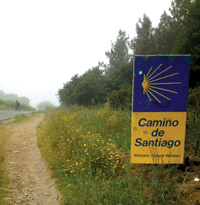
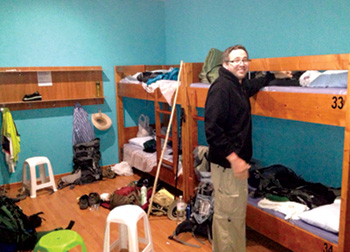
Departing from Sarria, Spain, each day the pilgrims began their walk — approximately 14 miles per day — with morning prayer and ended with evening prayer and Mass, staying in trailside hostels each night and passing by ancient stone churches, granaries, hórreos and wayside crosses and cruceiros, along with countless historically significant towns along the way.
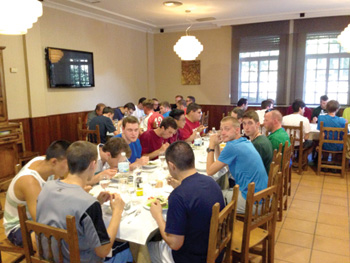
Absent from the trail was any sense of the creature comforts of home, save for the faith the travelers all shared.
“On the trail, you’re just walking all day, so there’s nothing better to do that to talk,” said Derik Peterman, 22, who will be entering seminary this fall from St. Theodore of Canterbury Parish, Westland. “And that’s whether you’re alone, just talking with God, or very often I’d talk with some of the other men I went on the pilgrimage with. The conversations were mostly very spiritual, and I learned a lot about the men I was with.”
Carrying nearly 18 pounds on their backs, none of the pilgrims expected the experience to be as physically taxing as it was, but the exhaustion was part of the their shared experience and unity, he said.
“There’s definitely something to working with a group of guys toward a goal, or just being in pain with other people — because the walk wasn’t always easy. But having those other people to lean on definitely made for some good friendships,” said Peterman, who said the experience gave him confirmation “that I am called to the priesthood.”
Following the apostle
Evan Karlson, 19, of St. Joseph Parish, South Lyon, called the pilgrimage “life-changing,” saying it “definitely confirmed” his calling toward the priesthood.
“I know it sounds simple, but being able to walk toward a goal — in this case a holy goal, going to see the remains of St. James the apostle — I think it set a good medium for us to experience what God has to say for us,” Karlson said.
He said having priests there to talk to and ask questions of was a tremendous blessing, especially having the opportunity to travel with a bishop.
“Having input from guys like that who have walked through this before and have done the most difficult part — which is the discerning itself” was invaluable, Karlson said.
Oldani said Bishop Hanchon’s homily while celebrating Mass at the Cathedral of St. James had a profound impact on him.
“He said all the hills that we walked represent the ups and downs of life, and that you’re always going to have trouble, but once you start praying, God will always be there and it will be a lot easier,” Oldani said. “It was just really good, because we had walked 72 miles, and he summed up what the Camino is, and it was touching to all of us.”
History holds that the Apostle St. James’ remains were carried by boat from Jerusalem to northern Spain, where he was buried on the site of what is now the cathedral that bears his name in the city of Santiago de Compostela. Along the way, the pilgrims could feel St. James guiding them, Oldani said.
“St. James, the shell is his symbol,” Oldani said. “So seeing the shell along the way, pointing us where to go, it gives you a trust feeling. Because you’re trusting the shells to lead you where to go.”
And reverencing the bones of the apostle upon the completion of the long journey was something none of the pilgrims will forget.
“I had never prayed to St. James, but when you kneel, you just have all this respect. You feel this relationship with him that I’ve never had before,” Oldani said.
Peterman agreed. “This is a man who walked, literally, with Christ, and ate with him and talked with him. And that was just amazing to be a part of that. It made me confident not only in my vocation, but also in my faith. That our faith is very real,” he said.
Fr. Birney said that feeling of closeness with the foundations of the Catholic faith was a primary reason for the pilgrimage.
“To spend a little time reflecting on that was very powerful and helped put everything in perspective for the men who were with me, when they were able to kneel down and pray in front of the relics of St. James. We did something and are now in the presence of someone who knew Christ himself,” Fr. Birney said.
Completing the journey
After walking to near exhaustion, the moment when the pilgrims first laid eyes on the cathedral at Santiago was a moment of relief and jubilation, but it didn’t last long.
“It was kinda cruel because we got to the town and we all assumed that the cathedral was right around the corner,” Fr. Birney said. “But we all commented on how it was at least another two miles before we finally arrived at the end point at the cathedral.”
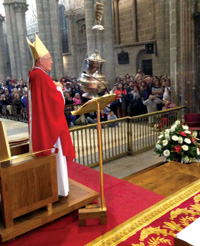
When they finally did arrive at the cathedral, “some guys were reduced to tears from the journey,” Fr. Birney said. “Other guys were all smiles. Some were saying, ‘I think I could do some more.’ So it was definitely a range of emotions, but what we all felt in common was a great sense of accomplishment and joy that we’d made it to the end.”
A memorable part of the cathedral was seeing the famed botafumeiro, the giant, 175-pound thurible used to dispense incense, swinging the length of the church. Created in 1851, the botafumeiro is the largest censer in the world.
“The behind-the-scenes story is that the pilgrims all smelled so bad that they needed something to help with the stench, so they developed this thing that could go the length of the cathedral and would help eliminate that,” Fr. Birney laughed. “I don’t know if that’s true.”
He said the journey was “everything I wanted” for the pilgrims. Although one of the men told Fr. Birney that the Camino had confirmed he was not, in fact, called to the priesthood, discernment was the intent.
“Obviously that wasn’t my desired outcome, but whenever you discern there’s a process of sorting out, and he was able to sort that out. So in that sense it was very much a success,” he said. “But other guys did talk with me and did express how this was exactly what they needed at this point in their life and it helped them to clear the air and they’re more certain of their vocation (to the priesthood).
“Mostly for the men, I hope this pilgrimage will help them realize who they really are: children of God. And that God has a plan for them. And that when they allow themselves to listen to the Lord, they will find what that is.”
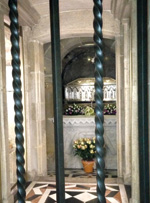
For Peterman, there isn’t a better way to do that than traveling a path that thousands of faith-filled pilgrims have trod before him.
“Although I think it may sound cliché a little bit, the Camino is all about walking. You get up early in the morning to start walking, sleep for the night and do it all over again. It’s this over-and-over process. It’s just a lot of walking, there’s no way to get around it,” he said. “And being in front of the remains of a person who walked with Christ, I think I’m going to take away from the pilgrimage that we, too, can walk with Christ. And I felt that along the way when I was talking with some of the guys and the priests who went with us — they’re so holy and they’ve been through so much — and I thought, walking with them, I’m walking with Christ in them.
“If I’m going to answer God’s calling in life, I need to continue to walk with him. I’m just going to try to remember that: Wherever I am, I need to walk with Jesus.”