Detroit’s first archbishop installed 75 years ago Aug. 3
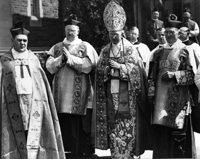
DETROIT — Seventy-five years ago, on Aug. 3, the newly created — and financially struggling — Archdiocese of Detroit was given its first archbishop, at the installation of Cardinal Edward Mooney.
He wasn’t a cardinal yet — that wouldn’t come until 1946 — but he was already an archbishop, having been ordained one when he was made apostolic delegate to India in 1926, the first American to ever be appointed an apostolic delegate.
The Diocese of Detroit had been made an archdiocese on May 31, 1937, the same day the Vatican announced that then-Archbishop Mooney would succeed the late Bishop Michael Gallagher as ordinary of the Detroit see.
Bishop Gallagher, who had become bishop of Detroit in 1918, had died Jan. 20, 1937, and Cardinal Mooney took the helm of an archdiocese with some big problems.
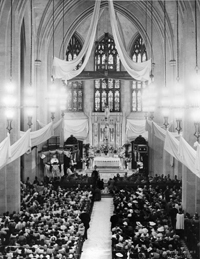
Bishop Gallagher had achieved a reputation in the 1920s for strengthening the diocesan organization and for building new churches and institutions to serve the growing Catholic population. Among his notable achievements were the founding of Sacred Heart Seminary and construction of its large building on Chicago Boulevard, as well as inducing several women’s religious orders to sponsor new Catholic hospitals within the diocese.
But in 1937, the diocese was in terrible financial shape amidst the economic crisis brought on by the Great Depression.
Besides a heavy debt, the diocese had never been able to follow through on plans to build a new cathedral to replace the inadequate and ill-situated SS. Peter & Paul Cathedral, on Adelaide Street and John R in the run-down neighborhood south of today’s Detroit Medical Center. The land purchased for it in the 1920s was still vacant.
Bishop Gallagher had also been a strong supporter of the controversial Fr. Charles Coughlin, pastor of Shrine of the Little Flower in Royal Oak, who had a nationwide radio audience.
Fr. Coughlin’s fiery radio addresses were widely criticized as anti-Semitic and increasingly seen as an embarrassment for the wider Church, said Fr. Timothy Pelc, pastor of St. Ambrose Parish, Grosse Pointe Park.
“The sense was that they needed to bring in a ‘heavy hitter’ to take on Coughlin,” said Fr. Pelc, a self-described avid student of archdiocesan history.
Cardinal Mooney had already handled diplomatic work for the Vatican in his post as apostolic delegate to India and later to Japan (1931-33), and had gained experience in diocesan administration as bishop of Rochester, N.Y., since 1933 (although he was an archbishop, Rochester’s status remained that of a diocese).
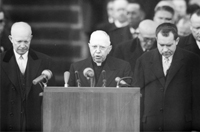
But even though the territory of the new Archdiocese of Detroit was to be smaller — a portion was taken to create the new Diocese of Lansing that same year — the Detroit see would now have the prestige of being an archdiocese and become the keystone of a new province of the Church that would include all the dioceses in Michigan.
Before that, they had all been under — “suffragan to,” in Church terminology — the Archdiocese of Cincinnati.
Although the 1917 Code of Canon Law had removed some of the prerogatives that archbishops once had over bishops, the designation “archbishop” or “archdiocese” still carried a certain prestige — though the differences were later to be almost completely removed by the 1983 Code, said Tim Ferguson, administrative director of the archdiocesan Metropolitan Tribunal.
Historically, Detroit Catholics were first under the Diocese of Quebec during the years of French and British rule, then under the Archdiocese of Baltimore from the handover of the area to the United States in 1796.
The local Church was included in the territory of the Diocese of Bardstown, Ky., when it was erected in 1808, and then of the Diocese of Cincinnati, established in 1821. The Diocese of Detroit was created in 1833.
As archbishop of Detroit, Cardinal Mooney was able to get Fr. Coughlin to withdraw from the national spotlight, and the archdiocese’s financial plight began to ease within a few years as war production for the Allies and later for the United States itself began to bring Detroit’s industry back to life.
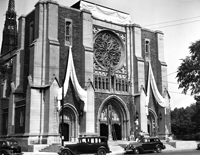
He shelved the idea of building a new cathedral, instead deciding to complete and modify Blessed Sacrament Church in Detroit’s north end to become the archdiocese’s cathedral, which it still is today. Interestingly, the prelate who came to inspect the church to approve it for that purpose was Archbishop Giovanni Montini, who would later become Pope Paul VI.
Archbishop Mooney was elevated to the College of Cardinals in 1946.
With post-war prosperity, Cardinal Mooney was able to build the churches needed to serve the growing Catholic families as they, more and more, settled in the new suburban communities being established outside the Detroit city limits.
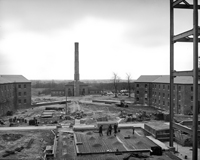
He also established and built St. John’s Provincial Seminary in Plymouth Township, a new major seminary to serve all Michigan dioceses.
Cardinal Mooney died Oct. 5, 1958 at age 76.