

Time-consuming process involves local bishops, nuncio, Vatican congregation and ‘strict confidentiality’
DETROIT — It’s one of the first questions bishops are often asked by young schoolchildren, and if we’re being honest, one many adults would be curious to know, too:
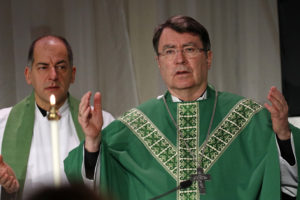 Archbishop Christophe Pierre, right, apostolic nuncio to the U.S., and Msgr. Giampietro Dal Toso, secretary of the Pontifical Council Cor Unum, pray during Mass Jan. 15 at the New York Encounter in New York City. (Gregory A. Shemitz | CNS photo)
“So, how did you become a bishop?”
While not quite as daunting as other questions that might come from an inquiring young mind, the answer is — well, rather complicated.
While most Catholics know that the ultimate decision when it comes to new bishops rests with the pope, common sense dictates that the bishop of Rome can’t possibly interview — let alone know personally — every bishop he appoints throughout the world.
So how does he know?
The answer, of course, is that he has a lot of help.
The primary player and liaison between prospective new bishops and the Holy Father is the apostolic nuncio, or ambassador, to the bishop’s home country. In the case of the United States, that’s Archbishop Christophe Pierre.
The role of the apostolic nuncio is to offer recommendations to the Vatican’s Congregation for Bishops, which in turn reviews the documentation and offers its own recommendation on episcopal candidates to the pope.
But even the apostolic nuncio, whose responsibility stretches throughout the entire United States, can’t possibly know everyone. So where do the initial names come from?
According to the U.S. Conference of Catholic Bishops’ website, “The process for selecting candidates for the episcopacy normally begins at the diocesan level and works its way through a series of consultations until it reaches Rome.”
The first step, according to the USCCB, is for the diocesan bishop to submit the names of priests he thinks would make good bishops to the metropolitan — usually an archbishop — of his province. The archbishop, in turn, circulates the names and backgrounds of the candidates submitted to him — along with his own recommendations — to the rest of the bishops of his province, who meet at least once a year to discuss them. Bishops then vote on the recommended names, and the tallies, along with minutes of the meeting, are forward to the apostolic nuncio.
In the case of the Archdiocese of Detroit — which is the metropolitan see of the Province of Michigan — Archbishop Allen H. Vigneron is the metropolitan and presides over the meeting.
Bound by “strict confidentiality,” the entire process often can take eight months or more, depending on whether the candidate is a bishop being transferred to another diocese or the first appointment of a priest as a bishop.
After the nuncio reviews the recommendations, which are also forwarded to the national bishops’ conference, he gathers his own facts about potential candidates and interprets the information for the Congregation for Bishops.
In the case of an auxiliary bishop, the diocesan bishop must justify his need for an assistant to the apostolic nuncio, which “is easier if he is requesting a replacement for a retired or deceased auxiliary,” the USCCB states. He then prepares what is known as a terna, or list of three candidates, for his requested auxiliary bishop and forwards it to the nuncio, who in turn sends it to the prefect of the Vatican congregation along with his own report and recommendations.
The nuncio’s role as a “gatekeeper” in the process is given “great weight,” the USCCB states, although that does not mean his recommendations are always followed.
Once the Congregation for Bishops reviews the material — a process that, for a new bishop, usually involves the full congregation — it discusses the potential candidates and then votes. The congregation may follow the nuncio’s recommendation, choose another of the names on the terna or even request that a new terna be prepared.
The prefect for the congregation then presents the recommendations to the Holy Father, who reviews it and informs the Congregation for Bishops of his decision. The congregation then notifies the nuncio, who calls the candidate to ask whether they will accept. Upon receiving a positive answer, the nuncio notifies the Vatican, and a date for the announcement is set.
Try explaining that to a fifth-grader.
Related stories
For more stories about the ordination and background of the Archdiocese of Detroit's new auxiliary bishops, Bishop Robert Fisher and Bishop Gerard Battersby, check out The Michigan Catholic's special section.