

Cardinal Pizzaballa recounts the plight of Christians in Gaza, but says the community 'refuses to hate' despite conflict and war
PLYMOUTH — During a news conference Dec. 5 at St. John's Resort in Plymouth, Cardinal Pierbattista Pizzaballa, OFM, spoke about the dire needs of the Church and community in the Holy Land, particularly in Gaza, where just 541 Christians remain.
Since the October ceasefire in the Israel-Gaza war, people in Palestine are living in abject ruin, Cardinal Pizzaballa said.
"The only difference is that we don't have bombs every day, but the vast majority of the infrastructure is destroyed," Cardinal Pizzaballa said. "Houses are destroyed. No water, no electricity, no schools, no hospitals. People are living in tents without anything."
Cardinal Pizzaballa, the Latin Patriarch of Jerusalem, was the featured guest Dec. 5 during a fundraising dinner hosted by the Archdiocese of Detroit and attended by approximately 500 area Catholics at St. John's Resort in Plymouth to support the pastoral care, education and relief of struggling families in the Holy Land.
The event came on the second day of Cardinal Pizzaballa's four-day pastoral visit to southeast Michigan at the invitation of Detroit Archbishop Edward J. Weisenburger, who, along with Bishop Francis Y. Kalabat of the Chaldean Eparchy of St. Thomas the Apostle, joined the cardinal at the event.
Cardinal Pizzaballa’s visit will conclude Sunday, Dec. 7, with a Mass at the National Shrine of the Little Flower Basilica in Royal Oak.
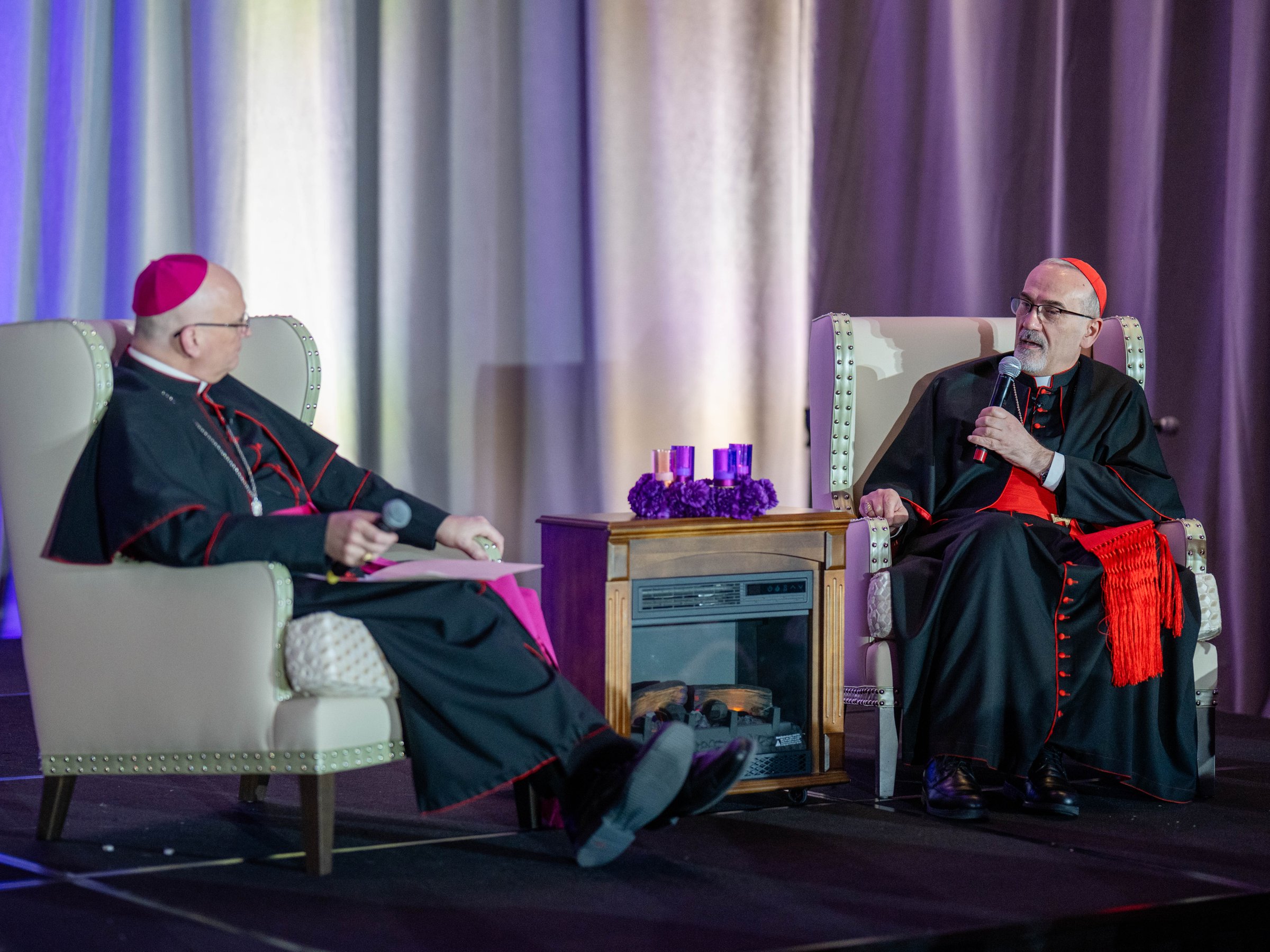
The fundraising dinner at St. John's Resort, "United in Faith: Bridging Hearts from the Motor City to the Holy Land," included a fireside chat between Archbishop Weisenburger and Cardinal Pizzaballa, who discussed a wide range of topics, including the cardinal's personal faith, his work to support persecuted communities in Gaza and the Middle East, and the dire humanitarian crisis facing the region.
Along with a Dec. 4 fundraiser hosted by the Chaldean Eparchy of St. Thomas the Apostle, Catholics in southeast Michigan raised more than $615,000 to aid the work, ministry and humanitarian efforts led by Cardinal Pizzaballa, Archbishop Weisenburger announced, with additional donations coming in.
The total is in addition to $533,000 raised by Catholics in Metro Detroit during a special collection for Gaza relief efforts in August, which supported the work spearheaded by Catholic Relief Services and the Catholic Near East Welfare Association in the region.
"We look to Jesus Christ as the foundation of our faith and our Church, and that's what tonight is about," Archbishop Weisenburger said. "We are helping to preserve the foundational mission of Jesus Christ in the land where he was born, lived, died and resurrected."
Preceding the event, Cardinal Pizzaballa, Archbishop Weisenburger and Bishop Kalabat addressed members of the local media during a news conference at St. John's Resort.
Even after the October ceasefire in the Israel-Gaza war, Cardinal Pizzaballa said, families in Gaza continue to face severe hardships, including the lack of adequate shelter, unreliable access to food, shortages of medicine and supplies, and a landscape in which 80 percent of homes have been destroyed and children cannot go to school.


"Living standards have not changed much" since the ceasefire, Cardinal Pizzaballa said. “During the war, the people were in survival mode — they didn’t know if tomorrow they’d be alive or not — but now with the ceasefire, they enter a new phase.”
Every single person in Gaza has been displaced because of the war, Cardinal Pizzaballa said, and there is no sense of how long rebuilding might take — or even when, or how, it will begin.
Children have not attended school in three years, the cardinal said, and more than 1 million people are living in tents on bare sand, susceptible to floods, cold and harsh elements.
"When there is rain, it's a disaster for them," Cardinal Pizzaballa said. "Medical assistance is almost impossible. Very few hospitals are working. It's not only the wounded because of the war, but also normal diseases everyone has. People need chemotherapy, dialysis, but all this is impossible."
Cardinal Pizzaballa said when he visited Gaza in July, "we were able to bring some food, some chicken and normal things, and it was the first time they saw meat after nine months."
Although trucks are beginning to enter Gaza to bring supplies, most of the food being imported ends up in marketplaces, he said.
"That means you have to purchase the food, but if you don't have any money, how do you do it?" the cardinal said. "Even if you have money in the bank, the banks are destroyed. You cannot access money; it is not a physical possibility."
While bombs have stopped falling, many are now struggling with intense emotional and spiritual trauma that requires pastoral care, he said.
"All these questions that couldn't find emotional space during the war are now coming out, and this has created a lot of frustration," Cardinal Pizzaballa said.


However, amidst these challenges, Cardinal Pizzaballa said the people of Gaza have not lost hope. But that hope must be accompanied by faith and action, he said.
“Hope is a word that cannot remain alone. It has to put its roots in something else,” Cardinal Pizzaballa said of the future in the war-torn Holy Land. “It can be faith; it can be desire. If you have faith, you want to give that faith expression. If you have desire, you want your desire to be realized. So hope cannot remain alone.”
Although the political and social institutions have failed to provide safety or relief, the spirit and will of the Gazan people — and the support and prayers of the international community — are sources of hope, he said.
“If the institutions have failed, at the grassroots level, we have to have people who are able to think differently and act differently — movement, organizations, the civil society, Israelis and Palestinians, Muslims, Christians and Jews,” Cardinal Pizzaballa added. “We have to try to defend as much as we can the rights of the poor.”
While grassroots advocacy and action won't solve the main problems, “at least it says to the people that not all is lost,” Cardinal Pizzaballa said.
Cardinal Pizzaballa's visit to Metro Detroit came at the invitation of Archbishop Weisenburger, who himself visited Gaza's lone Catholic parish in 2014 as part of a delegation of U.S. bishops and has written and spoken often about the plight of Gazans since his installation as Detroit's archbishop in March this year.


"I'm delighted to welcome His Beatitude, Cardinal Pierbattista Pizzaballa to the Motor City for a few days," Archbishop Weisenburger said. "The cardinal joins us at a moment when the people of his region continue to endure profound suffering. His visit is an opportunity for us to hear directly from a pastor who shepherds communities caught in the midst of conflict, to join our prayers with theirs, and to stand in solidarity for a just and lasting peace."
Archbishop Weisenburger thanked Cardinal Pizzaballa for his visit, "especially being aware of the intense demands that you shoulder in the Holy Land every day."
Recalling his own visit to Gaza a decade ago, Archbishop Weisenburger said Christian charity and justice calls for the Church to remember and stand for the voiceless.
"The poverty, the unsanitary conditions, the lack of basic services, is beyond comprehension," Archbishop Weisenburger said. "It was painful to see then, but I cannot begin to imagine how it looks now. And yet the lone Catholic Church, their Holy Family Parish, where Pope Francis called every night, stands as a tiny island of faith, hope and hospitality in a land that is suffering."
Since the war began, the already tiny Catholic population in Gaza has dropped by almost half — with many fleeing and many others having died — but the 541 Catholics who remain are a beacon of hope at Holy Family, the last church standing in Gaza, Cardinal Pizzaballa shared.
“They are all living in the church compound. They are all still there. Their houses are destroyed, they have nothing, but they are living in the church like a monastery," he said.


Amidst the bombings, food shortages and cutoff from modern amenities, the sacramental life for the people continues. Three priests and five nuns from two communities — the Missionaries of Charity and the Family of the Incarnate Word — live among the Catholic remnant in Gaza, serving in any way they can, the cardinal said.
"They are very devoted. They keep the children busy, the people busy. They have everyday rules, Mass, morning prayer, midday prayer, rosary, adoration, vespers," Cardinal Pizzaballa said. "It's more than to keep busy — it's also to remain united in this moment, so they keep the sacramental life very alive."
Over the past two years, the parish has seen three baptisms, three births and one marriage, Cardinal Pizzaballa said. “And the honeymoon was on the premises — on the other side of the church compound," he said. "There was a small house, almost abandoned, so they lived there for a few days. So, life continues.”
Cardinal Pizzaballa said the sacramental life of the community has created a spirit of togetherness that not only sustains life in the compound, but also preserves their souls.
“Every time I speak with them, I never hear a word of anger, never,” Cardinal Pizzaballa said. “And one person — I can’t even say their name, he was the director of the hospital — one evening, in Gaza, between the bombs that were falling not far from the compound, he just said, 'You know, Bishop, we Christians have a problem.' And I said, 'What problem?' He said, 'Amidst all the violence, we are not able to hate them.'”


As the focus slowly turns to rebuilding — a task that remains monumentally difficult given still-high tensions in the region — Archbishop Weisenburger said the United States has a moral obligation to support those who have lost their homes, their livelihoods and their society.
Archbishop Weisenburger recounted his days of studying at the Catholic University of Louvain in Belgium, where the library was destroyed inadvertently by Allied bombing during World War II and was later rebuilt through American donations after the war.
"I know that [the war] is incredibly complex, and none of us can really simplify the sound bites, but I would say that too many of those bombs that killed some 70,000 people, wiped their homes from the face of the earth and destroyed their cities, their schools and their hospitals, were from us," Archbishop Weisenburger said. "So I think we, in America, must accept some responsibility for rebuilding and helping.
"I'm so grateful to His Eminence for his words, because I find, as the American people, one of the areas where we maintain hope best is by doing something," the archbishop added. "Even though we cannot fix this, for us to do nothing would be too tragic."
The press conference was followed by a dinner and fireside chat hosted by emcee Chuck Gaidica, a former Detroit TV personality, who took questions from the audience for Archbishop Weisenburger and Cardinal Pizzaballa about the conditions and life in the Holy Land, the daily needs of people living in Gaza, and what the faithful in the United States should know about the conflict.


Cardinal Pizzaballa and Archbishop Weisenburger exchanged stories and perspectives about what life is like for Christians and others in Gaza and the rest of Palestine.
Cardinal Pizzaballa — who was raised in Italy, where "everyone was Catholic, even before they were born," he joked — reflected upon his 37 years in the Holy Land, including the different perspectives and faiths he's witnessed. Cardinal Pizzaballa encouraged U.S. Catholics to see beyond the "simplified" lens of "left or right" political ideologies, saying the situation in the Holy Land is "much more complicated."
Although pilgrimages to the Holy Land and the West Bank — a critical source of economic stability — have dramatically slowed since the war, Cardinal Pizzaballa also encouraged Americans to return to the places where Jesus walked, lived and taught.
"A lot of people are still very afraid to come," the patriarch said. "But this is an occasion for me to say that the pilgrimages are safe."
Fr. Alex Kratz, OFM, the executive director of Terra Sancta Ministries in Pontiac, which organizes pilgrimages to the Holy Land, was in attendance and said it was reassuring to hear Cardinal Pizzaballa speak about the need for Christians to resume pilgrimages.
"To hear him ask us to come, that it's safe, was really big," Fr. Kratz told Detroit Catholic. "Obviously, not everybody can go on pilgrimage. But we can network with other like-minded people, even those who lack faith but want to build a peaceful and just future for the Holy Land. This is a key place for all three great monotheistic religions."


Fr. Kratz said Cardinal Pizzaballa's visit to Detroit is especially appropriate, considering the Motor City's religious and ethnic diversity and large Middle Eastern community.
"It's exciting that this connection has been made," Fr. Kratz said. "It's been a long time coming, and I think many never thought it would come. But to have the leading representative for the Latin-rite Catholic Church in the Holy Land, and a cardinal, to connect with our diocese is amazing."
Even though the conflict is half a world away, the Catholic faith makes the war all the more personal for believers, Fr. Kratz said.
"This is where God himself became incarnate, and the second person in the Trinity became Jesus through Mary's 'yes,'" Fr. Kratz said. "In a way, he rendered the whole land sacramental. And it's from there that all the daughter churches formed from the mother church in Jerusalem, which sprang up as the apostles went out through all the world.
"So we owe our mother support in her time of suffering, as we would our natural mothers," Fr. Kratz added. "It's important we know and do what we can."
Lend your support
To make a gift to support the work and ministry of the Church in the Holy Land and the Latin Patriarchate of Jerusalem, visit united-in-faith.aod.org.