

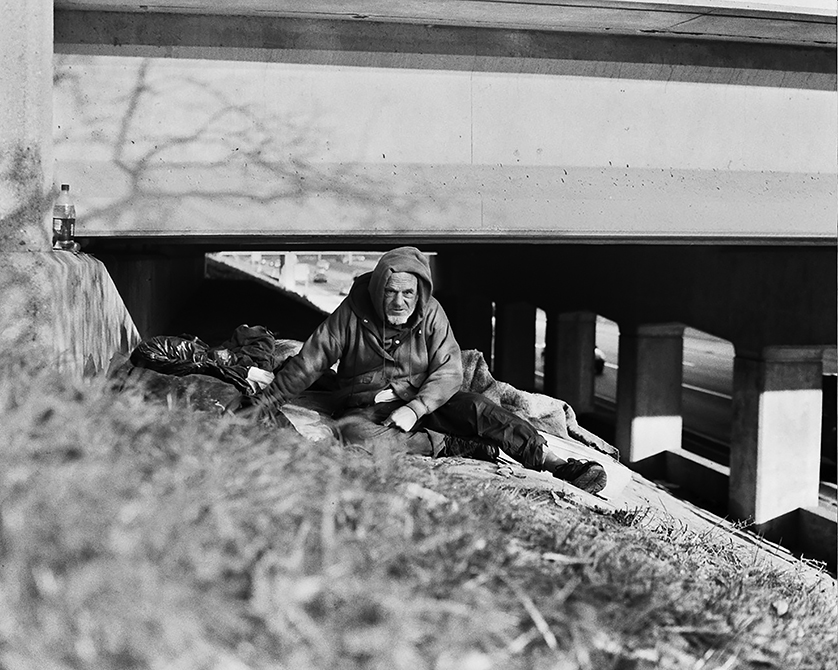
 A homeless man sits up from his mat under a freeway overpass in Detroit during the cold winter months. Advocates say Detroit has made progress in recent years by collaborating with local agencies to improve the situation for the city’s homeless, but much more can still be done for the 15,000 living on Detroit’s streets.
Advocates see progress in fighting homelessness in city, but more is needed
DETROIT — Detroit’s economic recovery is real.
Unemployment is decreasing, city services are expanding and there is a renewed sense of optimism in the Motor City.
These success stories — rightfully — have been well documented.
But for all the success, many are not feeling the effects of the recovery. Instead, there are people taking shelter on the stoop of SS. Peter and Paul Church, standing at the corner of Chrysler Freeway and Larned Street, looking for any change someone might spare and hoping someone might talk to them, showing they care.
Homelessness is Detroit is not new, but more and more people and organizations are noticing the problem. Tackling homelessness in the city forces people, churches and organizations to ask tough questions: How do people become homeless? Where did society fail them? What can be done about homelessness? And, is this a solvable problem?
But for people living on the street day to day without permanent housing, the question remains: do enough people care?
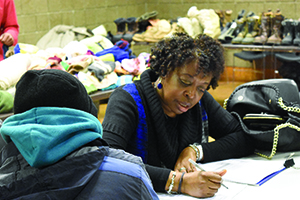 Carolyn Rayford of Alternatives for Girls completes a homeless survey form with a man at the Coleman A. Young Community Center.
How we got here
Addressing the root cause of homelessness is the key to solving it, advocates say.
The Homeless Action Network of Detroit (HAND) is the primary local organization for the U.S. Department of Housing and Urban Development (HUD) tasked with ending homelessness.
While every person’s situation is unique, HAND executive Tasha Gray said homelessness can be divided into two main categories: singles and families.
“We have singles who suffer from mental illness, addiction and substance abuse,” Gray said. “And families who experience a loss of job or a financial setback when they were already living paycheck to paycheck.”
Recognizing how people become homeless in the first place is an important step to keeping them off the streets as soon as they do find housing, Gray said.
HAND, and many other homeless advocacy groups in the Metro area, practices a national model called “housing first,” which looks to place people in permanent homes as soon as possible.
“When you don’t have a stable place to live, you don’t have an address for job applications, you don’t have a shower, you don’t have a place of focus on your health,” Gray said. “When you don’t have a home, you have nothing to build off of to getting your life back together.”
Gray and other leaders say mental illness and lack of support is a major contributor to homelessness, coupled with the lack of institutional support for those struggling with substance abuse.
Tra Hebrew III said he was a former Baltimore SWAT officer, but after moving to Detroit, fell into a cycle of drug abuse and failed recoveries. He now visits the Pope Francis Center at SS. Peter and Paul’s in downtown Detroit.
“For about a year I’ve been homeless,” Hebrew said. “It’s terrible; drugs just rip into your life. I want to get back on my feet; I want to get a house of my own. But I turned to drugs and people on the street turn to drugs to help alleviate the pain of homelessness.”
Mental illness in itself is not new, but according to Bro. Jerry Smith, OFM Cap., of the Capuchin Ministries, the lack of institutional support for those who need help is a recent development.
“I think it all started with the emptying of the institutions,” Bro. Smith said. “Without supportive services, there are a lot of people who are unable to manage money, not medicate themselves, and that’s how you have so many with mental illness living on the streets.
“These people worked, they had jobs — nobody started out homeless. But they need help, financially or mentally. But we emptied out the institutions — and now they have nowhere to go. It should be easier for people to get help than what is right now.”
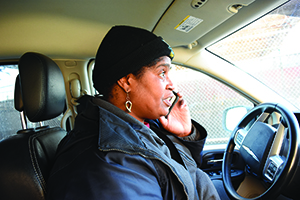 Stephanie Taylor, Covenant House outreach manager, answers a call from a young person who needs shelter and care at Covenant House in Detroit.
What’s being done
Plenty of organizations and charities in Detroit assist the homeless in everything from the basics such as food, clothing and hygiene products to more sustainable forms of aid, such as job and life skills training.
Gerald Piro is the executive director of Covenant House Michigan, which works to assist homeless youths ages 18-24 with emergency housing and a Rite of Passage program to help them obtain a high school diploma, a job and the pathway to self-sufficiency.
“Kids come here with an emergency, and we work with them,” Piro said. “If they have no diploma, we get them a diploma. If they have no job, we work with them to get them a job.”
Covenant House opened three academies in Detroit to allow youths to finish their education and learn the skills necessary for getting a job. The Rite of Passage program can house 75 people at a time on its campus, and to date, more than 3,000 have gone through Covenant House’s program.
For the chronic homeless, dealing with mental issues and long-term unemployment can be more challenging, but Gray said it has to be done on a case-by-case basis.
“We do something called strength-based case management,” Gray said. “That’s assigning each client with a case worker, looking at what strengths they might have in terms of job skills, opportunities of financial assistance and then using that to build a case around.”
The key issue for these organizations, however, is finding the people who need help.
“Some are not willing to seek help, and for these reasons we have outreach teams,” Gray said. “We go where people are gathering: underneath bridges and overpasses, parks, anywhere we know homeless people socialize.
“We build their trust, but it takes time, several engagements before we can start to integrate them into our services. A lot of these people are mistrustful of the system; it let them down in the first place, they were promised things that didn’t happen, so they are skeptical of anyone saying they can help.”
Aaron, nicknamed “Nameless” after he sold his I.D. card for $2, spends time at the Pope Francis Center because they serve hot meals and he can spend time inside SS. Peter and Paul Church.
“I’ve been in foster care since I was 6; when I turned 18, I told my co-worker I was taking a trip to Las Vegas, but when I returned the state cut my money off,” Aaron said. “I stayed at some friends’ houses, but eventually that was too much.
“Some people just don’t care about the homeless, about other people. If I’m looking for a job, I have a mental disability, so I get fired a lot. The Bible says you’re not supposed to work for money, you’re supposed to work for God, so I’d rather beg for change then work for someone who doesn’t care about me.”
The next steps
Overall, the situation is getting better. Every year, HAND puts together an annual report on homelessness in the Detroit Continuum of Care, which includes Detroit, Hamtramck and Highland Park.
Homeless agencies go out in teams and visit areas where the homeless congregate, counting the number of homeless in the area.
In 2014, 15,717 were counted, a 3 percent decrease from 2013 and a 17.8 decrease from 2012. Homeless singles make up the largest number with 11,178, with 3,300 classified as chronically homeless, being homeless four or more times in the past three years.
A majority of Detroit’s homeless, 52 percent, are between 25-54 years old, and 89 percent are African-American. Men comprise 62 percent of the city’s homeless.
Organizations such as HAND and Covenant House work with the homeless on a case-by-case basis, trying to solve the problem one step at a time. But financial realities limit how much of an impact they can make.
“Much of our funding comes from HUD — $26 million a year through federal programs,” Gray said. “Detroit also gets a direct allocation of $3 million.”
Grey said HAND is responsible for $26 million for all the organizations in the city that work with the homeless, and said the situation seems to be improving.
“The resources we’re receiving are getting better, especially because of the veterans groups and other sources of help. But for long-term, systematic change, we need a vision and political will. For a long time, the city of Detroit wasn’t at the table. Through the money was there, there was a sense of, ‘These are our clients,’ and nobody, the city, other organizations, worked together.”
On Jan. 27, Detroit City Councilwoman Mary Sheffield partnered with homeless advocacy agencies — including Covenant House — for the Point in Time count, which is when all the agencies try to count how many homeless are in the city.
To complete such an undertaking, the agencies host events with food and clothing giveaways, drive to areas where homeless people gather and visit shelters, asking people to complete a survey.
“Detroit has a lot of abandoned houses, and unfortunately, the homeless take shelter in them,” Piro said. “Therefore, it’s hard to help them, because they’re hiding. For youth homelessness it’s worse, because they sleep on friends’ couches, you see them on the street and you wouldn’t know they’re homeless.
“It’s about more than just a place to stay for one night. What we try to do at the Covenant House is give them the skills to prevent them from becoming chronically homeless, because once they get to that stage, it’s hard for them to get out.”
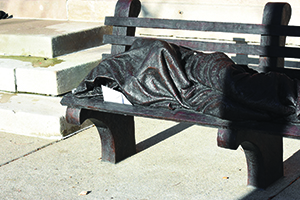 A handwritten note is left for “Jesus the Homeless” outside the Pope Francis Center in downtown Detroit.
Not about the money
Back at the Pope Francis Center, Aaron (Nameless), has a simple request for concerned individuals looking to help: care.
“I appreciate it when a person gives me a penny, because it shows me they care,” Aaron said. “If you give a person just a penny, when all you have to give is a penny, you show that you care. It’s not about the money; it’s never about the money, it’s about showing you care.”
Homelessness in Detroit can be solved, according to activists.
“I know individuals who’ve been put in homes and are doing well,” Bro. Smith said. “When you house a person, their mental health improves; they are in a much better place psychosocially.”
According to Bro. Smith and others, the biggest thing concerned citizens can do to help isn’t to give money on the street, but to become educated on what can be done to prevent homelessness and to support agencies working to eradicate its root causes.
“The homeless want what everyone else wants, meaning in life,” Bro. Smith said. “Our society look upon the homeless as a species, and they aren’t. They are people, they are you and me.
“This is a problem that can be solved, if we as a society had a real commitment to end it. Homelessness is a piece of the problem, the result of a lack of care for our fellow man. We can end it. It will take a lot of will, but we can do something. We are called to do something.”
How to help
To learn more about ways to help the homeless in Detroit: visit handetroit.org, covenanthousemi.org and cskdetroit.org.
 The Renaissance Center is seen through a blighted alley near downtown Detroit. The city’s homeless, who often can be found sleeping under bridges and overpasses, in parks or abandoned buildings, often need help dealing with issues such as substance abuse and mental disorders, advocates say, and coordinated efforts to help them could go a long way toward improving the plight of Detroit’s poor.