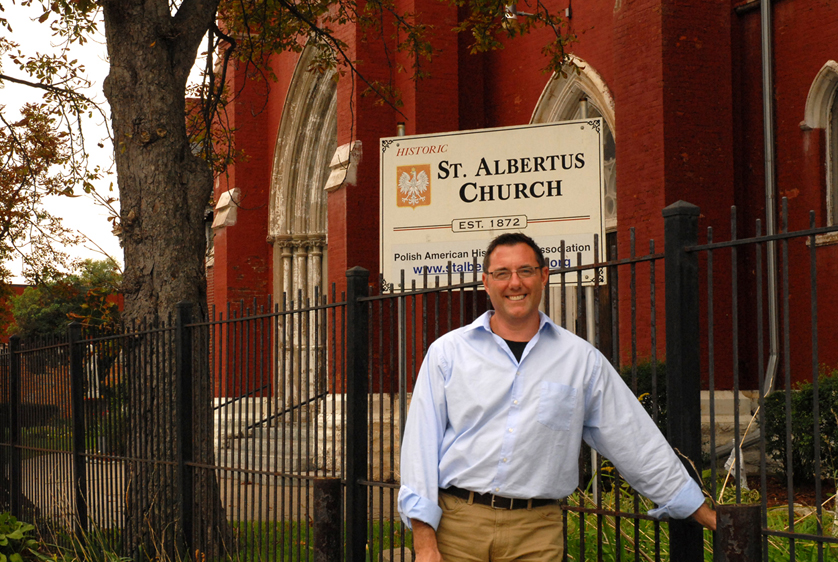
 Robert Mowry, author of “Years of Faith: The Ethnic Heritage and History of Ten Catholic Parishes of Detroit,” stands in front of St. Albertus Church, which recently saw a visit from the Detroit Mass Mob movement. St. Albertus is one of 10 historic parishes profiled in Mowry’s book.
Detroit — Robert Mowry became fascinated with classical architecture in college, so it made sense to write a book based on the classically designed churches of Detroit’s rich past.
“The style and that type of architecture has always fascinated me,” said Mowry, who recently published “Years of Faith: The Ethnic Heritage and History of Ten Catholic Parishes of Detroit.”
Mowry, who today lives in Livonia and attends St. Kenneth Parish in Plymouth, said he was intrigued by the Gothic architecture of Europe, as well as Renaissance Revival architecture while in college.
“I got particularly fascinated with the Gothic cathedrals built, and then the Romanesque period of architecture that followed,” he added. “When you look at the architecture of churches in Detroit, that architecture is based on the (European) churches.”
He was also greatly impressed by the origins of old Detroit’s Catholic churches, whose parishioners had usually been poor immigrants who nevertheless donated to the construction: “What little they made and lived on (to) have this magnificent church to worship in.”
“My grandparents emigrated from Italy in the early 1930s, and got married at San Francesco,” said Mowry of the Italian parish on Detroit’s east side, long ago demolished. “I was fascinated by the pictures of their church, and the history of Italians in Detroit.”
Mowry began researching his grandparents’ old church, and in the process began finding other old, often forgotten churches. He determined that these abandoned symbols of Detroit’s past needed to be brought to light once more.
Spending about a year and a half on research, visiting the church sites to photograph the remains — Mowry counts architectural photography as a personal hobby — and spending another year to actually write the book, “Years of Faith” was published this March.
Mowry explained that the Catholic immigrants in old Detroit were “heavily involved with their churches at that time. They brought their deep faith here, and their deep faith was reflected in their churches.”
The book focuses on 10 churches that played roles in Detroit’s historic past. Though Mowry agrees that there are “tons of churches in Detroit that would fit that same description,” he found the stories behind these 10 most interesting.
The churches featured include St. Agnes, St. Anthony, St. John Cantius, St. Stanislaus, St. Albertus, St. Rita, St. Theresa of Avila, St. Elizabeth, St. Thomas the Apostle and Immaculate Conception.
While most are now closed and some even demolished, Mowry said he tried to avoid emphasis on ruin, and placed more attention on the rich cultural background.
“I think it’s a lesson learned for today’s Catholics who look back and see what their ancestors thought was most important to them,” Mowry said. “I don’t think it’s as deep in the heart today for everybody.”
Additionally, “every one of those churches had a school attached to it for their children,” Mowry discovered. He said even with public schools being established in the city of Detroit, the Catholic people “wished for their children to be educated in the Catholic faith.”
“The church was the anchor of the community,” Mowry said. “I think that’s why there were so many of them, and so magnificent.”
Mowry said he hopes his book will inspire people to pay greater attention to the still-existing churches in the city. He encourages readers to “attend Mass at one of these older churches. It’s a different experience than attending a modern church.”
He described “a feeling of being connected with God when you look at the magnificence; you feel a deeper connection. If (someone is) feeling lost, maybe going to a church like that can help you reconnect with your faith.”