
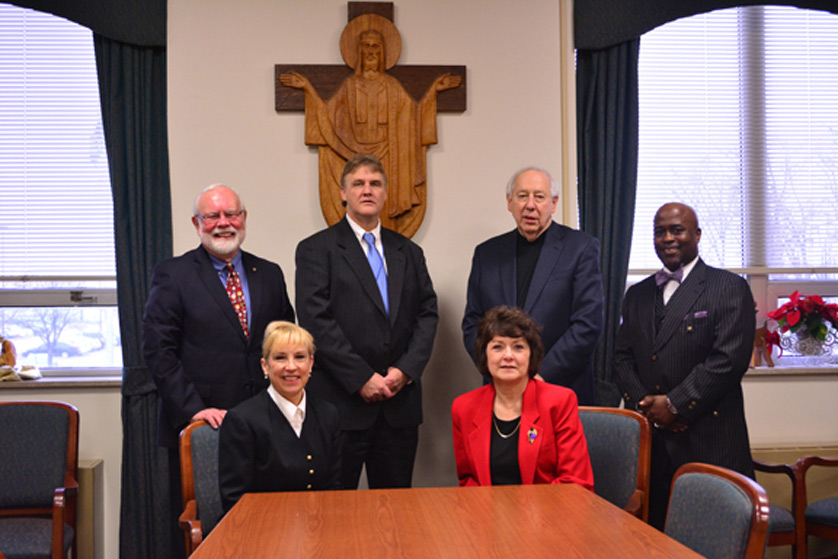
 Archdiocese of Detroit and Madonna University officials meet Dec. 10 to discuss a new professional development initiative in which the university will help provide training for Catholic school teachers in the archdiocese’s Central Region.
Superintendent says it’s ‘tip of the iceberg’ for collaboration
Detroit — Superintendent Brian Dougherty likens it working on automobiles: “You wouldn’t take your GM car over to Chrysler,” he says, so when local Catholic schools train their teachers, why look anywhere other than to local Catholic institutions?
Starting this year, two local Catholic universities — Madonna University in Livonia and the University of Detroit Mercy — have been authorized by the state Department of Education to provide professional development training to teachers in the Archdiocese of Detroit’s Central Region.
The new arrangement represents much more than simply a change in providers, said Dougherty.
“It has two huge advantages,” he told The Michigan Catholic. First, rather than an outside, third-party vendor, the Catholic educators at Madonna and U-D Mercy are “local talent” who share the archdiocesan schools’ Catholic mission, he said, and because of that can provide teachers with ongoing accessibility to local mentors.
Karen Obsniuk, dean of the College of Education at Madonna, said the university can provide a “wrap-around approach,” that also allows for consideration of faith and spirituality in professional development, keeping local Catholic schools’ overall mission in view.
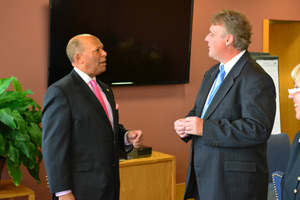 University of Detroit Mercy president Antoine M. Garibaldi, left, talks with Archdiocese of Detroit superintendent Brian Dougherty about the benefits U-D Mercy can provide archdiocesan teachers via a new professional development initiative.
“Many of our students who graduate from Madonna go on to teach in (archdiocesan) schools, and many of our graduate students are currently teaching in Catholic schools. So we have a clear understanding of the differences in curriculum, and some of the things that our teachers are finding more challenging,” she said. “We’re able to design an in-service that specifically tailors to the needs of the school or the subject area.”
In typical professional development settings, “the (third-party provider) comes in, and they’ll use what I call a ‘spray and pray’ (approach): They’ll say it for a day and hope you get it, but then they’re gone,” Dougherty said.
On the contrast, “There’s a big difference between coming in for a day’s seminar and having something that is two or three months long where there’s constant dialogue not only among the professionals who are attending, but the professionals who are providing,” he said.
Lorri MacDonald, education department chair at the University of Detroit Mercy, said building relationships with local Catholic schools is good for the colleges as well.
“The main advantage is that we are truly invested,” she said. “This isn’t a money-making opportunity; it’s a true partnership. We’re really invested in the archdiocesan schools, as opposed to an outside provider might come in with a different kind of attitude.”
Topics to be addressed during Madonna’s teacher in-services this year include classroom management, learning disabilities, content-area literacy and math education, while U-D Mercy’s sessions could focus on reading strategies and comprehension, differentiated instruction and leadership training, educators at both colleges said.
And while Madonna and U-D Mercy can provide another unique advantage to local Catholic schools — enough physical space to accommodate large-scale seminars — being based in southeast Michigan also could allow those providing the training to easily travel to the more far-flung areas of the archdiocese if opportunities expand in the future, Dougherty said.
“The Archdiocese of Detroit is 1,200 square miles. So for the teachers up there in Port Huron, they’re might read this and say, ‘that’s nice,’ and turn the page,” he said. “But at vicariate level or regional level, going out to them provides that flexibility level with using local professional providers.”
Karen White, associate superintendent for the archdiocese’s Central Region schools, said federal Title II-A money is being used for the Central Region’s training with Madonna and U-D Mercy this year, which is the result of a bidding process that took into account an annual needs assessment for local Catholic schools. However, neither White nor Dougherty ruled out future collaboration with the colleges using other funding sources.
Dougherty added such partnerships are becoming a growing discussion even at the national level, with the U.S. Conference of Catholic Bishops and the National Catholic Educational Association looking for more ways to pool resources. Detroit Auxiliary Bishop Arturo Cepeda, who heads the archdiocese’s Department of Evangelization, Catechesis and Schools, is a member of the USCCB’s Committee on Catholic Education.
“This theme is starting to really get some traction,” said Dougherty. “It’s at those levels where this idea of shared services, shared networking (are being discussed).”
Professional development is “just the tip of the iceberg,” he said. Another area of collaboration might include joint purchasing of textbooks and supplies among multiple schools or even districts to leverage better rates from suppliers, he noted.
The Archdiocese of Detroit this past summer also partnered with the University of Detroit Mercy to offer up to $20,000 in university tuition grants for students who attend a local Catholic school from first through 12th grade as part of an effort to promote a local “K-16 education for students in Catholic schools,” Dougherty said.
“I think what you’ve seen over the last several months is a re-alignment and a closing of the ranks between Catholic elementary, high school and post-secondary education, recognizing that we are in mission together, and we’re starting to look across the tables at each other to define what our needs are and how we can solve those needs within,” Dougherty said.