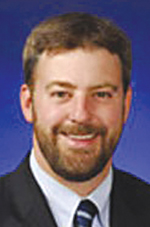
 Hickson
Lansing — The Michigan House of Representatives passed several bills Dec. 4 aimed at protecting religious freedom for both private citizens and faith-based organizations within the state in a move widely praised by Catholic leaders in Lansing.
House Bill 5958 is the Michigan Religious Freedom Restoration Act, or RFRA; it was sponsored by House Speaker Jase Bolger (R-Marshall).
House Bills 4927, 4928 and 4991 involve conscience protections for faith-based child placement agencies. These were sponsored by Republican Reps. Andrea LaFontaine, Ken Kurtz and Tom Leonard.
House Bill 4454, sponsored by Democratic Rep. Kate Segal, involves school attendance records; specifically, that when granting an award or recognition for attendance, a school would not hold a religious holiday-related absence against the student.
“We think that it’s a historic day, a big day, not only for Catholics but also for people of faith — every faith,” said Tom Hickson, the Michigan Catholic Conference’s vice president for public policy and advocacy.
He added that the MCC has been working for “nearly 20 years to get the RFRA and 10-15 years to protect Catholic charity agencies and other diverse organizations.”
He said the hope is to “make Michigan a great, welcoming place for religions and a tolerant place so people aren’t discriminated against for what they believe in.”
“We can’t restrict our work to the four walls of the Church and just worship; we must take it to the public square,” said Hickson, citing Pope Francis, who has encouraged Catholics to take their faith beyond the boundaries of their churches.
David Maluchnik, director of communications at the Michigan Catholic Conference, said Michigan would be the 20th state to enact a statewide RFRA, which closely mirrors the federal Religious Freedom Restoration Act signed by President Bill Clinton in 1993. The federal statue remains in place to this day.
However, “the Supreme Court has ruled that the (federal RFRA) doesn’t apply to the states,” Maluchnik said. He added that HB 5958 would essentially protect people “from being discriminated against, or coerced, if seeking to exercise one’s faith in public.”
Maluchnik said the key to the bill is that the state government would have to use the least-restrictive means of reaching a government goal to avoid prohibiting religious freedom, and that “substantial burdens” would not be placed on individuals’ faiths.
He offered the example of this summer’s Hobby Lobby decision at the Supreme Court, in which the company had been given an exemption from the requirement to include contraceptives on its health care plan based on the federal Religious Freedom Restoration Act.
In terms of the child placement agency bills, Hickson said that in several other places, such as Washington, California and Illinois, “adverse state laws or judicial rulings forced Catholic child placement agencies who do adoptions and foster care to violate the Church’s teachings.”
As a result, these placement agencies have since closed.
Hickson said Michigan’s Department of Human Services, with the guidance of director Maura Corrigan, “has done a lot of good work with faith-based child placement agencies to increase the number of foster families,” which he hopes will continue.
The Catholic conference now turns its hopes to the state Senate as its “lame duck” session draws to a close, with the hope that the religious freedom measures will be considered, Maluchnik said.
Hickson noted that the first settlers came to America to escape religious persecution, and that recent discrimination against people for their faith beliefs “doesn’t sound like America.”
“It is kind of bittersweet,” he said of the passing of such bills. “We shouldn’t have to do it, but on the upside we have lawmakers here that believe faith is critical and that everything else flows from that. Having that in place is positive against unwanted discrimination.”