|
The finance councils must meet the requirements of canon law and archdiocesan policy — over and above what many existing stewardship councils now provide.
Each pastor or parish administrator must appoint a parish finance council made up of three to nine parishioners. Besides being active, practicing Catholics, members must also be “equipped with the expertise or experience in the areas of finance, administration or law,” according to the “Parish, Vicariate and Archdiocesan Councils Handbook” published by the archdiocese in June 2011.
The council must meet at least quarterly, but monthly meetings are encouraged.
When it comes to parish expenditures, the finance council’s role differs according to the amount of money involved:
- Transactions classified as “acts of ordinary administration” (generally less than $10,000) may be authorized by the pastor on his own initiative, with the finance council only informed after the fact.
- “Acts of greater importance” (between $10,000 and $100,000), as well as the review of parish budgets and audits, and annual inventory of parish property, require the pastor to consult with the parish financial council.
Ranges apply to aggregates for a project — for example, the threshold for treatment as an “act of greater importance” would be reached by any activity or project that required expenditures of over $10,000, even if they came as four outlays of $3,000 each, instead of one at $12,000.
Some acts of greater importance, however, require not only consultation with the parish finance council, but also written approval by the archbishop or his delegate, such as significant property transactions, significant alterations to a church, the closing of a parish school or applications for loans from the Archdiocesan Loan Deposit Program.
- Acts of extraordinary administration (more than $100,000) require approval of the parish finance council as well as the written approval of the archbishop or his delegate.
Besides these functions, one of the chief functions of the new finance councils will be the preparation of the annual parish budget.
Besides the issue of canon law, the requirement for parish finance councils recognizes that lay people with administrative gifts can benefit the parish.
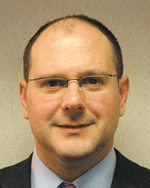
“The Church presumes that her pastors are competent to carry out the spiritual care of her faithful. The Church does not presume that her pastors are naturally competent to administer the temporal affairs of the parish,” said Michael Trueman, archdiocesan chancellor.
He emphasized, however, that the newly formed finance councils are not meant to have the upper hand over the already established parish pastoral councils.
“The parish pastoral council must give the vision and mission, and the finance council is subservient to that,” Trueman said.
When he was installed, Archbishop Allen Vigneron identified the need to redefine archdiocesan standards for parish finance councils to bring them into compliance with canon law and the norms established by theU.S.Conference of Catholic Bishops, Trueman explained.
At the archbishop’s suggestion, the Archdiocesan Pastoral Council embraced the project as one of its priorities.
Trueman said it was clear there was a need to “make sure someone is keeping a finger on the financial pulse of the parish.”
An APC subcommittee worked on a proposed policy, and Archbishop Vigneron promulgated it in January 2011, with a deadline for compliance of Jan. 22 of this year. After a number of pastors and parish administrators asked for more time to comply, the deadline was moved to April 1.
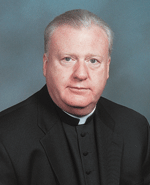
Fr. William Tindall, pastor of St. Michael the Archangel Parish, Livonia, played a key role in shepherding the new requirements as chairman of the APC’s Subcommittee on Finance and Administration.
The finance council requirement, Fr. Tindall said, “really changes the process completely.”
“Nothing is hidden; everything is much more transparent now,” he said.
And Fr. Tindall noted that finance council members will have direct access to the regional auxiliary bishops.
To help implement the new policy, training support is being made available through the archdiocesan Office of Parish Support Services. For more information, contact Kimberly Shepard at (313) 596-2163.