

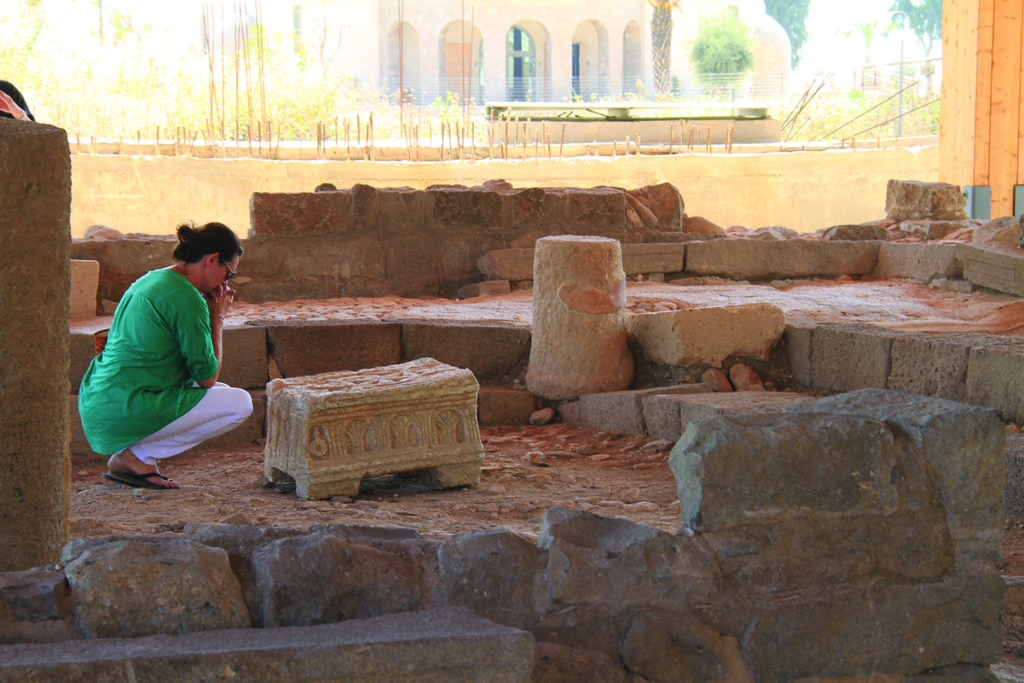
 A woman prays at the Magdala stone, a first century archeological discovery that depicts what scholars believe is the earliest known artistic representation of the second Jerusalem temple.
 Courtesy of Notre Dame of Jerusalem Center
Bloomfield Township — As a priest, Fr. Eamon Kelly, LC, tries to walk in the footsteps of Christ.
But he also gets to literally follow the footsteps of the savior, as the vice charge of the Pontifical Institute Notre Dame of Jerusalem Center and director of Magdala, an archeological site that has become a pilgrimage center for Christians looking to discover the Jewish roots of Christianity.
Fr. Kelly was in Michigan on Oct. 2 to speak with members of the Michigan Social Progress Israel Mission and the Michigan Israel Mission Delegations at the Jewish Federation of Metropolitan Detroit about his ministry in the Holy Land, introducing pilgrims to the places where Jesus and his apostles trod.
“Archeologists found a first-century synagogue, the seventh one they’ve discovered, but Magdala is the most beautiful one,” Fr. Kelly told The Michigan Catholic. “This is the first synagogue revealed where we’re pretty sure Jesus walked. We have a discovery that’s important for the Jewish people and everyone with a Jesus connection.”
Magdala was uncovered by archeologists in 2009, unearthing a lot of Jewish and early Christian history, causing many religious scholars to rethink the lives of the early Christian community in the context of first century Israel.
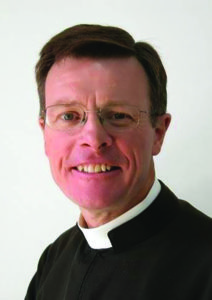 Fr. Kelly
“It’s the town of Mary Magdalene, at least her name is associated with the place,” Fr. Kelly said. “During the excavations, they uncovered a Christian place of worship that looked very much like a synagogue, but had the names of important women in Jesus’ life inscribed on the walls. So we see the importance of women in the early Church.”
Archeologists have determined that Magdala, located on the Sea of Galilee, was an important port town during the time of Jesus, leading some researchers to believe it may have been a town where Jesus preached and performed miracles.
Fr. Kelly said the history of the site makes for a powerful encounter for Christians.
“For Christians, this where Jesus would sit on the floor of the synagogue; it’s a very evocative place,” Fr. Kelly said. “The structure of the place is like a synagogue, but we know Christ’s followers prayed here. So if we go back to 67 AD, the first generation after Pentecost, we see the Christians weren’t divided, they weren’t alienated from the Jewish community; most were Jewish themselves. It’s evocative to recognize their commonality.”
Today, Fr. Kelly and the Notre Dame of Jerusalem Center lead retreats to Magdala, where Christians and Jews learn about what life was like in Galilee in the first century.
“It makes everybody think,” Fr. Kelly said. “When we find a discovery like this, it revolutionizes the way we think about the Sea of Galilee and the parables. There will be a lot of consequences and academics talking about this discovery for the next 40 or 50 years. But for now, there is a lot of interest for Jews and Christians.”
Seeing how Jews and Christians lived side by side in the first century can teach the faithful about the importance of ecumenism, something Notre Dame of Jerusalem Center encourages by offering tours to people of all denominations and backgrounds.
“In our time, culturally, we’re no longer in closed communities, so it’s important for us to learn to live with one another,” Fr. Kelly said. “I was raised in Ireland, and everyone in the area was Catholic. Today, we’re swimming in 15 cultures simultaneously. There’s been a rise in spiritual relativism, that everything is equal, everything is the same. But when you find archelogy, you’re hitting something very real.”
That “something very real,” Fr. Kelly says, helps Christians put their faith in Jesus into context — a reminder that Jesus really did walk the earth, and commanded his followers to live according to the Father’s will.
“Seeing something like Magdala is a continuation of the Incarnation,” Fr. Kelly said. “You can have a spirituality that’s entirely spirituality, or a spirituality that has a time and place. When people go on a pilgrimage, they say, ‘Wow, Jesus walked here. Jesus swam in this lake, Peter was here.’ It creates a real encounter, that there is something solid behind the whole Gospel story.”
Discover Magdala
Visit www.magdala.org to learn more about the archeological find at Magdala in Galilee.