
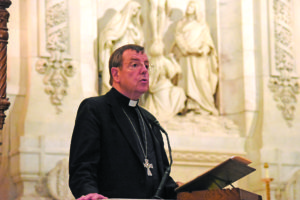
 Archbishop Allen H. Vigneron speaks from the pulpit at SS. Peter and Paul (Jesuit) Church in downtown Detroit on Nov. 7 during an Interfaith Religious Freedom Conference co-sponsored by the Michigan Catholic Conference.
Dan Meloy | The Michigan Catholic
Detroit — On a night when many Metro Detroiters cast their ballots in local and state races, Catholics and those of other faiths gathered in Detroit to stress the importance of religious expression in a truly free society.
“Religious liberty is the first freedom, securing a field for seeking and finding the truth and ensuring all other liberties aren’t just grants from the state or from a majority of opinions,” Detroit Archbishop Allen H. Vigneron said Nov. 7, speaking with faith leaders and legal scholars at SS. Peter and Paul (Jesuit) Church in Detroit.
Archbishop Vigneron and others spoke at the Interfaith Religious Freedom Conference, held on election night and sponsored by the J. Reuben Clark Law Society’s Detroit chapter and the Michigan Catholic Conference.
“Religious liberty is grounded in the fact that you and I are agents of the truth,” Archbishop Vigneron said. “That we, because we think, let truth emerge and be clear to us, especially religious truth. Because we’re those kinds of agents, we can act as agents who perform works in the world. This is what everyone expects of us, to be agents of truth. When we do that, we’re worthy of praise. When we fail, we’re worthy of blame.”
Archbishop Vigneron cited Catholic teaching from the Second Vatican Council regarding religious liberty, saying freedom to practice one’s faith is a fundamental human right.
“This liberty means we’re immune from coercion from any individuals, groups or human power,” Archbishop Vigneron said. “No one is to be forced to act contrary to his own beliefs, whether privately or publically, within reasonable due limits. It is in some sense private because it is not of the state, but it is not private in the sense that it is all up in the head. It is very much in the public sphere.”
The liberty to practice religion in the public sphere is essential to the Catholic Church’s, and other faith groups’, mission to honor God and love their fellow human beings, the archbishop added — even in public works of charity.
“If we don’t have and defend religious liberties of other communities, of Islam, of the Jewish faith, then we won’t be able to do these acts of charity, of education, of health care — these good works that make our community better,” Archbishop Vigneron said.
Elder Von G. Keetch, General Authority Seventy and executive director of public affairs for The Church of Jesus Christ of Latter-Day Saints, opened the conference by linking religious liberty with the very essence of a free will.
“We believe one of the most important gifts God has given us is the right to choose,” Elder Keetch said. “We believe that agency is central to God’s plan. We can’t become more like God unless we’re able to freely choose and accept the consequences of those choices.”
To that end, Elder Keetch acknowledged that religious liberty isn’t an absolute in a pluralistic society. Freedom to believe and practice one’s faith must not be abridged; but the practices of religiously affiliated organizations and religious people must be balanced with the civil rights of all citizens, he said.
“In a diverse society with diverging visions of life and morality, conflicts between religious freedom and other freedoms will naturally arise,” Elder Keetch said. “That is the very nature of freedom. The only reason you and I need religious freedoms set out for us is because those freedom clash with other freedoms.”
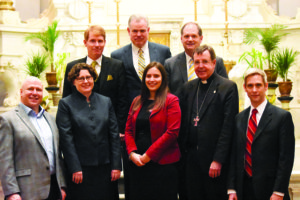 Jewish, Muslim, Catholic and Mormon faith leaders and legal scholars gathered to share views and strengthen common bonds during an Interfaith Religious Freedom Conference on Nov. 7 at SS. Peter and Paul (Jesuit) Church in Detroit.
Christopher Lund, a legal professor at the Wayne State University Law School, said the rights of religious individuals and organizations can be balanced with the rights of others in society — including those of different faiths or no faith — without compromising religious principles.
“Religious liberty includes the freedom of belief, the right to follow one church or another, or the right to reject the belief of all churches,” Lund said. “Government doesn’t coerce matters of belief, and it doesn’t influence, either.”
Lund highlighted the American history of religious liberty, saying the increase in religious denominations, coupled with the increase in the regulatory state since the Constitution’s conception, make the balance between religious liberty and civil liberties all the more difficult to attain.
“Eventually, there will be limits on practicing religion, but the civil right to believe does little if you don’t have the right to act,” Lund said. “It does little good to believe in God, but not allow you to live that way. Banning religious practices is as effective as just banning religion by name.”