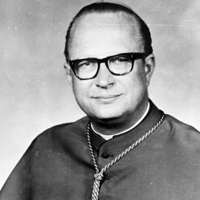
DETROIT – Being a bishop started 40 years ago for Cardinal Edmund C. Szoka – and it was a very memorable beginning.
When hewas first named bishop of the Diocese of Gaylord in 1971, there wasn’t much to start with.
Bishop Szoka’s installation Mass was celebrated in the gymnasium on the campus of St. Mary’s High School in Gaylord, because the church wasn’t large enough.
St. Mary’s was named the cathedral of the diocese, somewhat by default – it was the only Catholic Church in the city.
Even finding a place for the new bishop to live turned out to be an adventure.
“The city of Gaylord was very small,” recalled Cardinal Szoka in a recent interview. “I don’t know what it is now, but it was 3,500 people and there was only one parish, St. Mary… that little church only held maybe at the most 300 people. When I came they were having nine Masses on the weekend.”
What does a bishop do when a diocese is created by the Holy See, then put under his pastoral care? Cardinal Szoka had to learn that through experience.
“When I came there, I had no place to live, I had no chancery office, I had no secretary,” he recalls. “I had a territory, with some parishes and priests, but none of the facilities I needed.”
He recalls making his first home in a small parish rectory.
“My bedroom was next to the church side and the church bells rang every half hour,” he says. “Even during the night — they’d ring and wake me up. I would practically jump. It would scare me.”
That lasted a mere three days before he found a retreat center 40 minutes away in Petoskey in which to make his temporary home.
Working quarters were a challenge, too. As he was installed in July, he had a couple months during which he could use the school building as makeshift diocesan offices.
“There were a couple of women in the parish who volunteered to do secretarial work, so I used the high school library for a couple months as my office,” he says.
In a few months time, he had found a building to renovate for chancery offices, and had even found a house to rent for a permanent residence. He gathered a small staff for the chancery.
“Gradually I got things organized,” he recalls.
To unite the clergy – half of whome had belonged to the Grand Rapids diocese and half of whom had come from the Saginaw diocese – he started a presbyteral council, long before such a body was required of a diocese.
“I made every priest a member, because I had altogether more or less 60 diocesan priests and about 25 religious priests,” he says. “They were all invited to every meeting.
“God really helped me, because when I think back on it now, it went much easier than you might think.”
By the end of a decade, he also had spearheaded the building of a cathedral, rectory and bishops residence; started an education department; and established a network of social service offices throughout the diocese.
“It went very well and I was very happy,” he said.
When it was time for Bishop Szoka to leave, he was given a rare honor – Pope John Paul II requested he come to the Vatican in 1981 and personally accept his new assignment to succeed Cardinal John Dearden as archbishop of Detroit.