The new covenant brought about a major increase of certainty and ability to ascertain spiritual truth in all things. Yet strong notions of authority were present in the old covenant, too, notwithstanding sinners and corruption (as always; nothing new there!).
What did King Josiah do as soon as the Torah was found (2 Kings 22-23)? He went to the priest. The priest went to the prophetess. The king followed the advice of his authoritative advisers.
Nor does the fact that the Law as a whole needed interpretation rule out the possibility that certain parts of it were clear and apparent without the need for much interpretation (just as with the Bible as a whole). Catholicism does not require a totally obscure Bible at all. This is a myth. I would argue that the portions that Josiah chiefly acted upon were in fact pretty clear.
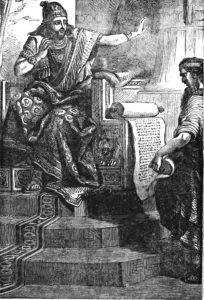 The Jewish King Josiah hears the book of the Law in this 19th century work by an unknown artist. Analogous to the Catholic Church’s understanding of interpretative authority in the new covenant, the Jewish people — even kings — had authoritative advisers to guide them in understanding God’s word.
For example, how hard is it to understand that idols were contrary to the Law? That’s a no-brainer, and was repeated endlessly in the Old Testament and messages of the prophets, so kings could see that right away.
But does it thereby follow that the entire Law and Bible could be understood without the need of authoritative teachers? No. And that is rather obvious to this day. The Torah was ineffective when the priests and Levites were lax in their duty to properly teach and interpret it. It doesn’t follow that all Levites should have been abolished, because some failed in their duties.
As for false priests and prophets, Jesus issued devastating criticisms of the Pharisees, yet He also commanded His followers to abide by their teaching (Mt 23:2-3). St. Paul respected the high priest, Ananias, who wasn’t even a Christian, even when the latter had him struck in the mouth during his trial (Acts 23:1-5).
Thus we see that Paul accepted (at least to some tangible degree) the authority of the corrupt priests, just as Jesus accepted the authority (and taught others to do so) of the very Pharisees that He elsewhere excoriated. In fact, right after He says to “practice and observe whatever they tell you” (Mt 23:3), He launches into His famous denunciations for hypocrisy for the rest of the chapter.
Jesus and Paul see nothing improper at all in the concept of a corrupt teacher preserving true teaching. They don’t think that the corrupt teacher loses all authority.
We can’t plausibly argue that the presence of false prophets rules out any prophets at all, functioning as a primitive “magisterium” for the Jews. Protestants often highlight the wicked guys. But Israel had Jeremiah and Ezekiel and Isaiah and all the rest to tell them the truth. Many did not heed that truth or accept their authority. What else is new? That’s the same as always. Not all (not even a majority) listened to John the Baptist or Jesus Himself, either. And what does that prove? Exactly nothing, as to whether they possessed authority to teach or not, and bind others to their teaching.
St. Paul presupposes in his writing — as if it were self-evident — one true tradition, received and passed along. A sort of “practical infallibility” is certainly present in the Old Testament, and was God’s intention for Israel. It just wasn’t continuous, because of human sin. We see that in Levites and prophets alike. The Church Age and the coming of the Gospel and the Holy Spirit made that possible, because of its supernatural protection, which alone would suffice to accomplish it.
Claiming that the old covenant teaching system is irrelevant because it didn’t exist in an unbroken, uncorrupted manner for 3,000 years or so of Old Testament history does not suffice. There was a truth preserved one way or another. One had to simply find it, in the context of the old covenant. When we understand the actual system instituted by God, it’s far more similar to Catholicism than any form of Protestantism.
Priests, Levites and prophets exercised something between binding teaching authority and infallibility. This is analogous to popes, councils and bishops in the Catholic Church. Popes can be infallible, and so can councils in agreement with the pope. It’s true that in the Old Testament there was not one, absolute figure like the pope, but when one was in the presence of an Ezra or Jeremiah or Samuel, did it really make any practical difference?
Prophets routinely spoke what purported to be the word of God, which is a much higher claim than papal infallibility: primarily a preventive, or “negative” guarantee, not positive inspiration or “revelation on the spot.” One could argue, then, that the infallibility (or the charism) was even greater, at least in the case of prophets.
It was even said of the Levites in Malachi 2:4-8 (RSV): “True instruction was in his mouth, and no wrong was found on his lips. He walked with me in peace and uprightness, and he turned many from iniquity. For the lips of a priest should guard knowledge, and men should seek instruction from his mouth, for he is the messenger of the LORD of hosts.”
This is quite strong and has all the hallmarks of infallibility. The only thing missing is the promise of continuity and succession (indefectibility), which is a new covenant feature, made possible by the Holy Spirit. But all the essentials are there.
 Dave Armstrong
Dave Armstrong has been a published Catholic apologist since 1993 and webmaster since 1997. He lives in Allen Park, grew up in Detroit, and is a member of Mother of Divine Mercy Parish near downtown. He’s been happily married to his wife Judy since 1984, and they have three sons and a daughter. Dave has written or edited 48 books on apologetics, including several bestsellers. If you’d like to help keep his influential teaching apostolate going as a much-needed monthly supporter, write to Dave at [email protected].