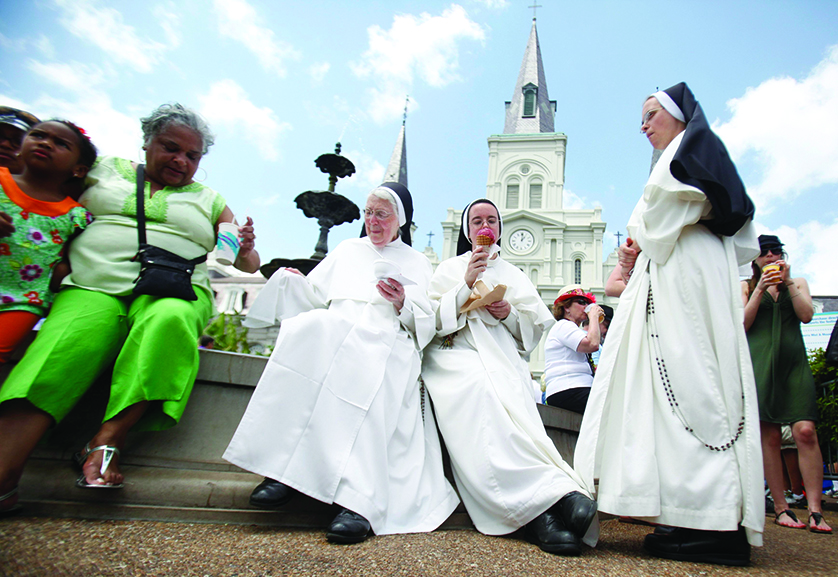
 With St. Louis Cathedral in the background, Dominican nuns enjoy ice cream during the 29th annual French Quarter Festival in New Orleans April 14. More than 500,000 people packed the French Quarter for the April 12-14 event. (CNS photo/Sean Gardner, Reuters) (April 16, 2012)
A common tactic of biblical skeptics is to question the veracity and historical trustworthiness of the New Testament based on Scripture’s alleged numerous “contradictions.” This is what might be described as the “1001 Bible contradictions” ploy. But most of these so-called “problem passages” can easily be shown to be not contradictory, but rather, complementary.
In the zealous desperation to find contradictions, any instance of a report not absolutely identical in all respects is regarded as contradictory, when in fact this is very often not the case at all. A simple example will suffice to illustrate:
- Joe says he saw Bill walk up to the Dairy Queen and buy an ice cream at 3:10 p.m. on a hot Saturday afternoon.
- Alice says she saw Ed walk up to the Dairy Queen and buy an ice cream at 4:10 p.m.
- John says he saw Kathy walk up to the Dairy Queen and buy an ice cream at 4:30 p.m.
- Sally says she saw Bill walk up to the Dairy Queen and buy an ice cream at about 3:15 p.m., Ed buy an ice cream there at about 4:20 p.m., and Kathy buy an ice cream there at about 4:45 p.m.
Now, according to these supposedly “conflicting” and “contradictory” reports, how many people bought an ice cream at the Dairy Queen between 3:10 and about 4:45 p.m. on a hot Saturday afternoon? Was it one, two, three, or six? Actually, none of the above, because (in all likelihood) many more people went there during that time to buy ice cream. They just weren’t all recorded.
But skeptical hyper-critics look at the above data (let’s say they represent the four Gospels) and see a host of contradictions:
- Joe contradicts Alice as to who visited there in an hour’s time.
- Joe contradicts John as to who visited there in an hour and 20 minutes time.
- Alice contradicts John as to who visited there in 20 minute’s time.
- Joe says someone visited at 3:10, but Alice claims it was at 4:10, and John says it was at 4:30.
- Joe, Alice, and John can’t even agree on who visited the Dairy Queen in a lousy span of only 80 minutes! They are obviously completely untrustworthy! Probably two or more of them are lying.
- To top it all off, we have the utter nonsense of Sally, whose time for Bill’s arrival contradicts Joe’s report by 5 minutes!
- Sally’s time for Ed’s arrival contradicts Alice’s report by 10 minutes!
- Sally’s time for Kathy’s arrival contradicts John’s report by 15 minutes!
And so on and so forth. Yet this is the sort of objection we get from so many skeptics of the Bible, and many examples of this sort can be easily located in the usual laundry lists of biblical contradictions that frequently appear in skeptical and atheist literature, often exhibiting the most elementary errors of fact or logic.
Fair-minded and open-minded folks should be able to easily see through the shallowness of such proofs. The skeptical underlying assumptions are almost always assumed as axioms (mere reasons for this acceptance are deemed unnecessary), and the Christian assumptions are almost always frowned upon as irrational, implausible or impossible.
We often hear, for example, the weak argument that John’s Gospel excludes a lot of the important events in Jesus life, which are recorded in the synoptic Gospels. But it obviously had a different purpose (it was more theological in nature, rather than purely narrative). In the world of biblical hyper-criticism, however, facts such as those are of no consequence. The usual predisposition is that contradictions are involved, per the above reasoning.
I’ve compiled many resources for Christians who encounter this sort of thing on my Bible and Tradition web page on my blog (final section).
I had an encounter a few days ago with a man who listed off four alleged contradictions in the Bible. I spent a significant amount of time offering counter-explanations in a comment section on my blog, showing (I think) that contradictions were actually not present, complete with links to the material that answers the charges.
How did this man respond when I did all that for him? He deleted all of his comments and split. He couldn’t care less about actually solving these alleged Bible difficulties, or giving the Bible a fair shake. He wants only to tear it down. He has no interest in defenses of an infallible, inspired Bible, only to embarrass Christians.
Therefore, when a Christian seriously interacted with his criticisms, he wanted no part of it, because that didn’t advance his agenda, and so he disappeared. He wasn’t interested in either serious Bible study or serious discussion. If I’ve seen it once, I’ve seen it a hundred times.
Dave Armstrong has been a published Catholic apologist since 1993 and webmaster since 1997. He lives in Allen Park, grew up in Detroit, and is a member of Mother of Divine Mercy Parish near downtown. He’s been happily married to his wife Judy since 1984, and they have three sons and a daughter. Dave has written or edited 48 books on apologetics, including several bestsellers. If you’d like to help keep his influential teaching apostolate going as a much-needed monthly supporter, write to Dave at [email protected].