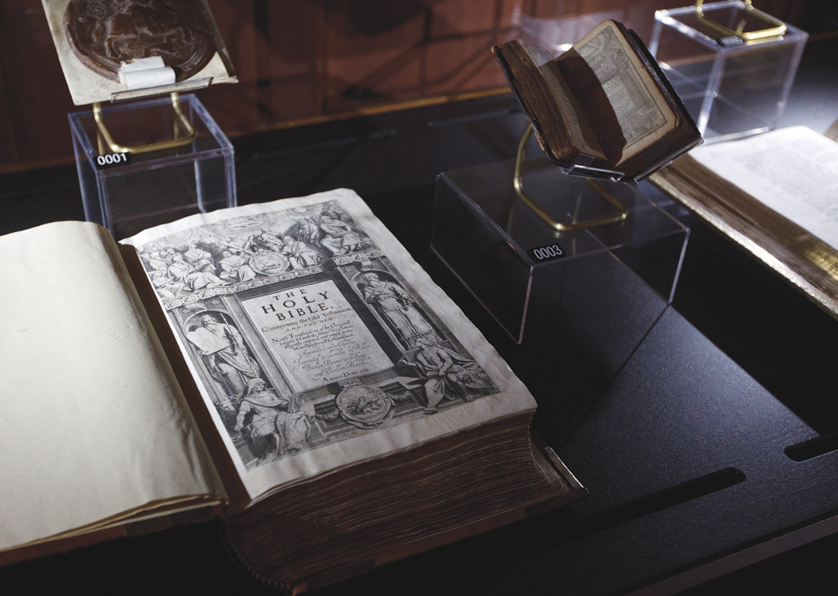
 A 1611 first edition of the King James Bible is seen in the "Verbum Domini" exhibit of rare biblical texts and artifacts at the Vatican Feb. 29. The new interfaith exhibit showcases 150 items from the third century B.C. to the 17th century.(CNS photo/Paul Haring) (March 2, 2012) See VATICAN LETTER March 2, 2012.
We commonly hear such accusations: that the Church for centuries provided only a few difficult-to-access “chained Bibles” and forbade Bible translations in the vernacular. This broad topic is one of the most cherished anti-Catholic myths, yet in point of fact it’s an outrageous falsehood, easily overturned by fair-minded historical investigation. I shall attempt to briefly summarize the facts that run counter to this viewpoint.
Perhaps the best and most decisive response to this myth is to cite the preface of the King James 1611 English translation of the Bible, which describes the long history of vernacular translations in England long before Protestantism ever arose. In part, it notes that “to have the Scriptures in the mother tongue is not a quaint conceit lately taken up ... but hath been thought upon, and put in practice of old, even from the first times of the conversion of any Nation; no doubt, because it was esteemed most profitable, to cause faith to grow in men’s hearts the sooner ...”
 Dave Armstrong
The history of English Bible translation — preceded earlier by editions in the earlier common language of Anglo-Saxon — is very long, starting with Caedmon in the 7th century, Aldhelm (c. 700), the Venerable Bede (d. 735), followed by Eadhelm, Guthlac, and Egbert (all in Saxon). King Alfred the Great (849-99) translated the Bible, as did Aelfric (d. c. 1020). Middle English translations included those of Orm (late 12th century) and Richard Rolle (d. 1349).
Vernacular Bibles in many languages appeared throughout the early and late Middle Ages (after Latin ceased being a common, widespread language). Fourteen translations of the Bible were published in High German, and five in Low German, between 1466 and 1517. Raban Maur had translated the entire Bible into Teutonic, or old German, in the late 8th century. Between 1450 to 1520 there were 10 French translations, and also Bibles rendered in Belgian, Bohemian, Spanish, Hungarian, and Russian. Twenty-five Italian versions (with express Church sanction) appeared before 1500, starting at Venice in 1471.
So why were Bibles chained?
The accusation that the Catholic Church chained Bibles in order to keep them from the common people is equally wrongheaded and historically misinformed. The exact opposite is true: Bibles were chained in libraries so that they would not be stolen, precisely because they were so valued and treasured (especially before the invention of the movable-type printing press in the mid-15th century), in order to be more accessible to all. Protestants did the same thing themselves for some 300 years. For example, Eton and Merton Colleges (Oxford) did not remove their chained Bibles until the 18th century.
It is true that the Catholic Church has (at least sometimes) forbidden reading the Bible in the vernacular: for example, the Synod of Toulouse in 1229. How can that be explained, except as a result of hostility to the Bible? The Protestant objection has been that if the Bible were allowed to be read in the language of the people, it would stop false doctrine, not promote it. Therefore, the Catholic Church was and is scared to let people read it, because the Bible would supposedly refute what are thought to be false doctrines in the Catholic Church.
But the Catholic Church, as the guardian of Holy Scripture, opposed only unauthorized translations, which is no different from many Protestants today who protest against various translations as “liberal” or inaccurate, due to a perceived bias based on the religious beliefs of the translator(s). This flows from a praiseworthy concern for the accurate transmission of God’s word.
Likewise, the Catholic Church is entitled to have an opinion on the matter also, without being unjustly accused of being “anti-Bible.” The early Protestants, including Martin Luther himself, often censored or prohibited Catholic translations in their districts, on the same basis (while they also were prohibiting the Mass). It’s a double standard, then, to accuse the Catholic Church of something that Protestants have always selectively done, too.
Stopping false doctrines
The Church prohibited vernacular Bible reading in some circumstances because false doctrine was already rampant, such as in 1229, when the bizarre Gnostic heresy of Catharism was influential. Protestants claim that the Bible is clear enough to stop such heretical sects. But the fact that Protestantism has never achieved doctrinal unity in its own ranks based on the “Bible alone” as the sole infallible source of authority (sola Scriptura), makes this questionable.
Moreover, all Bible interpretation occurs within a context of an overall belief-system and tradition. If, for example, Baptists read the Bible together, they will arrive at Baptist doctrine, because groups have a way of preserving their own particular beliefs and biases.
Protestant Church historian James Gairdner confirms this:
“The truth is, the Church of Rome was not at all opposed to the making of translations of Scripture or to placing them in the hands of the laity under what were deemed proper precautions. It was only judged necessary to see that no unauthorized or corrupt translations got abroad; and even in this matter it would seem that the authorities were not roused to special vigilance till they took alarm at the diffusion of Wycliffite translations in the generation after his death.
“... To the possession by worthy lay men of licensed translations the Church was never opposed; but to place such a weapon as an English Bible in the hands of men who had no regard for authority, and who would use it without being instructed how to use it properly, was dangerous not only to the souls of those who read, but to the peace and order of the Church” (Lollardy and the Reformation in England, Vol. 1 of 4, 1908, 105, 117).
Dave Armstrong has been a full-time Catholic apologist since 2001. He lives in Melvindale, grew up in Detroit, and attends St. Joseph Church near downtown. He has been happily married to his wife Judy since 1984, and they have four children. Dave has written 44 books on various apologetics topics, including five for Sophia Institute Press, and several bestsellers in the field. These are available for purchase (ePub, mobi, or PDF) at his deep discount booksite, www.biblicalcatholicism.com, and in paperback elsewhere.