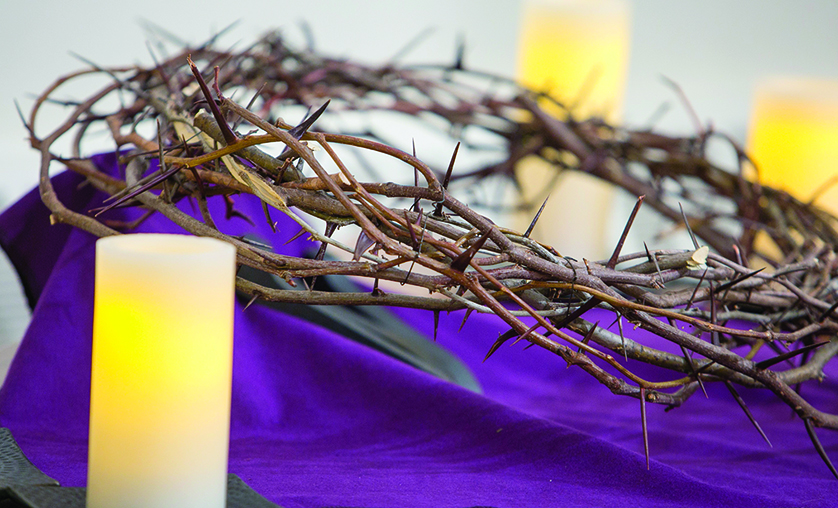
 A crown of thorns is seen on Ash Wednesday at St. Bonaventure Church in Paterson, N.J., March 5. Ash Wednesday marks the beginning of the penitential season of Lent, during which Christians reflect on the suffering of Jesus, especially on Good Friday, observed April 18 this year. (CNS photo/Octavio Duran) (March 6, 2014)
Next weekend we will celebrate the first Sunday of Lent. During morning prayer on Sundays in Lent, the Church puts before us a passage from the Book of Nehemiah: “Today is holy to our Lord. Do not be saddened this day, for rejoicing in the Lord must be your strength” (8:10b).
Rejoicing during Lent? Isn’t Lent supposed to be a time of sacrifice and penance, of recalling our sinfulness, of focusing on the passion and death of Our Lord? Then why this repeated emphasis on rejoicing?
Recently, I was discussing with my eighth-grade students the fact that all people desire happiness. One of the students had some difficulty with this concept: “But is that really possible?” she asked. “It seems like so many people are unhappy. Why do we all desire happiness if we can’t get it?” My student found it difficult, based on her own experience and her perception of the experience of many around her, to comprehend that happiness is something that is actually attainable.
I think looking at rejoicing as a key element of Lent can give us a clue to the answer to the question of the attainability of happiness. The joy that we seek to embrace during Lent is not at all divorced from its practices of sacrifice, penance and conversion from sin, and meditation on Our Lord’s passion. Rather, it is through these spiritual exercises that we are freed to encounter the joy of Lent.
When I go to confession and seek to live a life of conversion, I am set free from my sinful habits that have bound me and made it more difficult to choose the good. I know that is why I feel a great sense of peace and joyful lightheartedness when leaving the confessional, no matter how I may have felt beforehand.
When I make a sacrifice of some good that I enjoy — whether that be a certain food I like or some recreational pastime — I am able to make the choice that that good thing will not be the most important thing in my life. In addition, the times when I do enjoy that good will become more special because of the times I have sacrificed them. Once again, this freedom of spirit will lead to a deep joy.
Finally, when I recognize the gift the Lord gave me, that He suffered, died, and rose for me, I encounter His love in a deeply personal way. I am able to see the love that chose to give His only Son rather than to lose me for all eternity. I encounter Love Himself who sacrificed His own life for my sake. And as I repeatedly encounter His unconditional love for me, how can I help but be filled with a deep sense of joy?
Happiness is indeed attainable if we have a true understanding of what it means to be happy. It does not mean that we will never have suffering in this life. Rather, happiness comes from knowing that we are deeply and intimately loved by God and responding to that love with our whole hearts. As we prepare for Lent, let us consider how we can open ourselves up more during this season to joy of the Lord.
Sr. Mary Martha Becnel is a member of the Ann Arbor-based Dominican Sisters of Mary, Mother of the Eucharist.