
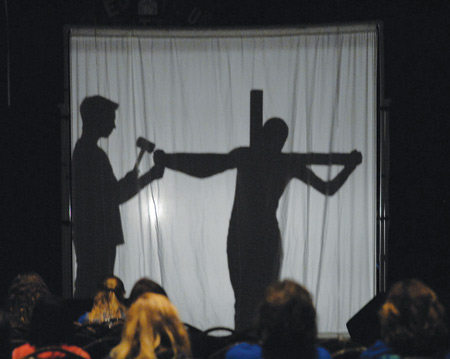
 Youths enact “shadow” Stations of the Cross during CYO Rainbow XXXIII Conference in Detroit. See story, Page 5.
This February, we can take as inspiration for our Lenten observances the example of a hero of World War II, Fr. John Washington; his self-sacrifice transformed Arctic waters into a “sea of glory,” the title one historian gave his book about the event.
In the wee hours of Feb. 3, 1943, the young priest and hundreds of U.S. soldiers bound for Britain awoke to an explosion; torpedoed by a German submarine, their ship would sink within 20 minutes. Amid the pandemonium, Fr. Washington began administering last rites and encouraging those who could escape. Survivors say the voices of Fr. Washington and his three fellow chaplains cut through the night’s utter darkness and the screams and curses of wounded and terrified men with words of courage and faith. When lifejackets ran out, the chaplains one after another removed their own, handing them to four frightened young soldiers; “I’m staying,” each chaplain said simply. At the ship’s last sighting, the chaplains were standing arm-in-arm, bracing themselves against the listing deck, praying aloud.
Fr. Washington’s heroism that day blossomed as the fruit not of the hour, but of a lifetime of smaller gifts of self, little kindnesses to his mother and six younger siblings, hard-won cheerfulness after the deaths of his sister and father, and ever-ready wisecracks that left friends in stitches.
Fr. Washington always strove to bring happiness to those in his life, and we can make this a guiding principle for our Lenten sacrifices. A priest I once knew would say, “Giving up candy for Lent is for kids.” He meant that, as adults, we should know that Lent is not about what we give up, but about what we give and are given. Fr. Washington was less “giving up” his life jacket than giving another the chance to live. During Lent, by giving to others and to Christ, we open ourselves to receive what He wishes to give us, deeper friendship with Himself.
Lent traditionally involves prayer, fasting and almsgiving. These exercises can be interrelated: we can make time for prayer by fasting from unnecessary activities like watching a favorite TV show. Our alms can be prayers offered for someone who needs them.
However, it is always good to practice fasting and almsgiving in a literal sense. As creatures of body and soul, we benefit from corporal mortification. One wouldn’t undertake any unusual or extreme penances without consulting a spiritual director, but abstaining from meat on Lenten Fridays, as the Church asks, and, say, consuming less of a favorite drink will remind us to turn our minds to Christ. The money saved by our fasting can be given to charity.
Three principles can guide our Lenten practices: pick just one or two to which you think you can be faithful, look for ones that make others’ lives happier, and focus not on what you are giving up but on your interior conversion to Christ. Then, your Lenten sacrifices will turn your workplace and home into places of God’s glory.
Sr. Maria Veritas Marks is a member of the Ann Arbor-based Dominican Sisters of Mary, Mother of the Eucharist.