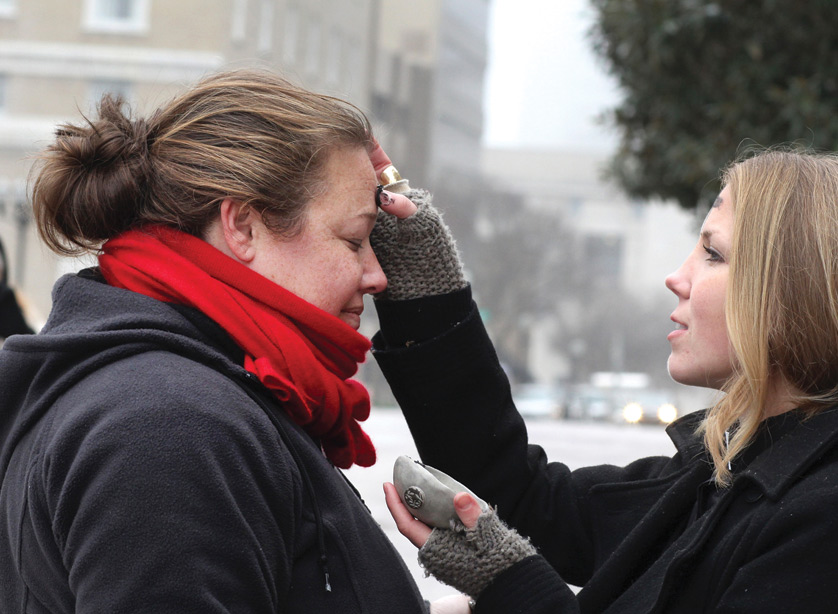
 Ingrid McIntyre receives ashes from street chaplain Lindsey Krinks in Nashville, Tennessee. Though the word "Lent" is not explicitly used in the Bible, Catholics are certainly justified in deducing the practice from Scripture.
Kathleen Barry | CNS Photo
In one of the Facebook theological groups I am involved with, a Protestant stated that “Jesus nowhere explicitly commanded us to use ashes,” and “There’s no Lent in the Bible, either.”
This person wanted to quibble about Lent, demanding to know — as I have pointed out in other posts — where every major component is discussed in Scripture.
Yet a curious double standard seems to be in play here, whether intended or not. The New Testament never mentions a host of things that Protestants of various stripes believe. For example, it knows nothing of an “altar call” or the typical “sinner’s prayer” of evangelicals. It doesn’t mention church buildings; it never uses the word “Trinity” or the frequently mentioned evangelical terminology of a “personal relationship with Jesus.”
It never lists its own books (the biblical canon comes from the authority and proclamations of the Catholic Church and tradition). It doesn’t teach sola Scriptura, or the concept that the Bible is the only infallible source of authority (over and against Church and sacred tradition). Yet, oddly enough, this is one of the very “pillars” of the Protestant worldview. I’ve written two entire books about that issue alone.
Other beliefs or practices not explicitly mentioned in Scripture include Bible studies, separating young people during church services, grape juice as an element to be consecrated for communion (rather than wine), “asking Jesus into one’s heart,” a “body of believers,” Scripture interpreting Scripture (the more clear helping to understand the less clear), agreeing on “essential” or “primary” doctrines and permitted relativism regarding “non-essential” or “secondary” doctrines, and denominations (vs. the biblical “one Church”).
Of course, the very idea that one must find explicit biblical proof for every doctrine is not found in the Bible anywhere, either. It’s (ironically) a mere tradition of men.
Some popular Protestant (and also often Catholic) words or phrases that do not appear in the Bible include “rapture,” “invisible church,” “incarnation,” “virgin birth,” “holy communion,” “Lord’s prayer,” “Bible,” “original sin,” “fall of man,” “theology,” “go[ing] to church,” “grace alone,” “[total] depravity,” “unconditional election,” “limited atonement,” “irresistible grace,” “perseverance of the saints,” “spirituality,” “Scripture alone,” “pray for guidance,” “pray for direction,” “spiritual warfare,” and “sin nature.” “Faith alone” only appears once:
James 2:24 (RSV) “You see that a man is justified by works and not by faith alone.”
Protestants manage to believe all these things with no problem whatsoever. Why? Or, more specifically, why do they believe these things, which are absent from or non-explicit in the Bible, while giving Catholics misery for other doctrines and practices with equal or greater backing in Scripture?
The Catholic view on these matters is totally consistent and sensible. Here is how I expressed it in the introduction to my first book, A Biblical Defense of Catholicism (2003):
“Catholics need only to show the harmony of a doctrine with holy Scripture. It is not our view that every tenet of the Christian Faith must appear whole, explicit, and often in the pages of the Bible. We also acknowledge sacred Tradition, the authority of the Church, and the development of understanding of essentially unchanging Christian truths, as is to be expected with a living organism (the Body of Christ) guided by the Holy Spirit. A belief implicitly biblical is not necessarily antibiblical or unbiblical. But we maintain that the Protestant principle of sola Scriptura (“Scripture alone”), on the other hand, is incoherent and — I dare say — quite unbiblical.
“In fact, many doctrines accepted by Protestants are either not found in the Bible at all (for example, sola Scriptura and the canon of Scripture), are based on only a very few direct passages (for example, the virgin birth), or are indirectly deduced from many implicit passages (for example, the Trinity, the two natures of Jesus, and many attributes of God, such as His omnipresence and omniscience).”
Let me be clear about the exact nature of my argument: I do distinguish between things that are not in the Bible at all — in word or concept — and particular words that aren’t in the Bible, whereas the concepts certainly are. For example, “Trinity” is obviously a biblical concept. I’ve spent more than 30 years defending this truth using the Bible (it was one of my first major apologetics efforts). There’s no justification for arguing that because a specific word isn’t in the Bible (such as “Lent”), neither is the concept. It doesn’t follow. Something is “biblical” if the concept can be deduced using the Bible; whether a specific word is used to describe it is largely irrelevant.
I ran into this difference again with our esteemed Protestant brethren on another Facebook group, where someone asked why Catholics identify themselves using the name “Catholic,” which, of course, also isn’t in Scripture.
I replied by disputing the questioner’s premise that such a title must be found in Scripture for a Catholic to use it. The “tradition” of finding every word explicitly used in the Bible is itself arbitrary and “unbiblical.”
“Christians have as much justification to call themselves ‘Catholics’ as they do to refer to the Godhead as the ‘Holy Trinity,’” I said. “Neither is a biblical term, but both notions are clearly taught in the Bible. The fact that there was one Church meant that it was necessarily universal.
“We say we are ‘Catholics’ because it refers to the one, true, universal Church as opposed to the unbiblical notion of denominations.”
Dave Armstrong is a full-time Catholic apologist. He lives in Allen Park, grew up in Detroit, and has attended St. Joseph Church near downtown since 1991. He’s been happily married to his wife Judy since 1984, and they have three sons and a daughter. Dave has written 49 books on apologetics, including six for Sophia Institute Press, with several bestsellers in the field. He blogs daily at the Patheos super-site. Information for purchase of his books is available there.