
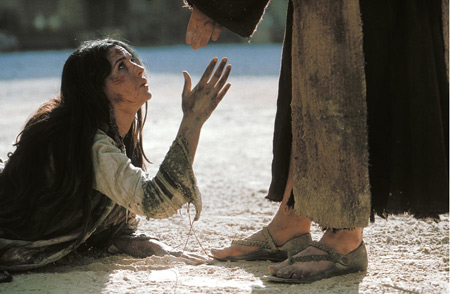
 Movie: Passion of the Christ
“Remember, thou art dust, and unto dust thou shalt return.” In just a few days, we will hear these murmured words as our foreheads are signed with the ashes of the palms of last year’s Palm Sunday.
Through the words and the ashes, the rite of Ash Wednesday calls to mind two complementary realities: first, our mortality, the result of human sinfulness, and, second, the hope of redemption, which rose on Easter Sunday from the ashes of the most heinous of all acts: the crucifixion of God Incarnate on Good Friday. As we wend our way through the next 40 days, let us hold together these two related realities:
First, the importance of acknowledging our sinfulness. In this Jubilee Year of Mercy, we are called both to experience and to dispense the incredible gift of divine forgiveness. This is impossible, however, if we do not know ourselves as sinners. In The Name of God is Mercy, Pope Francis explains to journalist Andrea Tornielli that this knowledge is a grace for which we must pray: “Without that grace, the most one can say is: ‘I am limited, I have my limits, these are my mistakes.’ But recognizing oneself as a sinner is something else. It means standing in front of God, who is our everything, and presenting him with our selves, which are our nothing. Our miseries, our sins” (32).
This self-knowledge might seem at best a depressing burden and, at worst, a first step toward manic self-hatred: how can the pope call it a “grace”? Self-knowledge is a grace, a gift, because it is only in acknowledging the truth of our situation as creatures suffering with original sin that we open ourselves to the workings of Truth Himself. Mother Teresa answers, “It is only when you realize your nothingness, your emptiness, that God can fill you with Himself.” We are indeed nothing, but, at the same time, God is everything, and He loves us.
This answer points us toward the second of the two realities of Ash Wednesday: the glory of the resurrection. Elsewhere in The Name of God is Mercy, Pope Francis recalls a sermon of Albino Luciani, the future Pope John Paul I, who explained that God likes to do His writing in dust, rather than in a durable material like metal or stone, so that, when the writing miraculously remains despite wind, rain, and trudging feet, we know that the writing was His.
Yes, we are dust, but God chooses to write in dust! He chooses to write through us His glory, His love, His tenderness. When we recognize that we are dust, He etches in that very dust the eternal message of mercy each time we utter words of love and forgiveness, each time our eyes and our arms embrace those who have hurt us — and Him. Thus, time and again, from the darkness of sin, God raises us and others up. His mercy always triumphs.
Sr. Maria Veritas Marks is a member of the Ann Arbor-based Dominican Sisters of Mary, Mother of the Eucharist.