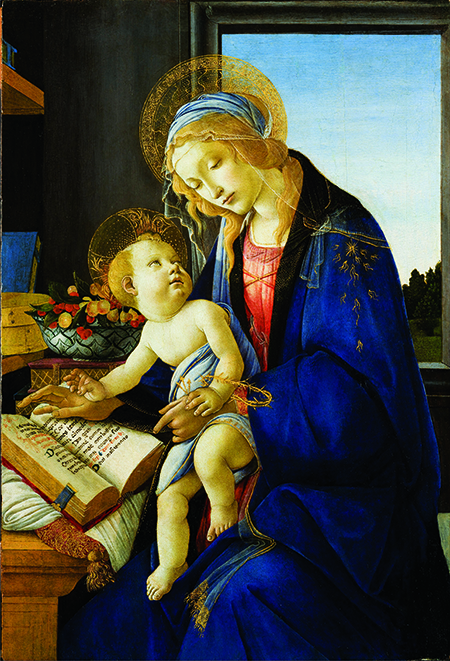
 The Virgin Mary and the Child Jesus are depicted in this 15th century work of Sandro Botticelli. The Catholic Church’s tradition of the perpetual virginity of Mary — and that she had no other children besides Jesus — can be defended by taking a closer look at Scripture’s usage of the Greek and Hebrew words relating to relatives, kin and siblings.
In a previous article on this topic (May 2016), I wrote about the “Hebraic” use of the Greek adelphos as applying to cousins, fellow countrymen, and a wide array of uses beyond the meaning of “sibling.” This is important as it relates to Scripture’s description of the relatives of Jesus — and, by extension, whether Mary had any other children or was, as the Catholic Church teaches, a perpetual virgin.
Despite this, adelphos is unanimously translated as “brother” in the King James Version (KJV): 246 times. The cognate adelphe is translated 24 times only as “sister.”
This is because it reflects Hebrew usage, translated into Greek. Put another way, in Jesus’ Hebrew culture (and Middle Eastern culture even today), cousins were called “brothers.”
Now, it’s true that the word sungenis (Greek for “cousin”) and its cognate sungenia appear in the New Testament 15 times (sungenia: Lk 1:61; Acts 7:3, 14; sungenis: Mk 6:4; Lk 1:36, 58; 2:44; 14:12; 21:16; Jn 18:26; Acts 10:24; Rom 9:3; 16:7, 11, 21). But they are usually translated as “kinsmen,” “kinsfolk,” or “kindred” in the KJV — that is, in a sense wider than “cousin” — often referring to the entire nation of Hebrews.
Thus, the eminent Protestant linguist W. E. Vine, in his Expository Dictionary of New Testament Words, lists sungenis not only under “Cousin” but also under “Kin, Kinsfolk, Kinsman, Kinswoman.”
In all but two of these occurrences, the authors were either Luke or Paul. Luke was a Greek Gentile. Paul, though Jewish, was raised in the very cosmopolitan, culturally Greek town of Tarsus. But even so, both still clearly used adelphos many times with the meaning of non-sibling:
Luke 10:29 (RSV): “But he, desiring to justify himself, said to Jesus, ‘And who is my neighbor?’”
Acts 3:17: “And now, brethren, I know that you acted in ignorance, as did also your rulers.”
Acts 7:23, 25-26: “When he was forty years old, it came into his heart to visit his brethren, the sons of Israel ... He supposed that his brethren understood that God was giving them deliverance by his hand, but they did not understand. And on the following day he appeared to them as they were quarreling and would have reconciled them, saying, `Men, you are brethren, why do you wrong each other?’”
Romans 1:13: “I want you to know, brethren ...”
Romans 9:3: “For I could wish that I myself were accursed and cut off from Christ for the sake of my brethren, my kinsmen by race.”
1 Thessalonians 1:4: “For we know, brethren beloved by God, that he has chosen you;”
They understood what all these words meant, yet they continued to use adelphos even in those instances that had a non-sibling application.
Strikingly, it looks like every time St. Paul uses adelphos (unless I missed one or two), he means it as something other than blood brother or sibling. He uses the word or related cognates no less than 138 times in this way. Yet we often hear about Galatians 1:19: “James the Lord’s brother.” In the other 137 instances, Paul means non-sibling, yet amazingly enough, we are told here he must mean sibling, because he uses the word adelphos? That doesn’t make any sense.
Some folks think it is a compelling argument that sungenis isn’t used to describe the brothers of Jesus. But they need to examine Mark 6:4 (RSV), where sungenis appears:
“And Jesus said to them, ‘A prophet is not without honor, except in his own country, and among his own kin, and in his own house.” (cf. Jn 7:5: “For even his brothers did not believe in him”)
What is the context? Let’s look at the preceding verse, where the people in “his own country” (6:1) exclaimed:
“‘Is not this the carpenter, the son of Mary and brother of James and Joses and Judas and Simon, and are not his sisters here with us?’ And they took offense at him.”
It can plausibly be argued, then, that Jesus’ reference to “kin” (sungenis) refers (at least in part) back to this mention of His “brothers” and “sisters”: His relatives. Since we know that sungenis means cousins or more distant relatives, that would be an indication of the status of those called Jesus’ “brothers”.
Jude is called the Lord’s “brother” in Matthew 13:55 and Mark 6:3. If this is the same Jude who wrote the epistle bearing that name (as many think), he calls himself “a servant of Jesus Christ and brother of James” (Jude 1:1).
Now, suppose for a moment that he was Jesus’ blood brother. In that case, he refrains from referring to himself as the Lord’s own sibling (while we are told that such a phraseology occurs several times in the New Testament, referring to a sibling relationship) and chooses instead to identify himself as James’ brother.
This is far too strange and implausible to believe. Moreover, James also refrains from calling himself Jesus’ brother, in his epistle (James 1:1: “servant of God and of the Lord Jesus Christ”): even though St. Paul calls him “the Lord’s brother” (Gal 1:19: dealt with above).
It’s true that Scripture doesn’t come right out and explicitly state that Mary was a perpetual virgin. But nothing in Scripture contradicts that notion, and (to say the same thing another way) nothing in the perpetual virginity doctrine contradicts Scripture. Moreover, no Scripture can be produced that absolutely, undeniably, compellingly defeats the perpetual virginity of Mary.
The alleged “disproofs” utterly fail in their purpose. The attempted linguistic argument against Mary’s perpetual virginity from the mere use of the word “brothers” in English translations (and from sungenis) falls flat at every turn, as we have seen.
If there is any purely “human” tradition here, then, it is the denial of the perpetual virginity of Mary, since it originated (mostly) some 1,700 years after the initial apostolic deposit: just as all heresies are much later corruptions. The earliest Church fathers know of no such thing. To a person, they all testify that Mary was perpetually a virgin, and indeed, thought that this protected the doctrine of the Incarnation, as a miraculous birth from a mother who was a virgin before, during and after the birth.
Dave Armstrong has been a published Catholic apologist since 1993 and webmaster since 1997. He lives in Allen Park, grew up in Detroit, and is a member of Mother of Divine Mercy Parish near downtown. He’s been happily married to his wife Judy since 1984, and they have three sons and a daughter. Dave has written or edited 48 books on apologetics, including several bestsellers. If you’d like to help keep his influential teaching apostolate going as a much-needed monthly supporter, write to Dave at [email protected].