 The Holy Father’s encyclical Laudato Si’ is a beautiful and definitive statement of Christian environmentalism and the theology of creation. For too long, Christians have been accused of being (or, too often, actually were in practice) indifferent to the problems of the earth and the environment: as if we merely want to exploit the earth and her resources, rather than being stewards of God’s marvelous creation.
I think this encyclical will go a long way toward dispelling those notions. The secularists don’t “own” this discussion, any more than they own economic or “nature of marriage and the family” discussions. Along these lines, the Holy Father observed:
“An inadequate presentation of Christian anthropology gave rise to a wrong understanding of the relationship between human beings and the world. Often, what was handed on was a Promethean vision of mastery over the world, which gave the impression that the protection of nature was something that only the faint-hearted cared about. Instead, our “dominion” over the universe should be understood more properly in the sense of responsible stewardship. [116]
“Living our vocation to be protectors of God’s handiwork is essential to a life of virtue; it is not an optional or a secondary aspect of our Christian experience.” [217]
The Holy Father harmonizes Catholic environmental and social teaching: “There can be no ecology without an adequate anthropology,” he writes [118].
“Today, the analysis of environmental problems cannot be separated from the analysis of human, family, work-related and urban contexts ...” [141]
Incarnation and environmentalism
Pope Francis “Christianizes” important scientific discussions that are usually hyper-secularized in the false dichotomy habitually drawn between science and God (i.e., a materialistic version of science, or what C. S. Lewis, G. K. Chesterton and others strongly critique as the error of “scientism”):
“It cannot be maintained that empirical science provides a complete explanation of life, the interplay of all creatures and the whole of reality. This would be to breach the limits imposed by its own methodology. If we reason only within the confines of the latter, little room would be left for aesthetic sensibility, poetry, or even reason’s ability to grasp the ultimate meaning and purpose of things. [199]
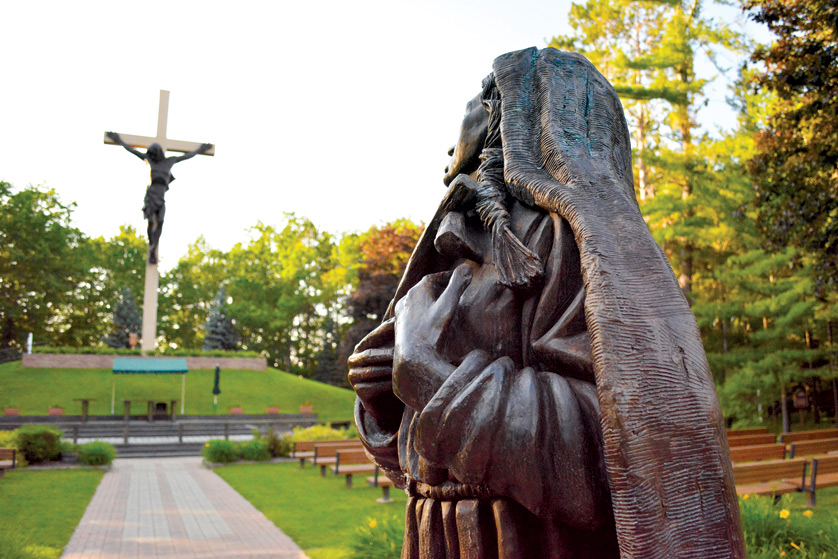 A statue of St. Kateri Tekakwitha gazes at the 55-foot-tall crucifix of the National Shrine of the Cross in the Woods in Indian River, Michigan, the largest crucifix in the world. The recently canonized Native American saint, whose feast day is July 14, is known as a patron of the environment, one of the focuses of Pope Francis' recent encyclical, Laudato Si
“Environmental education should facilitate making the leap toward the transcendent which gives ecological ethics its deepest meaning. [210]
“Then too, there is the recognition that God created the world, writing into it an order and a dynamism that human beings have no right to ignore. [221]
“The universe unfolds in God, who fills it completely. Hence, there is a mystical meaning to be found in a leaf, in a mountain trail, in a dewdrop, in a poor person’s face.” [233]
He (quite appropriately and relevantly) ties in the Incarnation with environmentalism:
“[T]he Son of God has incorporated in his person part of the material world, planting in it a seed of definitive transformation. [235]
“The Lord, in the culmination of the mystery of the Incarnation, chose to reach our intimate depths through a fragment of matter.” [236]
The pope did not ignore the wholesale slaughter of preborn human beings:
“Since everything is interrelated, concern for the protection of nature is also incompatible with the justification of abortion. How can we genuinely teach the importance of concern for other vulnerable beings, however troublesome or inconvenient they may be, if we fail to protect a human embryo ...?” [120]
Global warming a small part
I note in passing that a very tiny portion of the document espouses global warming (“warming” is mentioned nine times in the entire encyclical). This is a question of scientific facts and interpretations that have nothing directly to do with the Catholic faith or the magisterium; hence, a Catholic is at liberty to respectfully disagree. Pope Francis wrote:
“There are certain environmental issues where it is not easy to achieve a broad consensus. Here I would state once more that the Church does not presume to settle scientific questions or to replace politics. But I am concerned to encourage an honest and open debate so that particular interests or ideologies will not prejudice the common good.” [188]
I urge everyone to read and digest this wonderful and innovative encyclical. It’s a goldmine of practical and spiritual wisdom. I could easily quote 200 parts of it as especially noteworthy. Here are a few examples of its innumerable gems of insight:
“Let us ... continue to wonder about the purpose and meaning of everything. Otherwise we would simply legitimate the present situation and need new forms of escapism to help us endure the emptiness. [113]
“Since the market tends to promote extreme consumerism in an effort to sell its products, people can easily get caught up in a whirlwind of needless buying and spending. [203]
“Many people know that our current progress and the mere amassing of things and pleasures are not enough to give meaning and joy to the human heart ... [209]
“If someone has not learned to stop and admire something beautiful, we should not be surprised if he or she treats everything as an object to be used and abused without scruple. [215]
“A constant flood of new consumer goods can baffle the heart and prevent us from cherishing each thing and each moment. To be serenely present to each reality, however small it may be, opens us to much greater horizons of understanding and personal fulfilment. Christian spirituality proposes a growth marked by moderation and the capacity to be happy with little. It is a return to that simplicity which allows us to stop and appreciate the small things, to be grateful for the opportunities which life affords us, to be spiritually detached from what we possess ...” [222]
The Holy Father in his great wisdom has given us a fabulous guide to environmentalism and life in general. We need to read and ponder his words, rather than have them spoon-fed to us through the multiple biased filters of the secular media. This encyclical will edify and enrich beyond measure anyone who reads it.
Dave Armstrong has been a full-time Catholic apologist since 2001. He lives in Allen Park, grew up in Detroit, and attends St. Joseph Church near downtown. He has been happily married to his wife Judy since 1984, and they have four children. Dave has written 44 books on various apologetics topics, including five for Sophia Institute Press, and several bestsellers in the field. These are available for purchase (ePub, mobi, or PDF) at his deep discount book site, www.biblicalcatholicism.com, and in paperback elsewhere.