
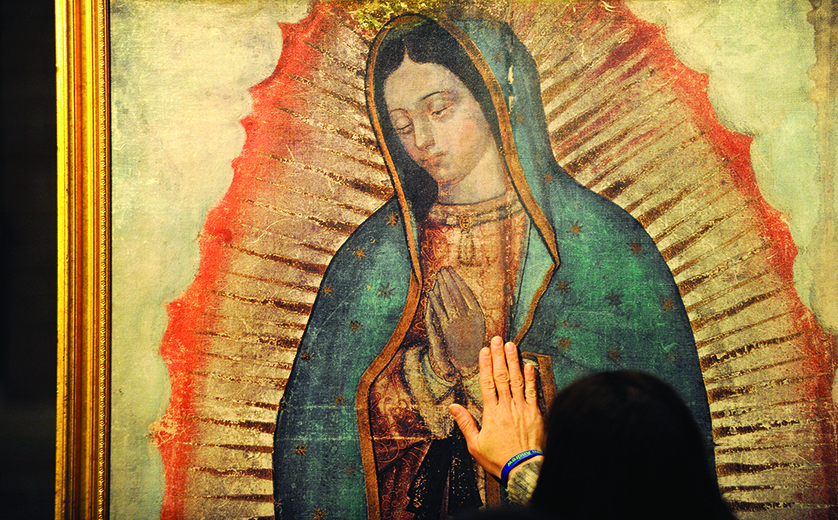
 A woman lays her hand on a traveling missionary image of Our Lady of Guadalupe during a visit by the replica to St. Louis Church in Pittsford, N.Y., Oct. 28. The digital image is a reproduction of the image left on the tilma of St. Juan Diego in present-day Mexico City in 1531. (CNS photo/Mike Crupi, Catholic Courier) (Oct. 31, 2012)
This year, 2016, marks the 800th anniversary of the birth of the Order of Preachers, the Dominican Order. One famous Dominican motto is laudare, benedicere, praedicare, “to
praise, to bless, to preach.” The phrase originated in a 13th-century Marian preface for the Dominican Rite of the Mass and has been preserved in the first Marian preface of the current Roman Rite, although translated into English as “to praise, bless, and glorify your name.”
The last part of this motto, praedicare, holds special relevance for all of us, religious and laity, in this time of summer travels. We are always called to bring the truth to others, but the summer can offer new opportunities — your seat-mate on the plane who confides that he is a fallen-away Catholic, or the street evangelist in the town you are visiting who asks eagerly whether you are saved.
How should one respond in these situations? Mary, the first person to bring the Word Incarnate to others, can teach us. In particular, the image of Our Lady of Guadalupe, which she left miraculously imprinted upon the cloak of Juan Diego in 1531, offers us three keys to evangelization: confidence, humility, and joy.
This image continues to amaze scholars. In recent decades, it has been discovered to be a kind of amoxtli, an Aztec codex common in Juan Diego’s time. These codices used glyphs to narrate events relevant to the entire people. Our Lady’s image also tells a story: first, of a Woman who stands in front of the sun and upon the moon, indicating her superiority to two Aztec gods. Herein lies the source of our confidence when explaining the faith: we speak, as she did, a Word who is greater than anything else that can draw human desire and who alone is able to fulfill this desire.
This Woman, however, is not herself a god, because she stands with bent head and downcast eyes. Similarly, we must always approach conversations about the faith with humility, realizing that we do not know the struggles of the persons with whom we are speaking. We are instruments to bring others to their Savior; we are not ourselves the Savior.
Finally, the bent left knee of Our Lady of Guadalupe indicated to Aztecs “reading” this codex that she was dancing. And should we not also dance? We possess the Truth — in fact, we are able to consume the Truth bodily on a daily basis in the Eucharist! What joy! Pope Francis reminds us in Evangelii Gaudium that “an evangelizer must never look like someone who has just come back from a funeral” (§10). Do you?
The pope summed up these three aspects of evangelization in his 2013 homily for World Youth Day: “Be servants of communion and of the culture of encounter … without being presumptuous, imposing ‘our truths,’ but rather be guided by the humble yet joyful certainty of those who have been found, touched and transformed by the Truth who is Christ, ever to be proclaimed”— semper praedicandus.
Sr. Maria Veritas Marks in a member of the Ann Arbor-based Dominican Sisters of Mary, Mother of the Eucharist.