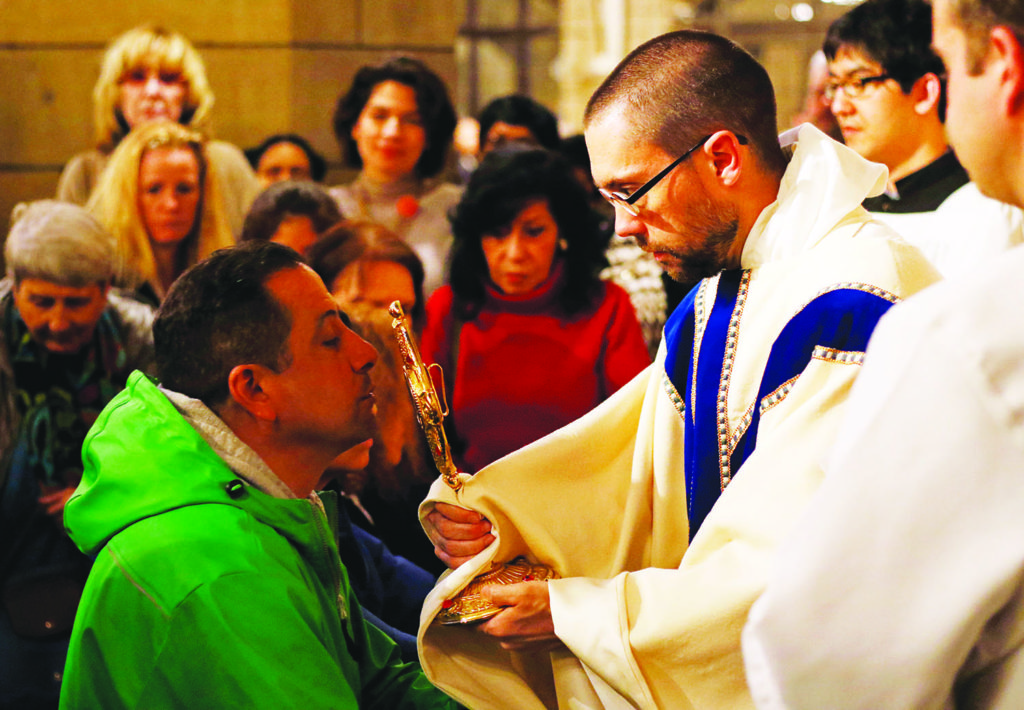
 Dominican Father Thomas More Garrett holds a reliquary containing a first-class relic of St. John Paul II as a man venerates it following a May 13 Mass marking the dedication of a shrine to St. John Paul at St. Vincent Ferrer Church in New York City. The liturgy coincided with the 100th anniversary of the first Marian apparition in Fatima, Portugal, and the 36th anniversary of the assassination attempt on St. John Paul. (CNS photo/Gregory A. Shemitz) See FATIMA-JPII-SHRINE-NEWYORK May 16, 2017.
Relics and sacramentals might seem pretty ordinary to Catholics, but for many non-Catholic Christians they seem strange and somewhat foreign to the Christian faith. They might say, “What does a piece of cloth or bone have to do with God’s grace? All we need is faith!”
However, these sacramentals and relics are not only found in the Bible, but there are a few striking examples in which God bestows spiritual benefits on people when they come in contact with physical things, like clothing that touched a saint or even a saint’s bones. Don’t believe it? Look at St. Luke’s account of Paul’s activities in Ephesus.
According to Luke, St. Paul’s missionary activity in Ephesus included many astounding miracles. In fact, Luke adds, “So extraordinary were the mighty deeds God accomplished at the hands of Paul that when face cloths or aprons that touched his skin were applied to the sick, their diseases left them and the evil spirits came out of them” (Acts 19:11-12).
This episode wasn’t isolated to Ephesus. Luke also records a similar phenomenon when the apostles were healing people in the temple area. The miracles that God performed through the apostles were so great and well known that the people, “even carried the sick out into the streets and laid them on cots and mats so that when Peter came by, at least his shadow might fall on one or another of them” (Acts 5:15).
Someone might retort: “But isn’t it the person’s faith that brings about the cure?” It’s true that Jesus healed people based on their faith. Jesus even healed people on the basis of the faith of a third party, such as when Jesus healed the slave of the centurion in accord with his master’s professed faith (Luke 7:1-10). But there are also other examples where God heals someone through contact with a saint when there is no faith present at all. For example, 2 Kings 13:20-21 says, “Once some people were burying a man, when suddenly they spied such a raiding band. So they cast the dead man into the grave of Elisha, and everyone went off. But when the man came in contact with the bones of Elisha, he came back to life and rose to his feet.”
What’s interesting about this episode is that faith is nowhere operative in the story. Elisha didn’t have faith. He was dead. The person who was cast into Elisha’s grave didn’t have faith either. He was dead, too. What about the people who cast the dead man’s body into the grave? Did they have faith? Apparently not. There is nothing in the passage that says so, in fact, and it seems the only reason they put the body there was to avoid a band of raiding Moabites. Nevertheless, God raised the dead man to life when his corpse touched Elisha’s bones (or, as we would say today, he touched Elisha’s first-class relics). Scripture doesn’t say why God did what he did, but I think it’s clear that God wished to show forth his power through Elisha, even in death.
But does this mean that sacramentals and relics confer grace like the sacraments? By no means. The Catechism of the Catholic Church helps clarify the difference between sacramentals and the sacraments when it says, “Sacramentals do not confer the grace of the Holy Spirit in the way that the sacraments do, but by the Church’s prayer, they prepare us to receive grace and dispose us to cooperate with it ...” (CCC 1670).
 Gary Michuta
This is important to keep in mind. Sacramentals and relics are not the causes of grace or spiritual benefits. You can’t say to a sick person, “Take two sacramentals and be healed in the morning.” Rather, they prepare us to receive grace and dispose us to cooperate with God’s grace. They, in a sense, provide the Lord with an opportunity to act, if he wishes do so.
Gary Michuta is an apologist, author and speaker and a member of St. Michael the Archangel Parish in Livonia. Visit his website at www.handsonapologetics.com.