
Why does the Church canonize people? Partly to give glory to God, who works marvels in frail human beings! We look at the cathedrals soaring to the heavens and praise the vision of their architects; we read Shakespeare and praise his literary genius. All human artistry, however, is but a participation in the divine artistry, whose greatest masterpieces are the holy men and women of every age.
Hopefully, each of us has been blessed to know someone holy, a person in whose eyes one sees God’s love, in whose words one hears it. But even if one has not, such holy people, the saints, are waiting to meet us. Standing before the face of God, they are, in a sense, more present to us than they were when living on earth. They desire ardently that we join them in heaven, and they rejoice to bring our petitions before God’s throne.
Saints spring up in all eras, all walks of life. Eighteenth-century Europe witnessed the peregrinations of St. Benedict Joseph Labre, whose mental illness excluded him from the religious life he desired and propelled him onto a different path of communion with God. He travelled from shrine to shrine and eventually settled in Rome, where he lived on the street and spent his days in the churches, speaking little and loving much, practicing mortification and almsgiving and accepting humbly the ridicule of others.
Across the Atlantic, a young Episcopalian widow of high culture and distinguished family was making her own pilgrimage of faith: St. Elizabeth Seton left friends, relatives, and financial security to embrace the truth of Catholicism and spent her life caring for the intellectual and spiritual formation of youth. On Nov. 1, All Saints Day, we celebrate not just these and all canonized saints but the countless non-canonized ones, those who lived their lives quietly with God and for him, day in and day out, faithful to prayer, kind in speech, generous with their time.
Reading books by and about saints stirs up our desire for holiness and introduces us to new heavenly friends, to whom we can turn for help. St. Augustine’s “Confessions” and St. Teresa of Avila’s autobiography combine candor, piercing beauty, and lively humor. “A Man For Others” and “Padre Pro,” two excellent modern biographies, recount the gripping stories of St. Maximilian Kolbe and Jesuit martyr Fr. Miguel Pro.
As we get to know the saints, and as their love of God inflames ours, let us make our own the prayer of Cardinal Newman: “Dear Jesus, penetrate and possess my whole being so utterly that all my life may only be a radiance of Thine. Shine through me and be so in me that every soul I come in contact with may feel Thy presence in my soul. Let them look up and see no longer me but only Jesus.”
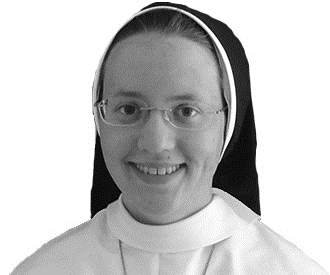
Sr. Maria Veritas Marks, OP, is a member of the Ann Arbor-based Dominican Sisters of Mary, Mother of the Eucharist.