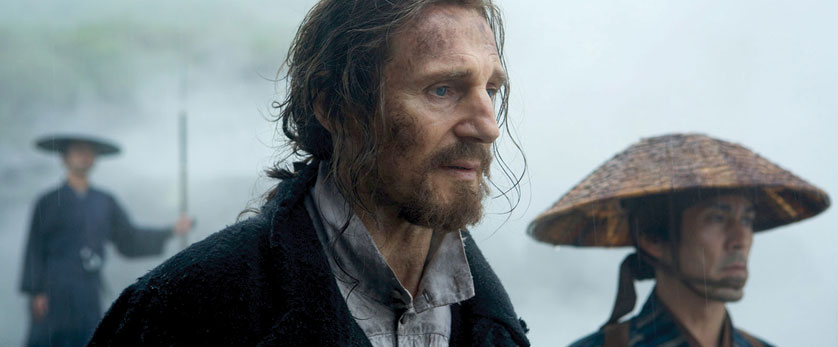
 Liam Neeson stars in a scene from the movie "Silence." The Catholic News Service classification is L -- limited adult audience, films whose problematic content many adults would find troubling. The Motion Picture Association of America rating is R -- restricted. Under 17 requires accompanying parent or adult guardian. (CNS photo/Paramount) See MOVIE-REVIEW-SILENCE-(EMBARGOED) Dec. 22, 2016.
Silence is a grueling examination of what persecution does to Christians (i.e., interiorly, emotionally), and about the apostasy that sometimes is a result of that. Whenever persecution sets in, there are always three types of Christians (sort of like the parable of the sower):
1.) Those who immediately cave in — cowards, weaklings.
2.) Those who agonize and realize the sublime gravity of the situation. They might go either way, depending on the level of pressure and various other factors (temperamental, health, etc.).
3.) Those who have heroic faith and achieve a glorious martyrdom and witness for Christ.
We go through that in daily life to a much lesser extent, but in an analogous way. If the faith is being mocked at our workplace, for example, do we laugh along, as spineless wimps? Do we feel very uncomfortable and troubled and conflicted, and make some kind of protest, however feeble? Or do we directly confront it and take a principled, public stand, which will cost us?
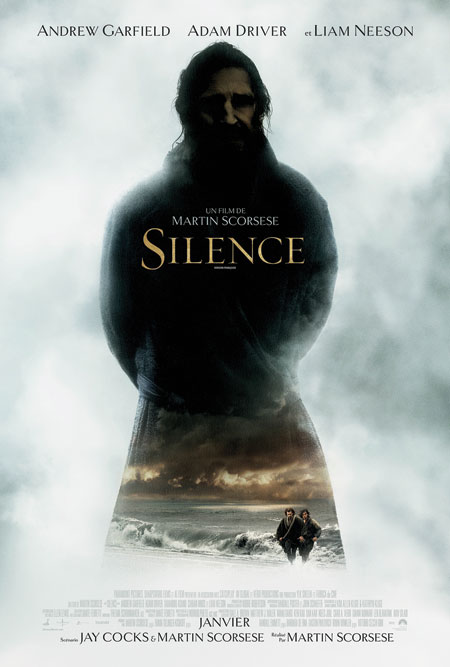 This is a poster for the movie "Silence," directed by Martin Scorsese. In two long interviews with Jesuit publications, Scorsese describes his new film as a major stage in his pilgrimage of faith, a pilgrimage that included flunking out of the minor seminary, investigating other religions and recognizing that the Catholic Church was his home. (CNS artwork/Paramount) See SCORSESE-SILENCE-JESUITS Dec. 9, 2016.
The film deals with these sorts of things, and also the apostasy that is a live possibility in these horrible scenarios. Priests in 17th century Japan were subjected to truly extraordinary pressures of brainwashing, psychological torture, and coercion (if the movie is accurate in this regard).
 Dave Armstrong
We must take that into consideration, if they don’t always act heroically. I wrote earlier, before having seen it: “It depends on how the whole thing is portrayed. There are such things as apostates. In any event, none of us know how we would act under threat of torture.”
I wrote recently on my Facebook page, before I saw the film:
“To portray apostasy, in and of itself is not necessarily trying to glorify it, or being slanted. But perceptions of whether or not a portrayal is excessive or bad cinema or slanted in some way are themselves subjective. That makes movies, like music, fun to discuss.
“How a Christian acts under persecution is a legitimate dramatic theme. I don’t see it as immediately objectionable for a movie to show that that happens in the real world.
“Theologians and apologists like myself, after all, write about and explain ‘sinners in the Church’ as a thing we should expect (referred to in the Bible), so we shouldn’t be shocked to actually find some, or to see it portrayed in a movie. If this one shows good examples of faithful Catholics, too, then I think it can be considered ‘fair’ in terms of cinematic portrayal.”
Having now seen it, I don’t believe that it is trying to glorify apostasy, but rather, it simply shows what people went through in these horrible situations. Not all will pass the test, and it’s absurd for us to sit in our easy chairs and judge them. I’m not saying they were right, or trying to excuse or rationalize what they did (as secularists will often do).
Christians ought to be willing to be martyrs if it comes to that. But we need to understand what they went through. Causes are not justifications, if sin is involved, but they are prior causes, to be considered.
The movie did indeed show many inspiring faithful Catholics, willing to suffer for their faith and to become heroic martyrs. Not every movie has to exclusively dramatize that. Plenty of “old-time” Christian movies do. There is also a place to explore the horrors of persecution on a human, emotional level: what the constant fear of it does to people.
Yes, we can do all things through Christ, Who strengthens us, including enduring torture and death. But some (many?) Christians will not have that strength when the terrible time of decision comes for them. They haven’t cultivated it enough in their spiritual life — haven’t allowed God’s grace to fully work in them — before their “hour” comes.
This film helps us sympathize with what persecuted Christians go through, and is very useful in that regard. The more we can relate to those struggles, the better. Christians are being slaughtered right now all over the world.
The film is not for those who have considerable struggles of faith and doubt. It might actually be traumatic. I’ve written similarly about the Harry Potter movies, contending that if one doesn’t have a strong Christian faith, there is significant danger there of being possibly drawn into the occult (as I was in my early life), to fill the spiritual void. But if one is well-educated in the Catholic faith, they pose little or no danger, and are understood as being fantasies: essentially modern fairy tales.
If we are strong in the faith, we know full well that there are plenty of weak, ineffectual Christians, barely hanging on. That shouldn’t make us doubt the faith at all. Rather, it shows us the rebelliousness and sinful weakness of human beings.
The proper response, then, is to redouble our efforts to spread the faith and its hopeful, joyful message (and the rationale for the faith: my area), complete with the grace and power to live the Christian life, if only we would fully resolve ourselves to do so, led by the Holy Spirit within us.
It’s good to become more familiar with stories of both martyrdom and apostasy, since we are so unfamiliar with persecution and this sort of “dramatic” apostasy. Most apostasy in our culture is of a very “cool” and detached and cynical variety: living as if God didn’t exist and as if Christianity has no bearing on one’s life. It’s much more sheer ignorance or apathy rather than direct renunciation.
We need to observe what many Christians now and in the past have had to endure, and try to put ourselves in their places, and do some serious soul-searching. This film provides an excellent opportunity to do that.
Footnote: The film has one scene where Jesus is speaking (a “voice from heaven”), which is disputable, but not in my opinion indisputably heretical or utterly impossible. I don’t personally believe that God would say it.
Dave Armstrong has been a published Catholic apologist since 1993 and webmaster since 1997. He lives in Allen Park, grew up in Detroit, and is a member of Mother of Divine Mercy Parish near downtown. He’s been happily married to his wife Judy since 1984, and they have three sons and a daughter. Dave has written or edited 48 books on apologetics, including several bestsellers. If you’d like to help keep his influential teaching apostolate going as a much-needed monthly supporter, write to Dave at [email protected].