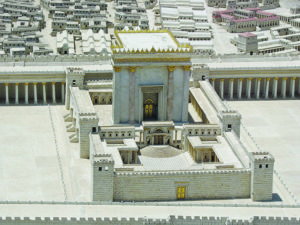
 A representation of the second Jerusalem temple shows the wall that separates the inner temple area from the outer “court of the gentiles.” By Christ’s crucifixion and resurrection, gentiles were admitted into the “new temple” of Christ’s body, the Church.
One of the most significant geopolitical symbols of our time is the wall.
Winston Churchill famously condemned the rise of the Soviet bloc as an “iron curtain” that had descended across Europe. Nothing better symbolized Churchill’s metaphorical wall than the Berlin Wall, which divided the German capital from 1961 to 1989. When Mikhail Gorbachev, the leader of the Soviet Union, wished to have a more open relationship with the West, U.S. President Ronald Reagan challenged him to “tear down this wall.”
The Berlin Wall was eventually torn down and the Soviet Union collapsed. The New Testament has its own symbolic and literal wall. Unlike the “iron curtain” that symbolized oppression or imprisonment, the New Testament wall was that of division and separation, namely the separation between Jews and gentiles.
This metaphorical wall of separation began as a good thing. As the Catechism states, “God, our Creator and Redeemer, chose Israel for himself to be his people and revealed his Law to them, thus preparing for the coming of Christ” (CCC 1961). By choosing the Jews as his people, God prepared the Israelites for the messiah’s coming. Like a good gardener, he planted, watered and erected a hedge around his garden to protect it from predators and other dangers.
This metaphorical hedge, or wall, was a series of laws and regulations that kept the Israelites separate from the rest of the world. However, the coming of the messiah changed this. No longer would God’s people be a garden separated from the world, but the messiah would transform the world into the garden — that is to say, both Jews and gentiles could now become members of God’s covenant people, Christ’s body, the Church.
The change was drastic. The Jews saw the gentiles as being “alienated from the community of Israel and strangers to the covenants of promise, without hope and without God in the world” (Ephesians 2:11). But now, through faith in the messiah, all people can become members of a new covenant. Unfortunately, not everybody was ready for the change. We learn in the Acts of the Apostles that some devout Jewish Christians insisted that gentile converts needed to be circumcised and follow the Mosaic law in order to be saved (Acts 15:1). The controversy became so heated that a council met and declared that Jews and gentiles are both saved by grace.
St. Paul picks up on this notion when he speaks of the “wall of enmity.”
“But now in Christ Jesus you who once were far off have become near by the blood of Christ. For he is our peace, he who made both one and broke down the dividing wall of enmity, through his flesh, abolishing the law with its commandments and legal claims, that he might create in himself one new person in place of the two, thus establishing peace” (Ephesians 2:13-15).
Like the “iron curtain” and the Berlin wall, Paul’s “wall of enmity” was both a metaphor and an actual physical wall, which was located in the courts of the Jerusalem temple.
The temple area was divided into precincts. Gentiles were only allowed to occupy an area called “the court of the gentiles.” This area was walled off from the rest of the temple area and it contained threats, written in Greek and Latin, forbidding gentiles from coming any closer to the temple.
In 1871, scholars discovered a stone from this wall that contained the following warning:
“No foreigner is to go beyond the wall and the plaza of the temple zone. Whoever is caught doing so will have himself to blame for his death which will follow.”
 Gary Michuta
As you can see, Paul’s description was quite accurate. It certainly was a “wall of enmity.” While the gentiles had some access to the temple in the court of the gentiles, they weren’t allowed full access. This wall was metaphorically “torn down” by the cross, when the temple of Christ’s body died and was resurrected. One generation later, in A.D. 70, the physical “wall of enmity” also came to an end when the temple was destroyed by the Romans.
Gary Michuta is an apologist, author and speaker and a member of St. Michael the Archangel Parish in Livonia. Visit his website at www.handsonapologetics.com.