
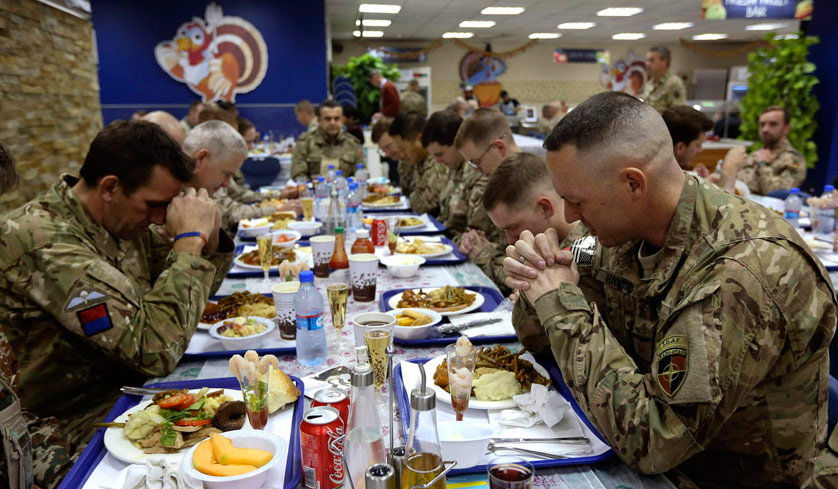
 U.S. troops pray before eating a Thanksgiving meal at a NATO base in Kabul, Afghanistan, Nov. 28. (CNS photo/Omar Sobhani, Reuters) (Dec. 2, 2013)
Thanksgiving, celebrated by our Puritan forefathers since 1777, is, at heart, a most Catholic celebration. “Thanksgiving” in Greek is “eucharist.” This might at first surprise us: wouldn’t the name of the “source and summit” of the Church’s life come from a more fundamental concept — “love,” perhaps, or “sacrifice”? Actually, “thanksgiving” holds depths of meaning.
We call Christ’s Body and Blood the “Eucharist” because, at the Last Supper, in the context of the Passover Seder, Christ “gave thanks” — in Greek, “eucharisted” — before changing the bread and wine into His Body and Blood. In fact, the entire Passover meal is an effusion of gratitude for all God’s blessings to His people. One of the Seder’s most poignant prayers is the “Dayenu” song, in which each of God’s gifts is listed, followed by the Hebrew word “dayenu,” “it would have sufficed”:
“If He had supplied our needs in the desert for forty years, and had not fed us the manna: Dayenu, it would have sufficed us! If He had fed us the manna, and had not given us the Sabbath: Dayenu, it would have sufficed us!”
Fourteen times a favor is listed, and 14 times the people respond, “Dayenu.”
As Catholics, we claim all these heavenly favors as our heritage, and we can extend the list to include the marvels of the New Covenant: “If God had given us Christ to redeem us and had not fed us with His Body and Blood: Dayenu, it would have sufficed us! If He had fed us with His Body and Blood and had not given us His life in all the other sacraments: Dayenu, it would have sufficed us!”
God’s gifts to the Church are astounding; equally so are His gifts to each of us personally. A helpful practice in prayer is to thank God for five blessings of the past day; this alerts us to God’s work in our lives and reminds us to praise Him, despite our crosses. In fact, eventually we will learn to thank God for our sufferings, too, because it is in them that we draw close to our crucified Lord.
It can be deeply moving to meet someone overflowing with gratitude who has little, on a superficial level, for which to be thankful. My grandfather lived to the age of 95; a conscientious gentleman not inclined to emotional display, he demonstrated in his last years a touching appreciation for what was done for him. He would tell his nurses again and again, “Thank you! You are wonderful!” Even when he no longer spoke, he thanked them with his eyes for the simplest things, for helping him to stand and walk. When he died, several of them told us, “It was a tremendous joy to care for him.”
Everything we have, everything we are, is a gift from God. “What do you possess that you have not received?” (1 Cor. 4:17). A true spirit of gratitude will make us beacons of light to those around us.
Sr. Maria Veritas Marks is a member of the Ann Arbor-based Dominican Sisters of Mary, Mother of the Eucharist.