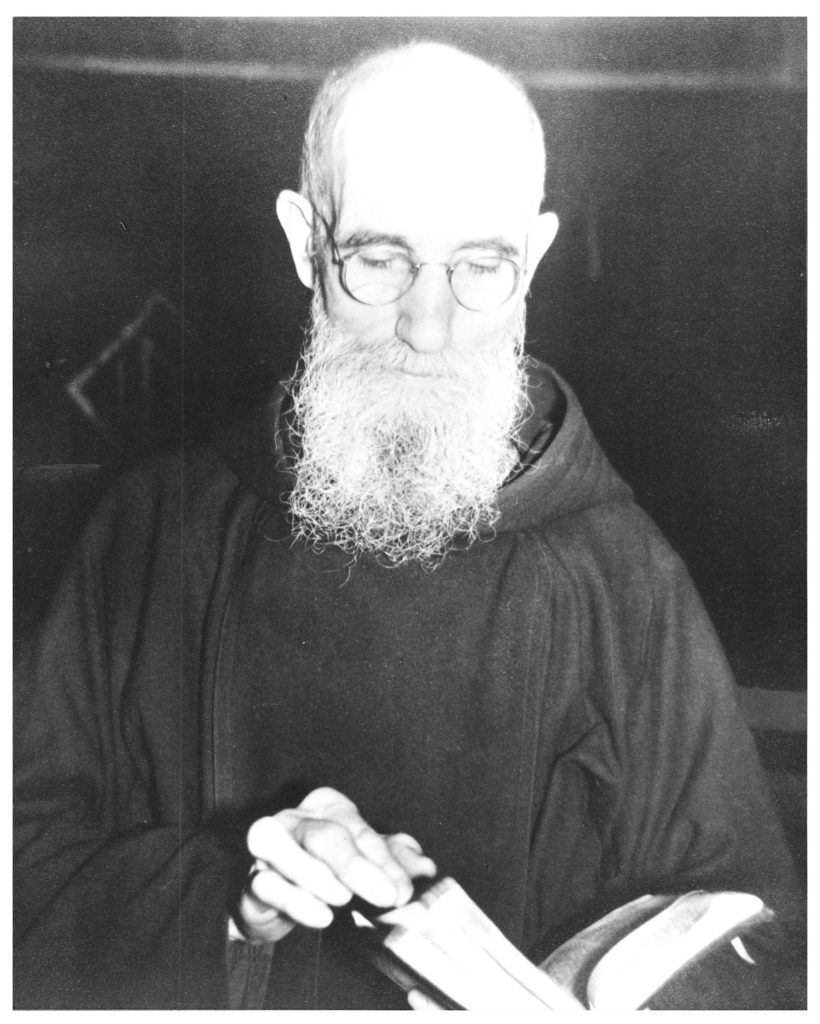
 Fr. Solanus Casey, OFM Cap., reads Scripture in this 1939 portrait. Like Fr. Solanus and all the saints and blesseds, Scripture holds up scores of holy men and women in the Old Testament — showing the veneration of saints is an ancient and biblical practice.
Courtesy of the Solanus Casey Center
With the beatification this week of Detroit’s own Fr. Solanus Casey, many Catholics are aware that the canonization of saints is an ancient practice. But fewer are aware that the roots of placing the saints as exemplars and role models goes back to biblical times.
The most famous example of extolling the righteous feats of the Old Testament saints is found in the eleventh chapter of the Epistle to the Hebrews.
In this chapter, the author introduces faith as “the realization of what is hoped for and evidence of things not seen” and then lists examples of those who “were well attested,” as the New American Bible puts it. The Revised Standard Version (Catholic Edition) translates this phrase as those who “received divine approval.” In other words, the saints listed weren’t just picked at random; they were chosen because God approved and attested to their righteous deeds in Scripture. Therefore, they are worthy of honor.
Who were these ancients? Hebrews 11:4-37 references Abel, Enoch, Noah, Abraham, Sarah, Isaac, Jacob, Joseph, Moses, Joshua, Rahab, Gideon, Barak, Samson, Jephthah, David, Daniel, Elijah, Elisha, the Maccabean martyrs, Jeremiah, Zechariah the son of Jehoiada, Isaiah, and the prophets in general.
After recounting the hardships they endured while remaining faithful to God, Hebrews concludes, “Therefore, since we are surrounded by so great a cloud of witnesses, let us rid ourselves of every burden and sin that clings to us and persevere in running the race that lies before us” (Hebrews 12:1). The saints surround us as a “cloud of witnesses” to encourage us to follow in their footsteps, endure hardships as they did, and to persevere in faith until we obtain our goal, eternal life.
But the Epistle to the Hebrews wasn’t staking out new ground when it praises these saints, nor was it a distinctively Christian practice. The Old Testament also “praises the fathers” and holds them up as role models. In Sirach 44:1-50:21, the author recounts how “There were those who ruled in their kingdoms, and were men renowned for their power, giving counsel by their understanding, and proclaiming prophecies; leaders of the people in their deliberations and in understanding of learning for the people, wise in their words of instruction; those who composed musical tunes, and set forth verses in writing; rich men furnished with resources, living peaceably in their habitations — all these were honored in their generations, and were the glory of their times” (Sirach 44:3-7).
Who were these people? Sirach describes the glory of Adam, Enoch, Seth, Shem, Noah, Isaac, Jacob, Aaron, Moses, Phinehas, Joshua, Caleb, the Judges, Samuel, Nathan, David, Solomon, Elijah, Elisha, Hezekiah, Isaiah, Josiah, Jeremiah, Ezekiel, the twelve minor prophets, Zerubbabel, Jeshua the son of Jozadak, and Simon the high priest, son of Onias.
As you can see, honoring saints and holding them up as role models was an ancient and biblical practice. Still, many non-Catholics fear that the honor Catholics show to the saints somehow detracts from the honor that should be due to God. “Why honor some creature,” they assert, “when we really should be directing all our honor and praise to God alone?”
The problem with this objection is that it assumes the situation is an either/or proposition. Either we honor God or we honor something other than God. Of course, such is not the case, as these scriptural passages show. The Bible isn’t detracting from the honor and glory due to God by recognizing these saints and using them as encouragement for us.
Quite the contrary. Praising these people is just another way of praising God, like honoring a painter by admiring his paintings. It is God’s work of grace in the saints that make the saints worthy of honor — as Our Lady herself points out in the Magnificat when she says, “For behold, henceforth all generations will call me blessed; for he who is mighty has done great things for me, and holy is his name” (Luke 1:48-49).
 Gary Michuta
Why will all generations call Mary blessed? God has done great things for her. As Sirach 44:2 says, “The Lord apportioned to them great glory, his majesty from the beginning.” How, then, can we too not raise them up and call them blessed?
Gary Michuta is an apologist, author and speaker and a member of St. Michael the Archangel Parish in Livonia. Visit his website at www.handsonapologetics.com.