 Dave Armstrong
Apologists hear every fable, myth, and tall tale regarding theology that anyone could ever imagine. I’ve heard this one for more than 30 years. In fact, one of my first research projects in the early 80s, after I started taking up apologetics (back in my evangelical days), was to collect biblical passages that provide evidence for the Holy Trinity and deity, or divinity, of Jesus Christ.
I’ve compiled this information in one of my books, called Theology of God (if anyone is looking for a handy guide on the issue). Presently, I’d like to highlight a few of the more obvious, undeniable, plain passages, to counter this notion that’s cropped up on occasion that Jesus was possibly someone other than God.
John 1:1, 14 (RSV) “In the beginning was the Word, and the Word was with God, and the Word was God. . . . [14] And the Word became flesh and dwelt among us, full of grace and truth; we have beheld his glory, glory as of the only Son from the Father.”
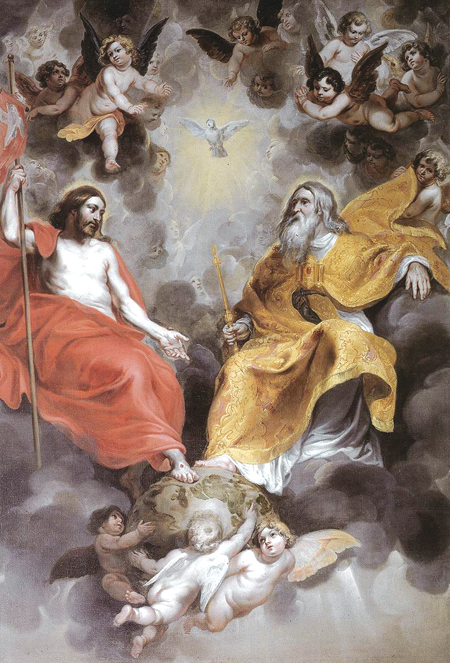 Jesus is depicted at the right hand of God the Father, with the Holy Spirit represented as a dove in Hendrick van Balen's "holy Trinity". The modern notion that Scripture doesn't claim Jesus to be God can be shown false in numerous passages. In Scripture, even the Father calls the Son by the name of God.
This is one of the most well-known “proof-texts.” Jesus is eternal (here, “beginning” means “eternity past”). He was with God the Father, and is God the Son. To make sure the reader has no misunderstanding, John (v. 14) reiterates that the “Word” referred to is the Son, and notes that He “became flesh” (the incarnation). Only the Son has a body. The Word = Jesus = God.
John 10:30 “I and the Father are one.”
Jesus’ hearers, unbelieving Jews, certainly understood His intent in saying this, because they tried to stone Him, as the next verse informs us. They didn’t believe His claim, which, if indeed untrue, would be intolerable blasphemy. Verse 10:33 informs us they tried to stone Him because (in their words) “you, being a man, make yourself God.”
John 20:28 “Thomas answered him, ‘My Lord and my God!’”
This had to do with the famous “Doubting Thomas” incident. Thomas didn’t believe Jesus had risen, so Jesus appeared for His sake and told him to touch the wound in His side. Then Thomas believed and said this. If it were untrue, Jesus would have corrected him, but He didn’t; He commended Thomas because he “believed.”
Colossians 1:19 “For in him all the fullness of God was pleased to dwell…”
In context, it is the Son Who is being described (1:13); He is eternal (1:15, 17-18), the Creator (1:16), and the unifying principle of the universe (1:17; cf. Heb 1:3): all attributes true only of God. Paul makes the notion even more explicit in the next chapter:
Colossians 2:9 “For in him the whole fullness of deity dwells bodily…”
Then, there’s this:
2 Peter 1:1 “... our God and Savior Jesus Christ:”
St. Paul uses the same phrase in Titus 2:13.
Hebrews 1:8 “But of the Son he says, “Thy throne, O God, is for ever and ever, the righteous scepter is the scepter of thy kingdom.”
This is a remarkable passage, in which God the Father calls His Son “God.” It is a reference to the Old Testament passage, Psalm 45:6-7.
In Hebrews 1:6, God the Father also says all the angels should worship God the Son. Worship can only be rightly applied to God, as we know from Exodus 34:14 and Deuteronomy 8:19. Yet Jesus accepted worship of Himself on many occasions (e.g., Mt 14:33; 28:9) and stated that He should be honored equally with the Father (Jn 5:23). In Revelation 5:8, 12-13 and Colossians 2:6-7, we find Jesus is worshiped in every way the Bible specifically describes worship of God the Father, with all the same words used (see: Rev 4:9-11, 5:13; 7:11-12, and Rom 11:33).
Jesus is omnipotent (possesses all power):
Philippians 3:20-21 “... the Lord Jesus Christ, [21] who will change our lowly body to be like his glorious body, by the power which enables him even to subject all things to himself.”
He’s omniscient (all-knowing):
Colossians 2:2-3 “... Christ, [3] in whom are hid all the treasures of wisdom and knowledge.”
He’s omnipresent (present everywhere):
Ephesians 1:22-23 “… the church, [23] which is his body, the fullness of him who fills all in all.” (cf. Col 3:11)
Another astonishing passage along these lines is one in which Jesus speaks about historical events described as being done by God the Father in the Old Testament. He casually applies them to Himself (what might be called “the Divine ‘I’”):
Matthew 23:34, 37 “Therefore I send you prophets and wise men and scribes, some of whom you will kill and crucify, and some you will scourge in your synagogues and persecute from town to town, ... [37] O Jerusalem, Jerusalem, killing the prophets and stoning those who are sent to you! How often would I have gathered your children together as a hen gathers her brood under her wings, and you would not!”
Many attributes that are said to belong only to “God” are applied to Jesus in Scripture. God the Father said, “besides me there is no savior” (Is 43:11; cf. 1 Tim 4:10). Yet Jesus is called the “savior” of mankind in passages such as Luke 2:11 and others.
God the Father stated, “To me every knee shall bow, every tongue shall swear” (Is 45:23). The same exact description is also applied to Jesus (Phil 2:10-11).
The Bible teaches that “God” is judge (1 Sam 2:10; Ps 50:6; Ecc 12:14; many others). But so is Jesus (Jn 5:22, 27; 9:39; Acts 10:42; 2 Tim 4:1). Therefore, He is God.
God the Father sits on His throne in heaven (1 Ki 22:19; Ps 11:4; 47:8). Jesus is on the same throne, too (Rev 7:17; 22:1, 3).
At every turn in the Bible, only one conclusion is possible, to make sense of all these statements, taken together as a whole: Jesus is God the Son. He is the eternal, all-powerful, all-loving, self-existent Creator God.
Dave Armstrong has been a full-time Catholic apologist since 2001. He lives in Melvindale, grew up in Detroit, and attends St. Joseph Church near downtown. He has been happily married to his wife Judy since 1984, and they have four children. Dave has written 44 books on various apologetics topics, including five for Sophia Institute Press, and several bestsellers in the field. These are available for purchase (ePub, mobi, or PDF) at his deep discount booksite, www.biblicalcatholicism.com, and in paperback elsewhere.