


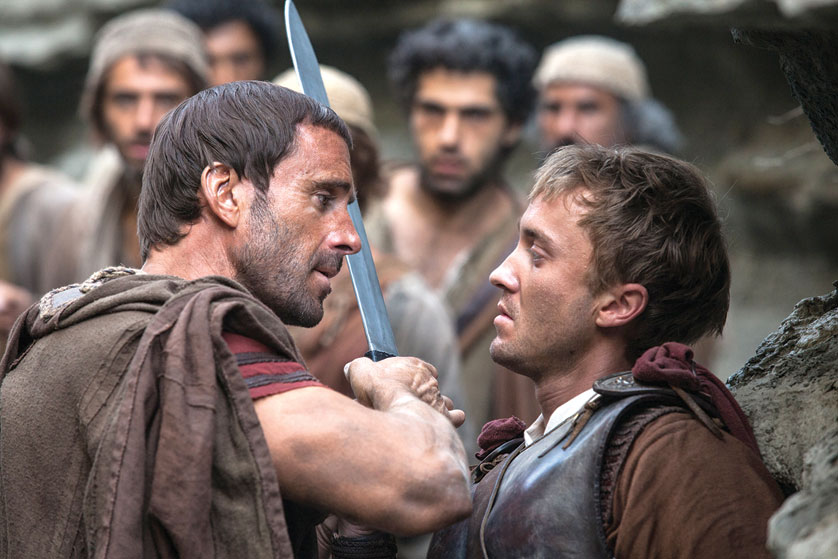
 Joseph Fiennes and Tom Felton star in a scene from the movie "Risen." The Catholic News Service classification is A-III -- adults. The Motion Picture Association of America rating is PG-13 -- parents strongly cautioned. Some material may be inappropriate for children under 13. (CNS photo/Columbia Pictures) See MOVIE-REVIEW-RISEN Feb. 18, 2016.
The priest giving our Community’s retreat one summer exuded dignity and solemnity. Weighed and weighted were each word in his talks, each gesture of his Mass, even each step as he strolled the Motherhouse grounds. And yet — was I mistaken? — I detected a subtle twinkling in his eyes. No matter the heft of the philosophical and theological concepts involved in his talks, his eyes whispered, “This is all part of a delightful divine joke.”
 Sr. Marks
Years of contemplating divine mysteries had taught Father, I think, that the universe is a comedy — a comedy not in our modern sense but in the classic sense of a story that ends happily. Humor often plays on incongruities, and the history of salvation cannot be better described than one immense incongruity — that ends happily. It starts with the self-sufficient One whose life is the interchange of Love among Three. For reasons beyond us, this One decides to create a universe of time and space, of plants, animals, and those inexplicable creatures, humans.
Sin turns the world topsy-turvy, so that God’s ways are nevermore man’s ways. To the Romans’ dreams of empire, triumph, and glory, Christ opposes a cross as throne, the pierced side of a corpse as fountain of life, and self-emptying love as the only true glory.
To carry on His mission, He could not have picked a more disparate band of Apostles, 92 percent of whom went MIA when He was saving the world. Middle-class, salt-of-the-earth fishermen sat alongside a former tax collector, someone despised by fellow Israelites because he and his confreres worked for the hated Roman occupiers and amassed wealth by cheating. Matthew, in turn, sat next to Simon, a member of the Zealot sect, whose members committed themselves to ousting the Romans by any means, even violence.
Recently, my sophomores watched Risen, a movie exploring Christ’s resurrection from the perspective of a Roman tribune charged with finding His missing body. Clavius, the tribune, grows increasingly incredulous as he interrogates followers of the crucified Jew, who frustrate him with their mysterious statements about “rising again” and kingdoms “not of this world.” Finally, in a tone laced with sarcasm, he asks Bartholomew, “Yahweh manifests himself through a crazy, poor, dead Jew?” With a twinkle similar to the one I saw in our retreat priest’s eyes, Bartholomew responds, “Well, so it appears!”
From this crazy, poor, dead Jew, and the crazy, poor Jews who followed Him, grew the Church. It has conveyed to the world tremendous gifts of truth, beauty and goodness, but has also proved itself deserving of Hilaire Belloc’s quip: “a proof of its divinity might be found in the fact that no merely human institution conducted with such knavish imbecility would have lasted a fortnight.”
The story goes on, with its incongruities and its sorrows. In our sufferings, Christ weeps with us, as He wept with Martha and Mary over their brother’s death. But then He says, “Lazarus, come out.” And the story ends happily.
Sr. Maria Veritas Marks is a member of the Ann Arbor-based Dominican Sisters of Mary, Mother of the Eucharist.



