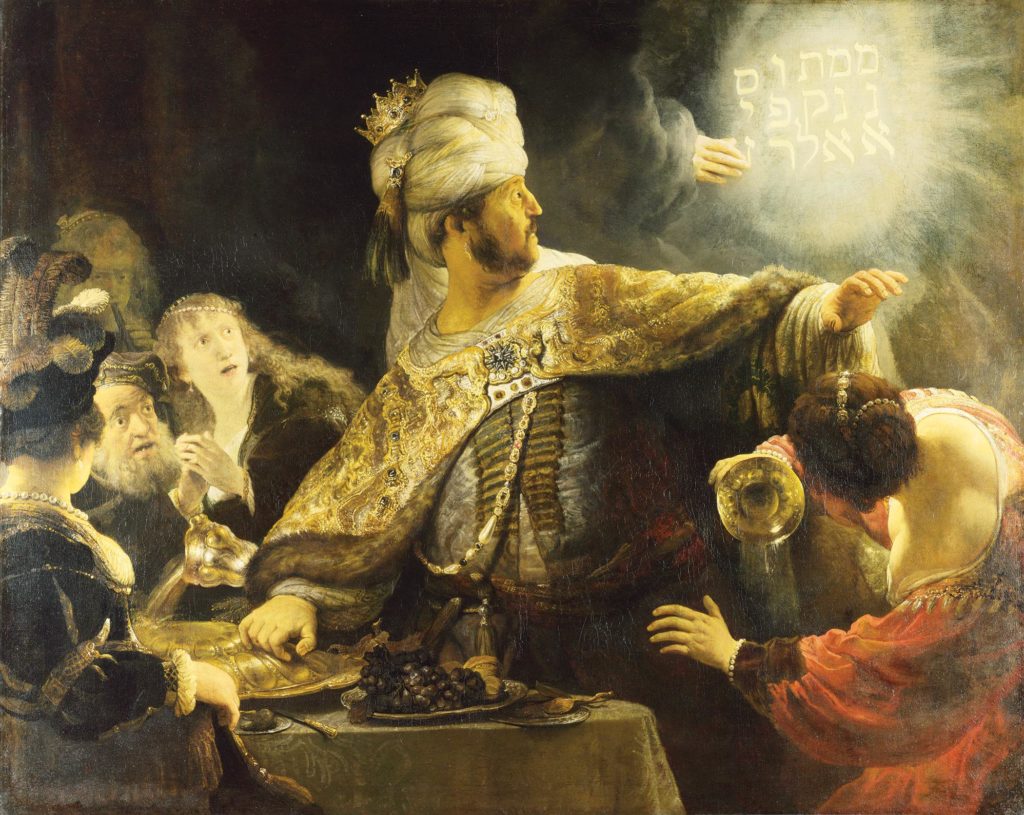
 King Belshazzar of Babylon takes sacred golden and silver vessels from the Jewish Temple in Jerusalem. In the Old Testament, sin is often likened to a “debt” to God, while good deeds are given as a “credit” — which helps explain why in Matthew’s version of the Our Father, we plead with God to “forgive us our debts.”
The most famous prayer in Christianity has to be the “Our Father.” We all know it by heart. But if you compare the Our Father we pray with Matthew 6:12 (Luke 11:4) you’ll notice that the words are somewhat different. We commonly pray “forgive us our trespasses as we forgive those who trespass against us,” but the text itself speaks of debts. Matthew 6:12 says, “...and forgive us our debts (Greek, opheiletēs; Latin, debita), as we forgive our debtors” and Luke 11:4 says, “... and forgive us our sins for we ourselves forgive everyone in debt to us...” Trespasses, I understand. But what is all this about debts? There is something more going on here than meets the eye.
There are a few instances in the Old Testament where Scripture regards sin and righteous deeds as debts and credits. For example, when King Nebuchadnezzar revealed his dream about being under God’s judgment, the prophet Daniel replied:
“Therefore, O king, take my advice; atone [Redeem] for your sins by good deeds, and for your misdeeds by kindness to the poor; then your prosperity will be long” (Daniel 4:24).
The word “redeem” is commonly used in the Bible for money that is paid to free someone from slavery (Leviticus 25:47-49). Nebuchadnezzar’s sins had placed him in debt to God, and good deeds (almsgiving) pays the debt back.
In the New Testament, Our Lord uses the analogy of debt in the parable of the unmerciful servant (Matthew 18:23-35). The King (the Father) forgives a servant of a massive debt. However, when that servant runs into another person who owes him a smaller debt, he demands repayment. The King learns of what had happened and calls back the unmerciful servant and demands that he pay back his entire debt. Jesus concludes: “So will my heavenly Father do to you, unless each of you forgives his brother from his heart.”
Where sin is likened to a debt, good deeds (especially giving to the poor) are likened to credit. The Book of Proverbs teaches us:
“He who has compassion on the poor lends to the LORD, and he will repay him for his good deed” (Proverbs 19:17).
In this rather shocking verse, we learn that in giving to the poor, we become God’s creditor. St. Basil, commenting on this verse, says:
“Consider the force of the statement, and you will admire the kindness of the Lawmaker. Whenever you have the intention of providing for a poor man for the Lord’s sake, the same thing is both a gift and a loan, a gift because of the expectation of no repayment, but a loan because of the great gift of the Master who pays in his place, and who, receiving trifling things through a poor man, will give great things in return for them. ‘He that hath mercy on the poor, lendeth to God.’”
The New Testament likewise speaks of righteous deeds in terms of credit. For example, our Lord speaks of giving to the poor in terms of accumulating a heavenly treasure when he speaks to the rich man in Matthew 19:21. Jesus tells the rich man, “... If you wish to be perfect, go, sell what you have and give to (the) poor, and you will have treasure in heaven. Then come, follow me.” In regards to fasting and almsgiving, Jesus says, “Do not store up for yourselves treasures on earth ... But store up treasures in heaven ... For where your treasure is, there also will your heart be” (Matthew 6:19-21).
All of this should be kept in its proper perspective. Every good work is the product of God’s grace that we freely assent to do. Therefore, the debt that is repaid through almsgiving is God’s grace working in us. Likewise, the righteous deeds that we do are also done freely by God’s grace. Therefore, whether it be our works of repentance for sin or the good deeds that we do, it is all grace working in us. As the Catechism of the Catholic Church says, quoting St. Augustine, “You are glorified in the assembly of your Holy Ones, for in crowning their merits you are crowning your own gifts” (CCC 2006).
 Gary Michuta
Gary Michuta is an apologist, author and speaker and a member of St. Michael the Archangel Parish in Livonia. Visit his website at www.handsonapologetics.com.