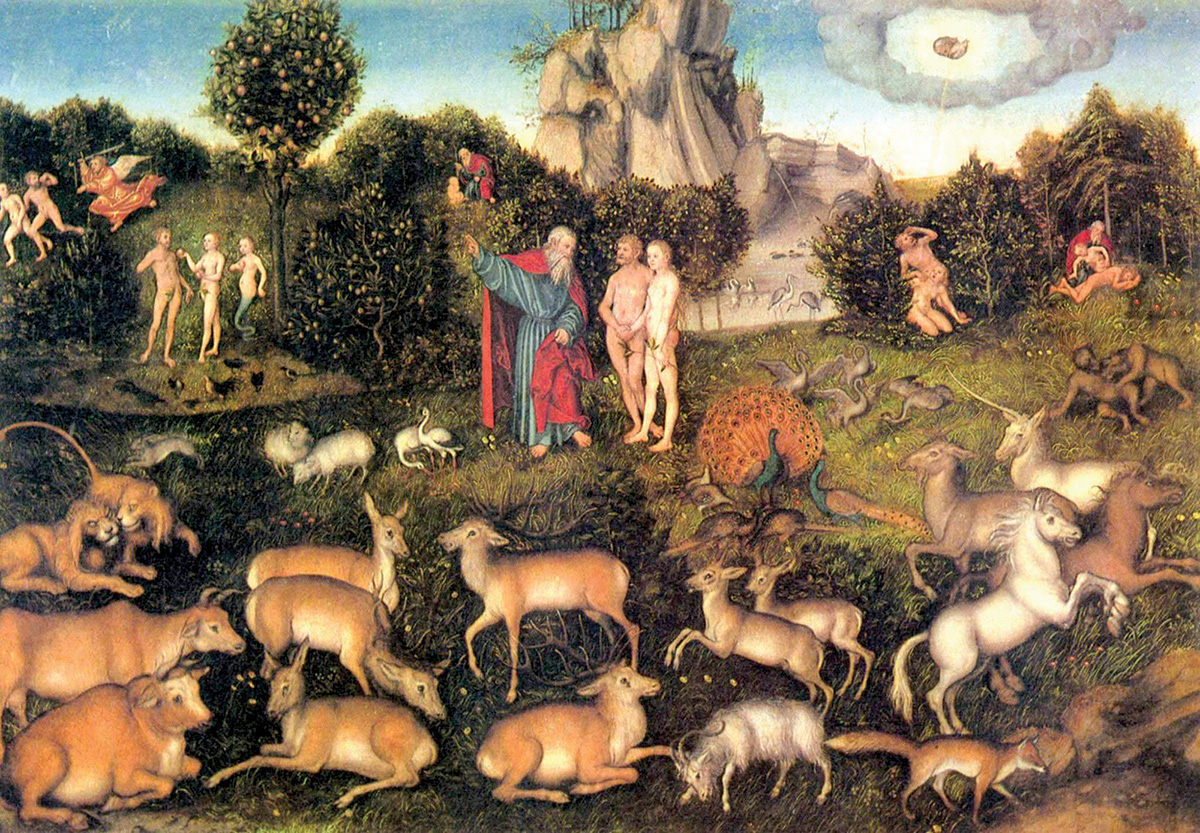
 The Garden of Eden is depicted in this 16th century work of Lucas Cranach the Elder. The story of creation in Genesis — and its later references in Wisdom and other works — can be thought of as two distinct parts: God’s “first creation,” or creation out of nothing, and His “second creation,” in which God fashions all He has made. | CNS photo
One of the last Old Testament books to be written is a book called The Wisdom of Solomon, or Wisdom for short. It is one of only two Old Testament books known to be originally composed in Greek, rather than Hebrew or Aramaic. In many ways, Wisdom is one of the most beautiful books to read.
Unfortunately, it is also one book that has been unfairly maligned by some. It is one of the seven Old Testament deuterocanonical books that have been rejected by Protestants as uninspired, or what they call the “Apocrypha.” In fact, most Protestant Bibles exclude this book altogether.
Wisdom also has raised a few eyebrows because it, unlike any other Old Testament work, seems to use terms and ideas that come from Greek philosophy. As a result, not a few non-Catholics have accused Wisdom of being “too Greek” to the point of being in error. In their haste to dismiss this book from the rolls of inspired literature, they’ve raised charges against certain passages that they believe contradict Judeo-Christian revelation. One such passage is Wisdom 11:18, which reads:
“For not without means was your almighty hand, that had fashioned the universe from formless matter...”
From this passage, people have rashly charged that the author has embraced Greek philosophy because the ancient Greeks believed that the universe (matter) was eternal, unlike the Christian doctrine that teaches that God created all things from nothing (Latin, ex nihilo). According to these critics, Wisdom 11:18 denies creation from nothing, opting for the Greek notion that God merely fashioned the universe from formless pre-existing matter. Wisdom, therefore, cannot be Scripture!
Does Wisdom 11:18 really reject creation from nothing? Not at all. The reason it might seem to many to be doing so is because we’ve forgotten about a very important and fascinating biblical distinction found in Genesis 1 that was recognized by the early Church fathers. This distinction concerns what the early fathers called the “first creation” (Latin, creatio prima) and the “second creation” (creatio secondo).
You might have noticed that the creation narrative in the first chapter of Genesis begins in a very odd way. It reads, “In the beginning, when God created the heavens and the earth...” (Genesis 1:1). It then continues by describing how God turns the formless and void earth and brings about land, water, sky, animals, etc. As the early Church father Severian of Gabala (d. AD 408) wrote:
“On the first day God created out of nothing whatever He has made; but on the following days He did not create out of nothing, but according to His good pleasure fashioned that which He had made on the first day.”
But when does God create all things from nothing? It occurs in Genesis 1:1, “In the beginning, when God created the heavens and the earth...” This is the first creation (creatio prima) or creation proper. As Severian of Gabala notes, everything that came afterward was fashioned from what was made on the first day. This is what is called the “second creation” (creatio secondo).
Severian was not the only early Church father to notice this distinction. The three great Cappadocian fathers recognized it, along with St. Augustine. As to whether God immediately followed creation from nothing with fashioning what he made is an open question. Genesis doesn’t tell us, although the early fathers generally believed that there was an interval between creation proper and God’s work of separation and forming.
 Gary Michuta
Keeping this view in mind, let’s look again at Wisdom 11:18. Because many people have forgotten the distinction between the first and second creation, they assume any writing referring to creation must be speaking about God creating all things from nothing. However, this is not the case. Wisdom 11:18 is not speaking about the first creation (creation from nothing), but the second creation in which God fashions what He has made.
In other words, Wisdom 11:17 is not denying Genesis 1:1 — God created the heavens and the earth — but it is commenting on what God did from Genesis 1:2 onward. Wisdom 11:17 didn’t replace Jewish-Christian revelation with Greek philosophy; rather, it is revealing an important distinction that many often miss.
Gary Michuta is an apologist, author and speaker and a member of St. Michael the Archangel Parish in Livonia. Visit his website at www.handsonapologetics.com.