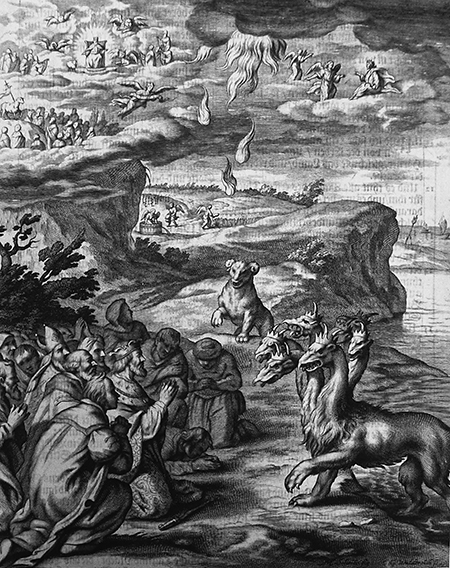
 The beast described in Revelation is pictured in this work of Phillip Medhurst. The writer of Revelation describes the “number of the beast” as 666, from which a number of implications can be drawn from the traditions and references of the Old Testament.
The number 666 appears all over the place, from horror movies to the markings on a popular energy drink. But what is so special about this number?
Those familiar with the Book of Revelation know that this is a number of the beast. In chapter 13, Revelation speaks about how the beast that will arise and perform miracles that will deceive the inhabitants of the earth. No one was allowed to buy or sell unless they had the image of the beast stamped on their right hands or their foreheads. The chapter closes with the following statement:
“Wisdom is needed here; one who understands can calculate the number of the beast, for it is a number that stands for a person. His number is six hundred and sixty-six” (Revelation 13:18).
What does it mean that the number “stands for the person”? Ancient languages didn’t use numbers; they used letters. Different letters were assigned certain numeric values, such as the case with Roman numerals. The letter “I” has the value of one and “V” has the value of five and so on. This means that names that contain letters with numeric values can add up to a number, and according to Revelation, the beast’s name adds up to 666.
I’m sorry to disappoint you, but there’s not even room in this article to identify the beast, per se. Instead, we are going to look at the biblical background of this number, which, in some ways, is just as fascinating.
Scripture often associates ideas with numbers. For example, the number seven seems to be closely associated with the sense of covenant, fullness and completeness. For example, God created in six days and rested on the seventh. The seventh day has the sense of completeness and it is also the Sabbath, the covenant day of rest. Likewise, Abraham sacrificed seven ewe lambs to make a covenant at Beersheba in Genesis 21. We also see the same sense of completeness in Psalm 12:6, which reads: “The words of the Lord are pure words; As silver tried in a furnace on the earth, refined seven times.” Refining silver seven times makes it most pure. The number six is obviously one short of seven. It therefore carries a sense of incompleteness and not being of a covenant.
The fact that six is repeated three times is also significant. It is sometimes thought that Hebrew didn’t have a way to express superlatives (that something is the best), so it repeats it three times. This is not true, however. This doesn’t mean that the threefold repetition is meaningless. Scripture often associates three with God. For example, the Shema “Hear, O Isreal: the LORD our GOD, the LORD is one” mentions God three times. God is called “Holy” three times (Isaiah 6:3-4, Revelation 4:8) and there are three persons in the blessed Trinity (Matthew 28:19). The thrice repeated six could be seen as a blasphemous mocking of God, which certainly fits the context of Revelation 13.
But what about six-hundred and sixty six? Is there any biblical precedence for this number? It occurs in two contexts: The first is in regard to the number of sons of Adonikam in Ezra 2:13, but this is likely a scribal error (cf. Nehemiah 7:18-19). The second time 666 appears is in the life of King Solomon.
King Solomon? How could Solomon possibly be associated with someone like the beast? As you probably know, Solomon started out good, but he had a great fall. Deuteronomy 17:14-17 commanded the kings not to multiply armies (horses), foreign alliances (wives), or accumulate wealth. Solomon, despite his great gift of wisdom, violated all three of these restrictions and during the peak of his power received 666 talents of gold in a single year (1 Kings 10:14; 2 Chronicles 9:13). Solomon’s excesses led to oppressive taxation and eventually a revolt that broke apart his father’s kingdom. Revelation 13:18 may have had this in mind when it instructs the reader, “Wisdom is needed here,” since Solomon was known for his wisdom. The beast, whoever he was, must have been very much like Solomon, having massive armies, foreign alliances and wealth.
Gary Michuta is an apologist, author and speaker and a member of St. Michael the Archangel Parish in Livonia. Visit his website at www.handsonapologetics.com.