
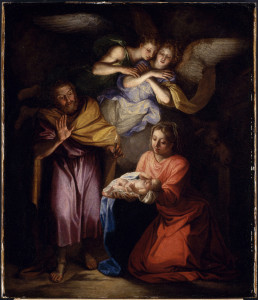
 "The Nativity" by French painter Noel Coypel features Mary, Joseph and angels in adoration of the Christ Child. The Christmas season begins with the Dec. 24 evening vigil commemorating the birth of Christ and ends with the feast of the Baptism of the Lord Jan. 10. (CNS/courtesy of Art Resource)
 When Christmas and New Year’s break upon us, the nearness to Christ we have cultivated in private prayer during Advent, in imitation of Mary’s attentiveness to the Child growing in her womb, can disappear into the lights and noise of the season. The irony is that, liturgically speaking, during the days following Christmas, Christ is now with us! The time of preparation has given way to the reality of His visible presence. Mary now gazes into the eyes of her Son, cradles His tiny body in her arms, coos to Him, cleans Him, and clothes Him.
Christ wants us, like Mary, to be near to Him, but unless we make time for prayer each day, we cannot encounter Him. What is it that makes it so difficult to stop our work for 10 minutes to speak with the Creator who humbled Himself to infancy out of love for us?
Many of us struggle, without knowing it, with what Christian tradition terms acedia, often translated “laziness.” You may be wondering, “What could laziness possibly have to do with me? I have my nose to the grindstone; I work diligently.” Yes, but what grindstone? What work? The real work of our life is God’s work of sanctifying the world, beginning with ourselves.
In respect to this work we can succumb to a numbing laziness, especially in our culture that values productivity above anything else. The spiritual lethargy of acedia hides behind exterior busy-ness: the packed calendar, the phone ever buzzing.
Francois Millet’s landscape, “L’Angelus,” provides an apt examination of conscience. In Millet’s painting, a man and a woman stand motionless in the center of a potato field. The man holds his hat in his hands, his head bowed and his hoe thrust into the ground beside him. The woman bends her head over her clasped hands, her basket of potatoes at her feet. Nothing breaks the horizon except the distant steeple of a church, which rises dark against the evening sky. The couple, hearing the tolling of its bells, have paused for a few moments to pray the Angelus, the prayer traditionally said at dawn, noon, and dusk to commemorate the Incarnation.
Millet’s scene is beautiful, but, if we are honest, it can also make us nervous. Endless rows of potatoes stretch around the couple on every side, calling out to be hoed and picked. In those three minutes in which they are praying, how much the couple could have done!
But something greater than potatoes called to them: God, without whose love the life nourished by those potatoes has no meaning. The opposite of acedia, according to St. Thomas Aquinas, is not diligence but charity, our participation in God’s tremendous and tremendously humble love. Something greater than potatoes calls you: He who reminds you, as He did Martha, that, in all that field, in all the world, the “one thing necessary” is that He who dwells sacramentally beneath the steeple dwell also in your heart in love (Luke 10:42).
Sr. Maria Veritas Marks is a member of the Ann Arbor-based Dominican Sisters of Mary, Mother of the Eucharist.