


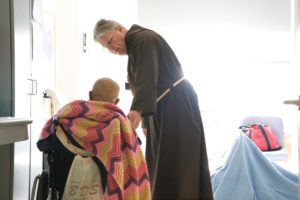
 Capuchin Father James Stump visits with Valentino Juanitas, a patient in early December in the acute-care ward at the Department of Veterans Affairs hospital in Palo Alto, Calif. Father Stump said he makes his rounds with one purpose in mind: to invite sick and wounded veterans to encounter the living Christ. (CNS photo/Jose Luis Aguirre, Catholic San Francisco) (Feb. 25, 2010) See CHAPLAIN Feb. 25, 2010.
St. John Vianney used to repeat, “The priesthood is the love of the Heart of Jesus.” What is this love? It is a love both divine and human, since Christ unites the two in His Person. Christ’s love is unconditional. And it is completely spent for others. These three aspects of the priesthood are aptly illustrated in Evelyn Waugh’s classic Brideshead Revisited.
First, the bridging of heaven and earth. Priests are normal human beings, yet, through the authority given them at ordination, ordinary things — bread, oil, water — become conduits of the extraordinary.
Waugh’s novel is narrated by Charles Ryder, an agnostic friend of the Catholic Brideshead family. The plot hinges on a quarrel over whether the dying Lord Brideshead should receive anointing of the sick. Brideshead has been living in adultery for 20 years and has rejected his faith. The parish priest makes the case: “‘Now doctor,’ said the priest, ‘how would I be a shock to anyone?’ He turned his bland, innocent, matter-of-fact face first on the doctor, then upon the rest of us. ‘Do you know what I want to do? It is something so small, no show about it. I just want to ask him if he is sorry for his sins. I want him to make some little sign of assent … then I want to give him God’s pardon.’” The sacraments really are “so small, no show,” and so, often, are our priests. And yet the divine life, infinite and dazzling, courses through them.
Fr. Mackay prevails, and a thrilling sequence follows. As his relatives kneel around his bed, Brideshead, until now rebellious, feels the oil upon his forehead and begins, laboriously, to make the sign of the cross. “A phrase came back to me from my childhood,” admits Ryder, “of the veil of the temple being rent from top to bottom,” a reference to the exposure of the Holy of Holies at the moment of Jesus’ death on the cross (cf. Mt 27:51).
Christ’s Heart burns with desire for every soul, even the worldly and arrogant, to taste the sweetness of the Holy of Holies. Because Brideshead has repented, he will presumably, after purification, experience the full bliss of union with God.
Finally, Christ’s love is one that spends itself. Priests minister often at great personal sacrifice, even at the risk of their lives, always on call, day after day. Fr. Mackay visits the Brideshead family three times. The first time, he is put off with polite excuses. The second time, he is coldly rebuffed.
It is only on his third visit that the shepherd, unfazed, unoffended, is able to reach the lost sheep. And on that visit, he reaches two more: Ryder and Brideshead’s daughter, Julia, themselves living in adultery. Witnessing her father’s conversion, Julia breaks off the relationship, and they set their lives straight, Ryder taking his first hesitant steps toward Christianity.
Priests, though often flawed and certainly ordinary, are bearers of a great dignity. The next time you see one, thank him — and God.
 Sr. Maria Veritas Marks, OP
Sr. Maria Veritas Marks is a member of the Ann Arbor-based Dominican Sisters of Mary, Mother of the Eucharist.



